
 E-Paper



Mumbai’s air post Diwali second-best in six years: SAFAR report
SAFAR had on Thursday predicted that Mumbai may witness its worst post-Diwali air quality since 2015 with a 50% firecracker emissions scenario on Diwali day.


Despite the use of firecrackers on Saturday in parts of Mumbai, hotter temperatures and faster winds kept the air quality in check on Sunday, making it the second-cleanest post-Diwali day air since monitoring began in 2015, the System Air Quality Weather Forecasting and Research (SAFAR) under the Ministry of Earth Sciences said.
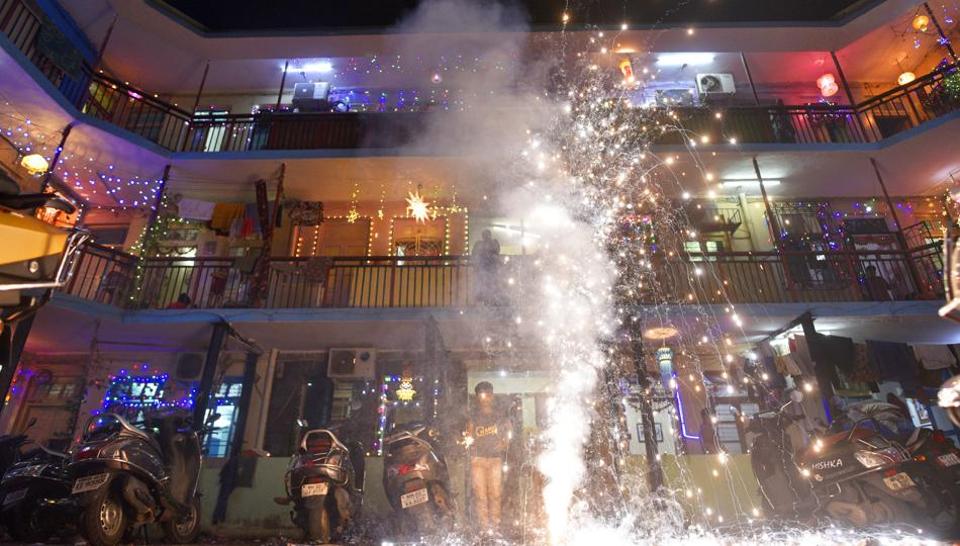
SAFAR had on Thursday predicted that Mumbai may witness its worst post-Diwali air quality since 2015 with a 50% firecracker emissions scenario on Diwali day. However, on Saturday, as Mumbai recorded its hottest day temperature of the season (36 degrees Celsius), SAFAR revised its forecast, predicting marginally lower air pollution after Diwali.
“Mumbai’s air quality a day after Diwali was found to be better than the forecast made (considering 50% of the average firecracker emissions of past years [2016-2018]). The air quality index (AQI) was in the moderate category. However, there was close to 0% firecracker emission scenario (between Saturday and Sunday). This tends to suggest that there were negligible local additional fire emissions,” read SAFAR’s Diwali 2020 air quality report released on Sunday.
Also read: Change in weather factors may keep air pollution lower than expected in Mumbai post-Diwali: SAFAR
It further said that sudden change in weather (winds from the sea at relatively faster speed) and probability of negligible firecracker emissions in Mumbai “worked positively to keep air quality in check”. “This was the best AQI post Diwali day in the past six years if the 2019 cyclone year is excluded,” said Gufran Beig, project director, SAFAR.
According to SAFAR, the AQI was recorded at 90 (satisfactory) on Saturday, which increased to 107 (moderate) on Sunday. However, by Sunday late evening, fireworks were burst across some areas. The AQI worsened to 115 (moderate) with a thin layer of haze across the skyline.
Last year, Mumbai recorded its cleanest air since monitoring began (during Diwali) as the AQI was as low as 75 (satisfactory) on Diwali (October 27, 2019) and 104 (moderate) a day after Diwali owing to fast winds under the influence of Cyclone Kyarr in the Arabian Sea.
Also read: Mumbai: BMC bans bursting of firecrackers except on Diwali evening
In 2018, the AQI was 221 (poor) on Diwali (November 7, 2018) and 305 (very poor) a day after Diwali.
In 2017, the AQI was 204 (poor) on Diwali (October 19, 2017), and 319 (very poor) a day after. In 2016, it was 278 (poor) on Diwali (October 30, 2016), and 315 (very poor) the day after, and in 2015, it was 279 (poor) on Diwali (November 11), and 313 (very poor) the next day.
According to the Central Pollution Control Board (CPCB), Mumbai’s AQI on Sunday was 148 (moderate) based on the average of data from 15 monitoring stations.
This year, Mumbai had the best Diwali and post-Diwali air quality among four cities —Delhi (severe), Pune (very poor), and Ahmedabad (poor) —where SAFAR monitors air. In Mumbai, the concentration of PM2.5 (fine pollutant particles that can easily enter the lungs and cause health ailments) was 54 micrograms per cubic metre (μg/m3) on Saturday and 62 μg/m3 on Sunday against the safe limit of 60 μg/m3 for 24 hours.
The highest PM2.5 levels in Mumbai were recorded between 11pm Saturday and 4am Sunday. Chembur was the most polluted area during this period with an AQI of 257 (poor), followed by Andheri 133 (moderate), while Bhandup had the cleanest air in the city at 73 (satisfactory).
Also read: Mumbai: BMC forms squads to monitor Covid-19 guidelines violations around Diwali
The Brihanmumbai Municipal Corporation (BMC) said they received around 50 complaints for excessive cracker bursting on Saturday. “While fireworks were used mostly in residential areas between 8pm and 10pm, there was a significant reduction in the number of complaints received by us compared to previous years,” said Tanaji Kamble, spokesperson, BMC.
An independent analysis of hourly particulate matter (PM2.5) concentration by city-based air quality researchers Respirer Living Sciences (RLS) Pvt. Ltd. revealed that fireworks in Mumbai started around 7.30pm with most neighbourhoods reaching their peak levels (worst air quality) around 10pm. “Our assessment showed that of 14 locations real-time air quality is monitored, the area around Sanjay Gandhi National Park, Borivli, which indicates the baseline level of the city, had twice as clean air than most parts of the city, while Kalyan reported worst levels at 342 μg/m3,” said Ronak Sutaria, founder and director, RLS.
Meanwhile, anti-noise campaigners Awaaz Foundation measured noise pollution during the permissible hours for cracker use on Saturday from 8pm – 10pm and until the next morning, but submitted decibel (db) readings of only one location in its report to the state government on Sunday. Maximum noise levels recorded was 105.5dB and just before the deadline of 10pm at Shivaji Park grounds near a Silence Zone board. The maximum level recorded in 2019 was 112.3 dB; in 2018, it was 114.1 dB and in 2017, it was 117.8 dB. “It was difficult to take measurements throughout the city since, although aerial shots and bombs were audible in parts of Mumbai, they were scattered in private residential societies which were inaccessible,” said Sumaira Abdulali, convener, Awaaz Foundation, adding that she received complaints from Borivali, Worli, Dahisar, Thane, Juhu and Versova. “Considerably fewer firecrackers were burst compared to previous years, but illegal and green crackers were used beyond the 10pm deadline in many areas.”
Stay updated with all the Breaking News and Latest News from Mumbai. Click here for comprehensive coverage of top Cities including Bengaluru, Delhi, Hyderabad, and more across India along with Stay informed on the latest happenings in World News.


