
 E-Paper



Firecrackers could lead to Mumbai’s worst air pollution post-Diwali in 6 years: SAFAR
The city could breathe its most polluted post-Diwali air in six years if firecrackers are used on Saturday, according to an air quality prediction by researchers.


The city could breathe its most polluted post-Diwali air in six years if firecrackers are used on Saturday, according to an air quality prediction by researchers.
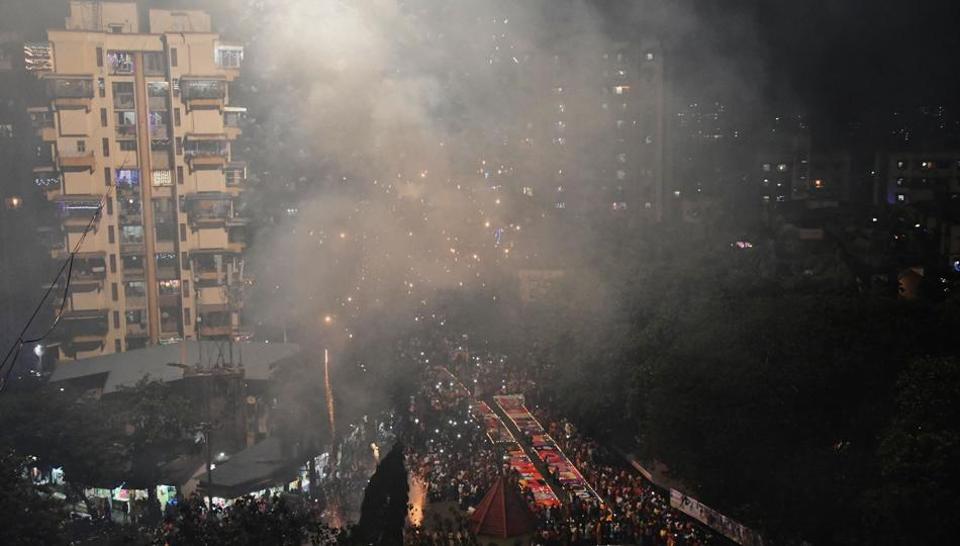
With a 50% firecracker emissions scenario on Diwali (Saturday) and prevailing weather conditions over Mumbai, high smoke level is expected to aggravate and push the city’s air quality to the ‘very poor’ range the next day, making it the worst air quality in the last six years, read the air pollution forecast for Diwali 2020 released on Thursday by the System of Air Quality Weather Forecasting and Research’s (SAFAR), under the Ministry of Earth Sciences. In an emission scenario where no crackers are burst, the air quality is likely to be in the ‘poor’ category. SAFAR began air quality monitoring in Mumbai in June 2015.
Last year, Mumbai had recorded its cleanest Diwali and post-Diwali air in five years, owing to high wind speed under the influence of Cyclone Kyarr in the Arabian Sea.
This year, the most polluted areas in the city are likely to be Andheri, Mazgaon and Chembur. “The highest levels of PM10 (large coarser pollutant particles) and PM2.5 (fine pollutant particles) are expected between 1am and 4am on the night of November 14 (Saturday) and morning of November 15 (Sunday). Air quality will start to improve from November 16 (Monday) and could reach poor or moderate levels by Tuesday,” the SAFAR forecast stated, adding that cool winds from the northerly to northeasterly direction were expected over Mumbai with moderate wind speed.
“The air quality has been predicted taking into account two emission scenarios. The first where 50% firecracker use as compared to the average analysed, based on usage in previous years (2016-2018), standard background emissions, and meteorological conditions such as wind speed, temperature, moisture, etc. The other scenario considers nil firecracker use and just weather parameters,” said Gufran Beig, project director, SAFAR.
“This may be the most polluted post-Diwali air since we began monitoring air quality in Mumbai, if firecrackers are used, as moderate wind speed and cool temperatures will allow pollutant particles to settle close to the surface and limit swift dispersion,” Beig added.
SAFAR categorises AQI levels from 0-50 as good, 51-100 as satisfactory, 101-200 as moderate, 201-300 as poor, 301-400 as very poor, and above 401 as severe.
In the scenario where firecrackers are used, the air quality index (AQI) for PM2.5 on Friday is expected to be 217, falling under the ‘poor’ category. On Saturday (Diwali) it may reach 263 (poor) and on Sunday may hit 338 (very poor). The AQI is likely to drop to 308 (very poor) on Monday. However, in the emissions scenario when no firecrackers are used, the AQI on Friday would remain the same but the Saturday recording would be 243 (poor), Sunday 267 (poor), and Monday 233 (poor).
SAFAR also predicted that the concentration of PM2.5 this Diwali was likely to be almost three times the safe limit if firecrackers were used, and almost twice the safe limit without firecrackers. Against the safe limit of 60µg/m3 (microgrammes per cubic metre), Mumbai could record 109µg/m3 on Saturday and 170 µg/m3 (50% firecracker emissions) and 103 µg/m3 and 110 µg/m3 (nil emission from firecrackers).
On Thursday, the city recorded an AQI of 204 (poor) with Mazgaon and Chembur being most polluted at 310 and 309 (both very poor), respectively. Bhandup (54) and Worli (68) had the cleanest air, both in the satisfactory category.
Last year, the AQI was as low as 87 (satisfactory) on Diwali day (October 27, 2019) and 96 (moderate) a day after Diwali. In 2018, Mumbai recorded an AQI of 221 (poor) on Diwali (November 7, 2018), and 305 (very poor) AQI a day after. Mumbai recorded high pollution levels during Diwali 2017, when the AQI was 204 (poor) on Diwali (October 19, 2017), and 319 (very poor) the next day. In 2016, an AQI of 278 (poor) was recorded on Diwali (October 30, 2016), and 315 (very poor) the day after. In 2015, the city recorded an AQI of 279 (poor) on Diwali (November 11), and 313 (very poor) the day after.
Stay updated with all the Breaking News and Latest News from Mumbai. Click here for comprehensive coverage of top Cities including Bengaluru, Delhi, Hyderabad, and more across India along with Stay informed on the latest happenings in World News.


