
 E-Paper



While others burn Ravana effigies, Jains honour him
Ravana may be the arch villain in the epic Ramayana, but for some people of the Jain community he is an ardent follower of lord Aadinath (or Rishabhadeva), their first religious teacher or Tirthankara, and a pious temple-goer in Himalayas

 Prefer HTon Google


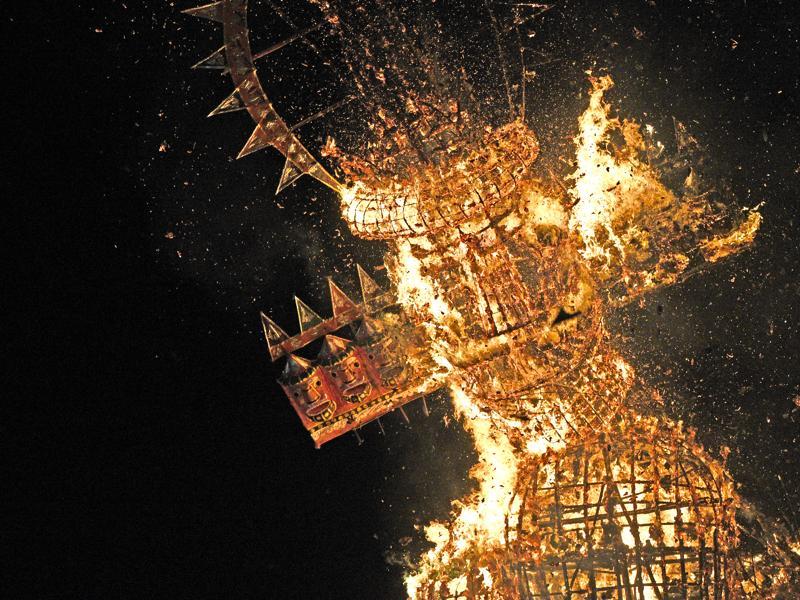
Ravana may be the arch villain in the epic Ramayana, but for some people of the Jain community he is an ardent follower of lord Aadinath (or Rishabhadeva), their first religious teacher or Tirthankara, and a pious temple-goer in Himalayas.
On Dussehra, when effigies of the demon king are burnt, many Jains honour him by creating rangoli or his image in their houses. “We make a small drawing on the floor with wheat flour and grass. We then perform a pooja seeking forgiveness for any mistakes we made, unknowingly or knowingly,” said Jainam Shah of the Digambar sect.
Jain scholars said the tradition of honouring Ravana is founded in legends. “Ravana and his wife, Mandodari, were staunch followers of Rishabhadeva, the first Tirthankara. Legend has it that the couple went to Ashtapad, famously known as Ratna Mandir, near Mount Kailash, where only a few people can make it,” said Dr. Bipin Doshi, a teacher of Jain philosophy at University of Mumbai. “The lord blessed Ravana with a boon that he was going to be one of the 24 Tirthankars of Jainism,” he added.
Some Jains believed that Ravana’s noble deeds could make him a Tirthankar too. “Worshipping Ravana is not a common practice in the community. Although in coming years, he would be our next Tirthankar. He was blessed with sublime knowledge and was devoted towards whatever he did. One incident and people forget all the good the man had in him,” said Shraddha Baphna, a marketing employee.


