
 E-Paper



Kidney ailments plague water-scarce villages in Maha
Doctors said Ghusal’s kidney stones are a result of drinking water with high concentration of minerals


This is the second time in four months that farmer Gyaneshwar Ghusal, 21, has been diagnosed with a kidney stone. In February, doctors found a stone in his right kidney and this week they found a 9 mm large stone in the left organ. On Friday, Ghusal came to a hospital in Aurangabad from drought-hit Buldhana district to undergo a surgery to get rid of the stones.
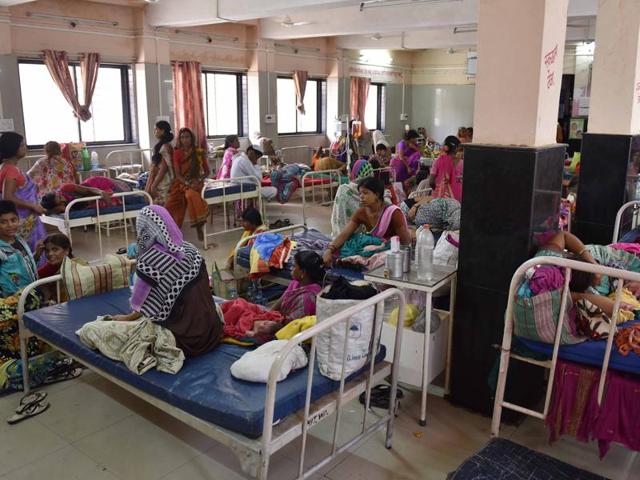
Doctors said Ghusal’s kidney stones are a result of drinking water with high concentration of minerals. Successive years of below average rainfall in Marathwada has caused the ground water level to drop, said the Beed collector, Naval Kishore Ram, adding that the number of rainfall days was now just 37 in the district leading to poor recharge. The deeper the water is drawn from, the more minerals it contains.
Like many in Marathwada, Ghusal too drinks water from a borewell a few kilometers from his village. “I can either drink that water or die of thirst. We are trying to get some filter to clean the water of the minerals that doctors told me are causing my stones,” said Ghusal, whose brother Yogesh, a 28-year-old farmer who lives in the same house, too has developed kidney stones.
Statistics at Sai Urology Centre in Aurangabad, where Ghusal got admitted, reveal a sharp spike in kidney ailments in the area: seven out of every ten patients in the hospital have kidney stones.
With patients like Ghusal, Maharashtra’s drought-affected villages are staring at a health crisis that won’t be easy to resolve. A study in the British Medical Journal has concluded that patients with kidney stones are twice as likely to develop renal failure. A person with kidney failure requires lifelong dialysis and ultimately a transplant -- treatments which are both expensive and inaccessible to rural India.
Explaining the impact of water scarcity and the kidneys, Dr Abhay Mahajan, urologist, said that less intake of water leads to dehydration -- a risk factor for developing kidney stones. “Less urine leads to stone formation in the kidneys,” he said. “Now if the patient drinks water with high concentration of minerals, it only adds to the problem.”
In some cases, stone formation can lead to permanent damage to the kidney, requiring its removal, said Dr Sharad Somani, urologist from Suyash Nursing Home in Aurangabad. “In my 16 years of practice, this summer is the worst. I saw at least three patients whose kidneys were completely damaged because of stones. In one of the patients, I will have to remove the kidney as it’s completely diseased,” Dr Somani said.
Doctors said women were generally more resistant to kidney stones but this did not hold true in Marathwada. Nisha Shinde, 19, from Varwati admitted to Beed civil hospital has been diagnosed with kidney stones. “We drink water supplied by a tanker. It is yellow and greenish in colour,” said Shinde.
Though doctors said that people should boil the water before drinking, Shinde pointed out that this was impractical. “It is so hot. If we boil the water, it will never cool down. And in this heat who wants to drink hot water?”
As patients delay trips to the hospital for lack of funds, the size of their stones is so large that operations are the only cure. Last week, doctors attempted to remove a 16-mm stone in the left kidney of Kantabai Shinde, 45, but they were unable to do so. Now they will have to resort to an open surgery instead of a less invasive procedure. Kantabai from Sirjadevi village said that she does not feel like drinking water. “There is no water in the house. We have to walk almost an hour to fetch water from a well,” said Kantabai.
Dr S Utture, member of the Indian Medical Association, said that women get the chore of fetching water for the family. “Hence, they avoid drinking enough water because if supply runs out, they have to go and get it. Also as women have a shorter urethra they are prone to urinary tract infections if there is no proper hygiene,” said Dr Utture who visited the Marathwada region.
Mirabai Rajput, who walks two kilometres from her home in Barabhai Tanda in Beed with her five children to collect water, said that she experiences occasional abdominal pain. “There is no water in the hand pump. We have to go in this scorching heat to fetch water every day,” said Rajput. Doctors said that stomach pain was a symptom of urinary tract infection and kidney stones.
Villagers said that in another village a few kilometers away from where Rajput resides, a woman died while she was fetching water from a well. This death has not been confirmed by government authorities. At Parli, a town nearly 100 km from Beed, the situation is no different. Bhim Nagar resident, Suvarna Wavle, 30, was admitted to a private hospital in Parli after she was unable to urinate. Doctors said that she like many others in the city had developed kidney stones. “We get water only once in eight days. I have two children at home. In this situation, how can I worry about my health,” asked Wavle who came to the hospital only when the pain became unbearable. “I don’t have money to pay the doctor, I came to the hospital as my mother insisted,” she said.
Even the elderly have not been spared the task of fetching water from far away sources. Gangoobai Sonawane, 85, walks 1km every day to fetch just one gallon of water for herself and her mentally retarded son. A widow, Sonawane is always ill but cannot shirk this chore. “If I don’t come, who will give us water,” asked Sonawane waiting at Rajori village to collect water from a borewell.
Stay updated with all the Breaking News and Latest News from Mumbai. Click here for comprehensive coverage of top Cities including Bengaluru, Delhi, Hyderabad, and more across India along with Stay informed on the latest happenings in World News.


