
 E-Paper



French protests highlight deep, historical faultlines
The rage reflects an urgent reckoning with a global polycrisis — erosion of human rights, climate disasters, genocides & the normalisation of authoritarianism

 Prefer HTon Google


On Saturday, as mass protests swept France, a youth orchestra struck a defiant note beneath a towering statue of Marianne, the representation of the French Republic. They played the Imperial Marchfrom Star Wars and the Avengers theme. Protesters cheered, waving placards saying, “They don’t care about us”. Minutes later, the orchestra was tear-gassed. By evening, columns of smoke from burning vehicles rose higher than the 82-foot statue. Marianne was wearing a yellow vest flapping in the wind; it read, “2026: The police are mutilating school students.”
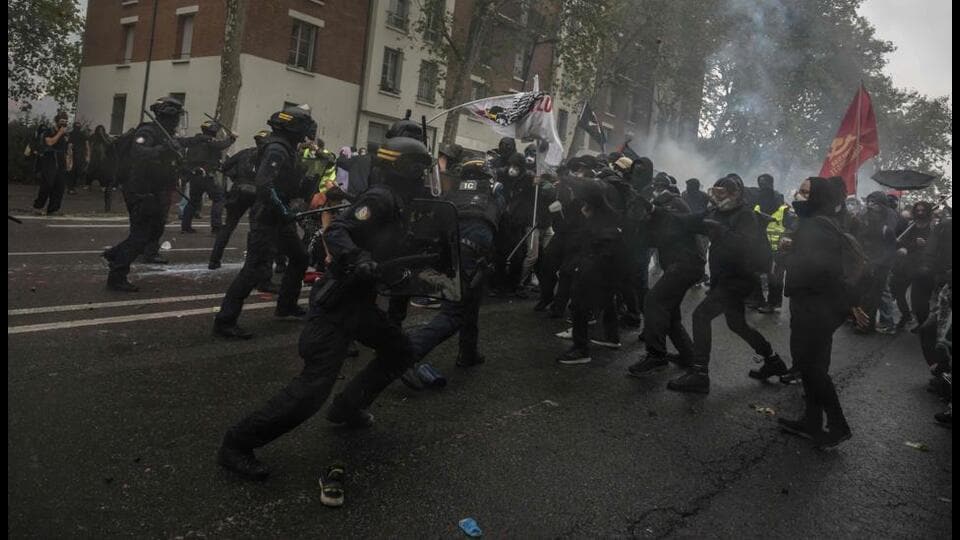
For a month now, France’s Gen Z has retained its irreverence amid police brutality with remarkable determination. Protests began mid-September at Lycée Saint-Exupéry in Créteil, south-east of Paris, where students joined teachers against staff shortages and inadequate resources.
Students are protesting years of austerity — dilapidated buildings, teacher shortages, unmanageable timetables, and university admission platforms reinforcing class and racial inequalities. Economist Thomas Piketty records a 20% real-term drop in per student higher education funding since 2017. Beyond daily indignities — rats in class, sweltering heat or freezing cold, too few chairs and unaffordable canteens — students also fear losing access to higher education. The insulated, privileged class treats them with disdain.
Protesters are facing the most heavily weaponised crowd-control arsenals in Europe. These fractured a teenager’s jaw on both sides, shattering his teeth; ripped off the hands of two others; and blinded another in one eye. The injured were all between 14- and 17-years-old. More than 10,000 detentions have been recorded since the protests began, nearly 8,000 of them by mid-October — 85% of the detainees are minors. Police dragged, kicked, thrashed, and tasered protesters; allegations of sexual assault by some police personnel have also emerged. By Saturday, the movement had converged with others, notably Gilets Jaunes (Yellow Vests), which protested rising prices and inequality in 2018. Universities, climate justice activists, farmers, trade unions, transport workers, and Left-wing parties joined. The interior ministry counted 550,000 protesters; organisers 800,000.
The logic of colonial repression persists in French mainstream culture: Dissenters are framed as dangerous, legitimising violence against them while delegitimising their demands. Saturday also marked the anniversary of the 1961 massacre of an estimated 300 Algerians protesting a racist curfew in Paris: police had thrown many into the Seine then.
Sections of the French political class have contemptuously branded teenagers from racialised, working-class suburbs as racailles (scum) for decades. Vandalism has long been part of French protests. Yet children from these communities, who initiated the current movement, are being accused of being anti-French. This reeks of colonial continuity. What goes unspoken are the disproportionate racist police checks and violence, and deep disenfranchisement. Collectives and unions now backing the movement are explicitly anti-racist and anti-police violence. Students from elite institutions have joined, openly acknowledging their privilege.
Some see only chaos and destruction — a town-hall spire collapsing in flames, pillaged luxury shops, and looted supermarkets. They refuse to see the dispossession and State violence. For many French youth, the social contract was broken by decades of police violence, including killings of Black and Arab young men, documented by independent media investigations. Immigrants and their descendants are cast as the problem, though France was built on colonised people’s labour and still depends on racialised workers and wealth-extraction from the Global South through neocolonial structures. A protest placard sums it up: “If we burn, you burn with us.”
The government calls Gen Z protests “urban violence” to be curbed with “intermediate force weapons.” After attending a Céline Dion concert the previous night, President Emmanuel Macron declared on Saturday that there was “no room for violence,” promised rioters would be punished, and offered the police the “support of the nation.” He made no mention of the violence against children. On a balcony somewhere in Paris, a banner carried an expletive directed at Macron. Partial overnight curfews were imposed in many cities, a chopper sweeping its searchlight across deserted Paris streets. Prime Minister Sébastien Lecornu warned he’d declare a state of emergency, if necessary.
French media relentlessly praise the police, foregrounding “unrest” while ignoring students’ grievances. Far-Right speakers dominate airtime. The backstories they bury keep surfacing elsewhere. Students are winning hearts with their irreverent memes, slogans, and street performances. Singer-songwriter Aya Nakamura’s Sexy Nana became a protest anthem. A line from the song, “It’s always my fault, you say”, throws shade at the French establishment criminalising dissent. One kid dressed as Napoleon marched through streets, playing on a popular caricature of Macron as a modern-day emperor.
These children sense something larger. While their schools crumble, French billionaires’ combined wealth has doubled since Macron took over in 2017, Oxfam France reports. Their rage reflects an urgent reckoning with a global polycrisis — erosion of human rights, climate disasters, genocides, and the normalisation of authoritarianism.
As an immigrant journalist of colour in France, I have witnessed police harassing young men of colour in my district and interviewed teenage victims. The 2005 deaths of Zyed Benna (17) and Bouna Traoré (15) — electrocuted while hiding from the police in Clichy-sous-Bois — have stayed with me. France’s glamorous image obscures the entrenched racism people of colour have to live with every day.
This weekend, far-Right politician Marine Le Pen, convicted of embezzlement of EU funds involving €2.8 million, released a presidential-style address, aired on French television even before Macron’s. She demanded the expulsion of school kids over 16 involved in vandalism, and accused the Left of nurturing “death and destruction impulses” among “certain” young people. Some are calling the protests, an early Christmas present for the far-Right.
With just six months to go before presidential elections, the determined resistance of Gen Z protesters offersa bulwark against France’s descent into a far-Right hell.
Noopur Tiwari is an independent journalist based in Paris. The views expressed are personal


