Keeping up with UP | In rural UP, dynasties, resemblances and great expectations
While dynastic politics has always been part of Indian politics, in UP today, Akhilesh faces a tough battle because of how he inherited the Samajwadi Party
In an interview with Hindustan Times on May 19, 2016, movie star Abhishek Bachchan said, “I am trying to be the best I can. I don’t want to be compared to anyone, especially my father. I am not just his son, but also his biggest fan. Plus, it has been 16 years, and I’m still here in Bollywood. I am who I am because of my parents. Being their son is a matter of great pride for me.”
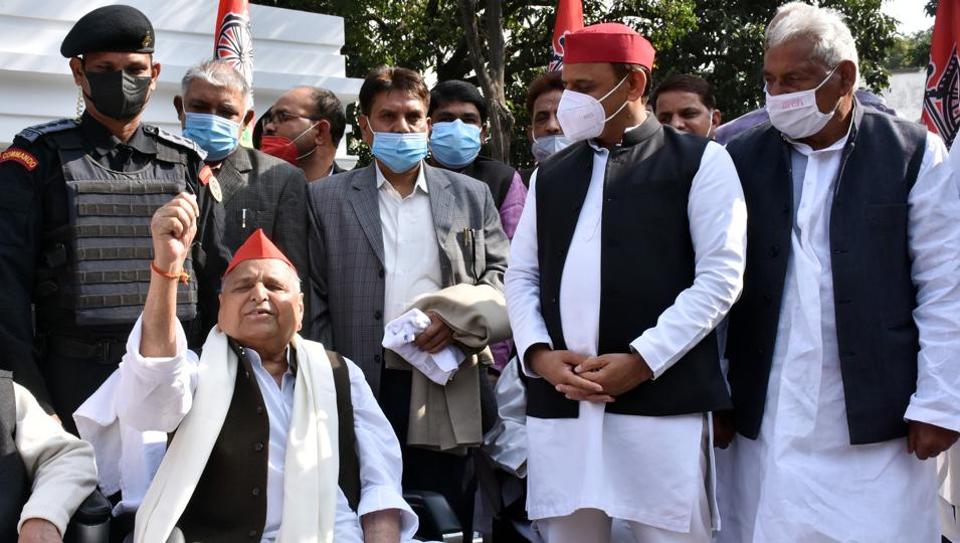
Because he bears a physical resemblance to his father Mulayam Singh Yadav, Akhilesh often faces a barrage of criticism for his style of functioning from his party seniors as well as opponents. (File Photo)
However, he disagreed with the contention that people have been hard on him because of his lineage. He said, “How many actors get compared to Amitabh Bachchan? How many actors have the privilege of being spoken about in the same breath as him? That’s my blessing. If anyone feels I am worthy of being compared to him, then I am doing something right.”
Dynasts in politics: Priyanka, Jayant, Akhilesh
The dynasts in the political world face similar challenges, perhaps even bigger. The comparisons are constant — of their looks and their work. And in every election, they are an easy target of attack from their opponents.
The Bharatiya Janata Party (BJP) has been — notwithstanding a few exceptions — trying to discourage party tickets to dynasty leaders. It has even made it a poll issue since 2014 by stating that the Congress, along with various regional parties, take on every election in the country and states, as parties that are run by families. Prime Minister Narendra Modi, in his rallies in Basti and Deoria on February 27, even went to the extent of dubbing the UP elections as a fight between dynasts and nationalists.
Despite the growing hue and cry over dynasties in politics, political parties continue to promote them, and there are valid reasons. While the educated youth in the cities are averse to the undue promotion of dynasties, rural folks aren't bothered by this. In fact, they tend to love the comparisons.
The Congress cadre has consistently been demanding Priyanka Gandhi Vadra's entry into active politics, primarily because she resembled her grandmother, late Prime Minister Indira Gandhi, and not for the political acumen that they saw in her. Hoardings and posters were sporadically put up in Prayagraj, demanding her entry even after Congress president Sonia Gandhi had introduced her son Rahul Gandhi as her successor.
Even after Gandhi Vadra dived into active politics, her every action was compared with her grandmother's — her quick, fearless steps, tearing into crowds, with bold statements, wearing cotton sarees, many of which were from her grandmother's collections. "She is Indira's avatar" — is how people reacted to her foray into the trouble-torn areas of UP, despite the bans and deployment of cops.
Jayant Chaudhary of the Rashtriya Lok Dal is also constantly compared to his grandfather, Chaudhary Charan Singh, a political stalwart. His clan members say fondly, “Arrey woh to Chaudhary jaisa lagta hai, baap pe nahin gaya hai (He resembles his grandfather, not his late father Ajit Singh).”
For someone, who is often accused of spending more time in Delhi than his home village Baraut in Baghpat, Jayant was in the news for the tenacity with which he stood with the farmers in 2021-22. The common refrain was, “He displayed the same temper as Charan Singh, spoke the same lingo in the same style, fiery yet witty. Who can say he studied abroad and quit a corporate job before taking charge of the RLD?” The Jat-dominated areas of West UP are seeing a rebirth of the RLD in 2022.
Akhilesh has it the hardest
However, neither Gandhi Vadra nor Jayant was beset with family issues like Samajwadi Party (SP) national president Akhilesh Yadav. Akhilesh faced this challenge the most because he inherited the party founded by his father Mulayam Singh Yadav, amid a family turmoil and a legacy battle with his uncle Shivpal Singh Yadav, which started soon after the 2012 victory, but flared up in 2017.
His opponents, especially the BJP, never spare an opportunity to take a dig at him, so much so that it had an objection to his father and founder-president of the SP, campaigning in the Karhal assembly constituency, along with the inclusion of his uncle Shivpal Singh Yadav and his wife Dimple Yadav in the list of star campaigners announced for the last four phases of elections in east UP. It is another matter that candidates, irrespective of the parties they belong to, depend heavily on the family members for their campaigning — an age-old practice in elections.
Because he bears a physical resemblance to his father Mulayam Singh Yadav, Akhilesh often faces a barrage of criticism for his style of functioning from his party seniors as well as opponents. “Had Mulayam been active, he would have kept the organisational machinery well oiled. He was a 24x7 leader. The other criticism was, while Mulayam had popular faces of all castes on party positions and billboards, Akhilesh had few. Third, he could not keep his family together as Mulayam did.”
Countering the charges, political experts feel the biggest challenge before Akhilesh is to change the image that the party encourages lawlessness. Akhilesh, without getting dragged into the discussions, has partly changed the pro-Yadav-Muslim image of the party and also denied tickets to big criminals. So, to refurbish the party's image, he stitched social alliances with other backward classes (OBCs) and established his political prowess. Experts feel that Akhilesh is now one of the tallest backward leaders of the state who, like his father, would play a crucial role in national politics in the years to come.
As for Akhilesh himself, he sums up the tumultuous situation with a famous quote, “Success has many fathers, defeat has none.” All said and done, he has come out of his father's shadow. Ask the people in rural areas about this debate on dynasties, and they quip, “An actor's son is a born actor. A doctor's children automatically pick the medical profession. So, why should there be an issue about a politician’s son or daughter pursuing politics?”
The scenario is no different in the western and the southern parts of the country where dynasties flourish, though the lookalikes may be a few.
The same looks may not always be a blessing as the legacy comes with lineage-triggered comparisons and caustic comments.
From her perch in Lucknow, HT’s resident editor Sunita Aron highlights important issues related to the elections in Uttar Pradesh

 E-Paper