E-Paper



Weather Bee: First half of 2025 likely to breach 1.5°C warming threshold
Global temperature data from the ERA5 dataset produced by the European Centre for Medium-Range Weather Forecasts (ECMWF) is now available up to June 23

 Prefer HTon Google


With data for nearly half of 2025 in, there is both good news and bad news for global temperature. The bad news is that the first half of the year is the second warmest in 2025 and more than 1.5°C warmer than the pre-industrial average, a threshold that global leaders agreed to keep long-term warming under in the 2015 Paris Agreement. The good news is that June warming is likely to end up below the 1.5°C threshold, the second consecutive month to do so. This is likely to keep the probability of 2025 ending as the warmest year lower than it was earlier in the year.

Global temperature data from the ERA5 dataset produced by the European Centre for Medium-Range Weather Forecasts (ECMWF) is now available up to June 23. With just a week of data to be factored in for June, the trends for half of the year seen right now should not change by a big margin by the end of the month. This shows that the average warming in the first 174 days of 2025 is 1.53°C. This makes the first half of the year the second warmest on record in 2025, after 2024, which experienced 1.62°C in the first 174 days. 2025 is also only the second year when the first half of the year has breached the 1.5°C threshold.
Chart 1
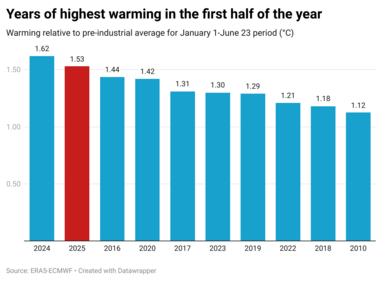
To be sure, while the first six months of the year average a warming of more than 1.5°C, this is because of the warming up to April. All of the first four months of 2025 averaged a warming of more than 1.5°C, but May averaged a warming of 1.39°C and June so far is only 1.31°C warmer than the pre-industrial average. If the trends seen so far carry on until the month’s end, June will only be only the second consecutive month and third month since July 2023 (apart from July 2024 and May 2025) that does not average a warming of more than 1.5°C.
The level of warming in May and June, however, should not be taken as a sign that the world is still far away from breaching the 1.5°C threshold in long-term averages. The reason for this is the recent trend in global warming. The 2015-2024 averages of warming in each month show that June warming was the least and May warming is ranked fourth lowest. In fact, as the accompanying chart shows, warming has been generally lower in the middle of the year, when the northern hemisphere experiences its summer. May, June, and July are also the only months that have crossed the 1.5°C threshold only once (either in 2023 or 2024).
Chart 2
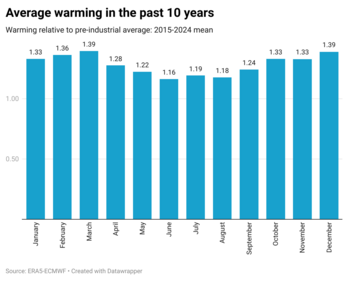
Clearly, the lower level of warming in May and June is not out of the ordinary in a world headed towards long-term 1.5°C warming. In fact, even the rest of the year needs to average only 1.47°C for 2025 to breach the threshold on average. For becoming the second-warmest year on record – a record currently held by 2023, which averaged 1.48°C warming in the ERA5 dataset – the rest of the year needs to average a warming of only 1.44°C.
However, May and June averaging a warming below 1.5°C has helped in one way. An unprecedented 1.66°C warming will be required in the rest of the year for 2025 to beat the 2024 record and become the warmest year on record. The previous record for the June 24-December 31 period is currently held by 2023, when the period averaged 1.65°C warming.
The lower level of warming in May is also why the probability for 2025 ending up as the warmest year on record was drastically decreased by Berkeley Earth (another organization that publishes a global temperature dataset updated monthly) in their May update compared to their April update: from 18% to 6%. However, Berkeley’s earth forecast for the year ending up 1.5°C warmer in their record is still 43%, a relatively small reduction compared to the 52% forecast in the April update. This is why the global temperature trends in the first half of the year are a mixed bag.