

 E-Paper


Finding God particle
1 / 9
 View Photos in a new improved layout
Updated on Jul 03, 2012 09:51 pm IST
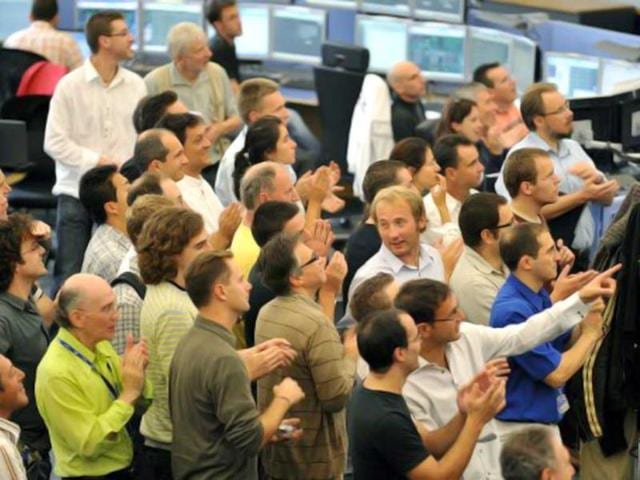
European Organisation for Nuclear Research (CERN) scientists applaud at the CERN's control center near Geneva during the switch on operation of the Large Hadron Collider (LHC), the world's biggest atom-smasher in a mission to answer some of the most perplexing questions of the physical universe. AFP/Fabrice Coffrini/Pool, File
2 / 9
 View Photos in a new improved layout
Updated on Jul 03, 2012 09:51 pm IST
British physicist Peter Higgs is best known for his theory explaining the origin of mass of elementary particles in general and the Higgs boson in particular. AFP/Fabrice Coffrini, File
3 / 9
 View Photos in a new improved layout
Updated on Jul 03, 2012 09:51 pm IST
Emeritus professor of the Universite Libre de Bruxelles (ULB), Francois Englert during a ceremony at Brussels' Academic Palace. Englert is known for pioneering work that has led to the insight of mass generation, whenever a local gauge symmetry is realised asymmetrically in the world of sub-atomic particles. AFP/Belga - Herwig Vergult
4 / 9
 View Photos in a new improved layout
Updated on Jul 03, 2012 09:51 pm IST
A handout file picture provided by the European Organisation for Nuclear Research (CERN) shows a large dipole magnet symbolically lowered into the tunnel in Geneva to mark the end of a crucial phase of installation of the Large Hadron Collider (LHC). Picture taken on April 26, 2007. AFP/Ho/CERN
5 / 9
 View Photos in a new improved layout
Updated on Jul 03, 2012 09:51 pm IST
This picture provided by the European Organisation for Nuclear Research (CERN) shows a large dipole magnet symbolically lowered into the tunnel, on 26 April 2007 in Geneva, to mark the end of a crucial phase of installation of the Large Hadron Collider (LHC). AFP/Ho/Cern
6 / 9
 View Photos in a new improved layout
Updated on Jul 03, 2012 09:51 pm IST
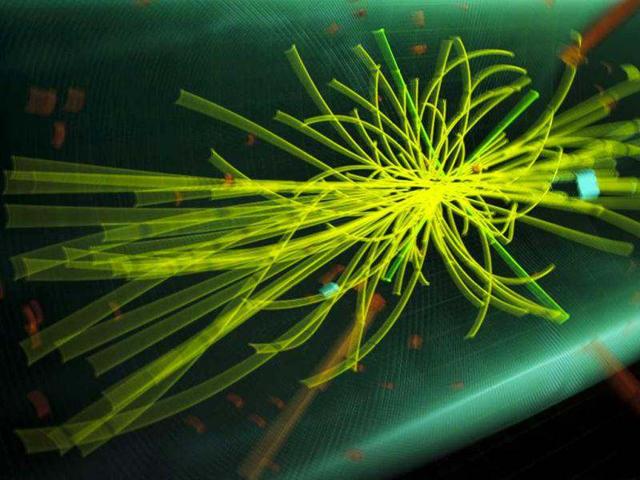
A graphic showing traces of collision of particles at the Compact Muon Solenoid (CMS) experience is pictured with a slow speed experience at Universe of Particles exhibition of the the European Organisation for Nuclear Research (CERN) on December 13, 2011 in Geneva. AFP/Fabrice Coffrini
7 / 9
 View Photos in a new improved layout
Updated on Jul 03, 2012 09:51 pm IST
Layers of the world's largest superconducting solenoid magnet (CMS), one of the experiments preparing to take data at European Organisation for Nuclear research (CERN)'s Large Hadron Collider (LHC) particule accelerator near Geneva. AFP/Fabrice Coffrini
8 / 9
 View Photos in a new improved layout
Updated on Jul 03, 2012 09:51 pm IST
This document provided by European Organisation for Nuclear Research (CERN) on December 13, 2011 in Geneva shows a graphic showing traces of two high-energy photons measured in the Compact Muon Solenoid (CMS) experience. AFP/Fabrice Coffrini
9 / 9
 View Photos in a new improved layout
Updated on Jul 03, 2012 09:51 pm IST