
 E-Paper



Dodging gangsters, cheating death: The route Punjab’s young take for the American Dream
Between October 2017 and May 2018, there has been a 50% surge in the number of Indians detained for crossing over illegally to the US.


A string of Singhs and Kumars pops up on the screen as one browses through the inmate locator of the US Federal Bureau of Prisons. Their release dates: Unknown.
The pull of the grand American dream pushes these Punjab youngsters to peril. They defy the swampy cocaine smuggling corridor of Darien Gap linking Colombia with the Panama, trek through Panama’s jungles, often empty stomach for days, groggily dodge snakebites, bear assaults by armed bandits, disease, injury and the eventuality of death.
These young people, mostly from Punjab and neighbouring states, are now detained in different federal prisons for entering the United States illegally or on asylum pleas. At present, more than 50 people are detained in Oregon’s Sheridan federal prison and many more at federal detention facilities in California, Arizona and the Washington state.
Some have a hope to get refuge having got thumbs-up from the asylum officers who interviewed them for determining a credible fear of persecution. Others face deportation, not to India, but to Mexico.
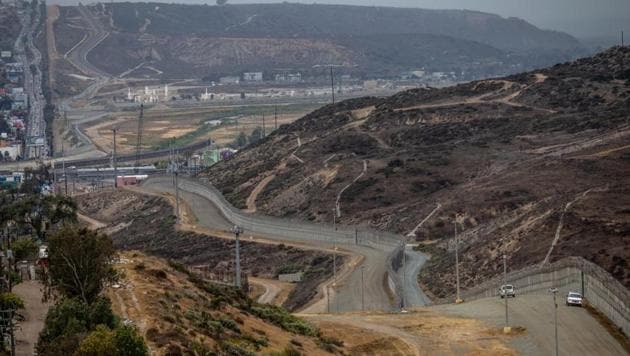
Yes Mexico, the country which shares a 3,155-km border with the US and is the final destination of these “illegal aliens”, a tag the Immigration and Customs Enforcement (ICE), the US agency tasked with enforcing immigration laws, chooses to describe them, before they enter the US soil.
“From Mexico, a coyote (a human trafficker) would stealthily slip them inside the US territory or they present themselves to the Customs and Border Protection (CBP) officials at one of the ports of entry with an asylum plea. Even if they are detained by the CBP for crossing over illegally, they have an asylum petition tucked in pocket,” said a CBP personnel who did not wish to be named as he was not authorised to speak to the media. This is the backdoor route to enter the US for thousands of youngsters from Punjab and neighbouring Haryana and Uttar Pradesh who put their lives at risk chasing Benjamin Franklin and a better life in the First World.

The Trump effect is gone
There was a steep decline in the number of Indian migrants daring to sneak inside the US in 2016-17 through the Central American backdoor trail when Donald Trump became the US President in 2016. But that was probably a one-off thing.
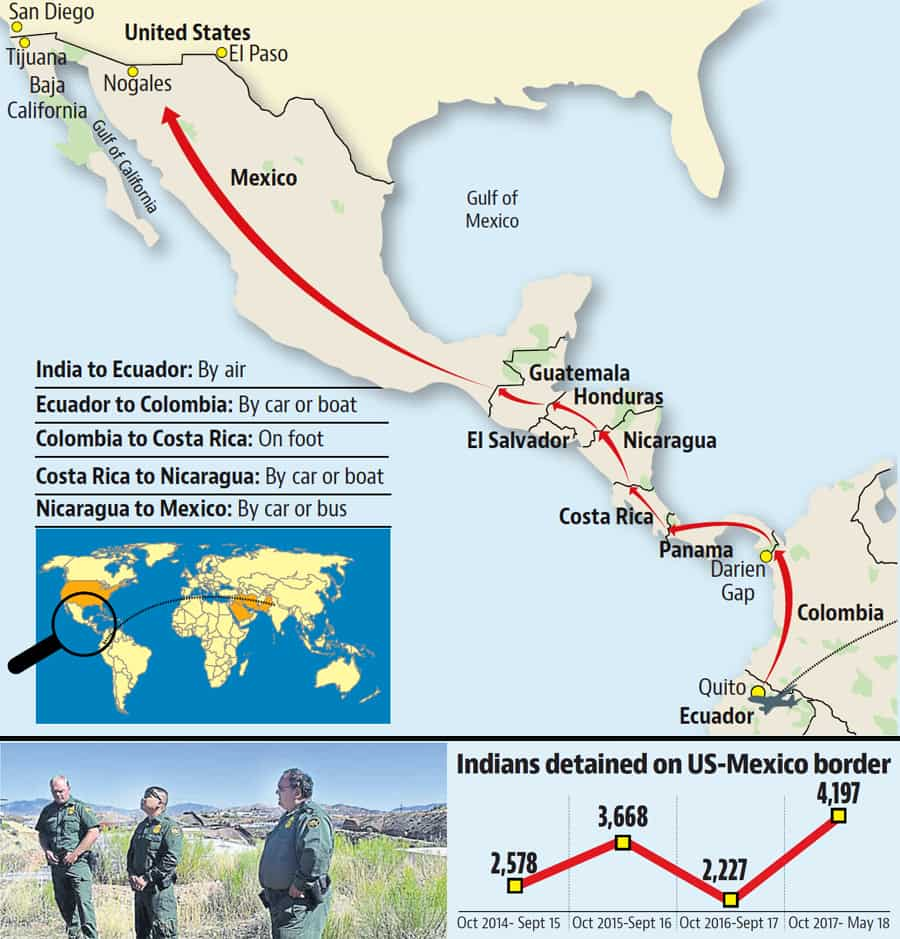
Between October 2017 and May 2018, there has been a 50% surge in the number of Indians detained by the CBP or the ICE for crossing over illegally into the US, statistics indicate.
Randy Capps, director of research, US programs, Migration Policy Institute in Washington DC, said that from October 2016 to September 2017 (when Trump was freshly sworn in), 2,227 Indians were apprehended by the US authorities for illegally entering the United States. “However, the number shot up to 4,197 apprehensions between October 2017 and May 2018,’’ Capps said.
The dip, Capps said, was probably due to the fact that migrants in 2016-17 were afraid of the stance of the Trump administration in tackling illegal migrants.
The United Nations Office on Drugs and Crime (UNODC) has estimated the size of the Central America-Mexico-United States migrant smuggling market in the 7-billion dollar range annually.
Gruelling passage starts at Ecuador
The hazardous journey often takes months to complete as human traffickers deploy buses, cars, boats and also make their clients walk for hundreds of miles, often without no food and sleep.
In fact, coyotes sketch out different routes for the migrants to cover the 4,600-km journey between Ecuador and the US.
The journey begins from the South American nation, Ecuador, an easy to pull in destination for the US-bound migrants due to its easy 90-day visa on arrival policy. Also, stricter migration regulations and enforcement by Mexico leading to increased migrant apprehensions meant that flying directly to Mexico to leap over into the US was not always workable.
The migrants then travel by sea to arrive at Capurgana in Colombia, embark on a demanding trek through the marshy Panama jungles, including the Darien Gap, to reach Costa Rica only to travel onward by sea or road to Nicaragua. They pass through Honduras and Guatemala hidden inside compartments in buses and cars before they get to Mexico, their gate to the United States.
S Alvarez Velasco, a research scholar at London’s King’s College, writes that a “relay race” modality has developed for defying controls along the route.
“Ecuadorian coyotes have been incorporated in broader transnational smuggling networks. Via mobile phones, they are connected with foreign coyotes along the route. They exchange information and even coordinate payments via Western Union or MoneyGram for the different stretches of the route,” said Velasco.
Why so many from Punjab?
Nirvikar Singh, distinguished professor of economics at University of California, Santa Cruz, says that Punjab is falling in the relative income rankings in India. “Many young men do not have meaningful occupations that they feel are consistent with their social status. This is especially true among marginal farming families,’’ he says.
Singh, who has co- authored a book on Indian migration, The Other One Percent, says for years, intermediaries have been actively recruiting young men in Punjab for illegal migration. Their grand promises are not exposed because the numbers are relatively small compared to the population, and the information flow back to Punjab about the reality is incomplete and biased. The migrants are misled about the actual trip and prospects. Also, many Punjabis have relatives in the US, and think that will give them a headstart when they get here, giving them an inflated sense of expected gains.”


