
 E-Paper



Gurugram’s flooding crisis, Can PPPs and municipal bonds fund the infrastructure the city needs?
Gurugram flooding: Despite repeated investments in drains, pumps, the city continues to come to a standstill with every intense spell of monsoon

 Prefer HTon Google


Every monsoon, Gurugram seems to rediscover the same question: why does a city that has spent hundreds of crores on stormwater infrastructure continue to flood after a few hours of heavy rain?
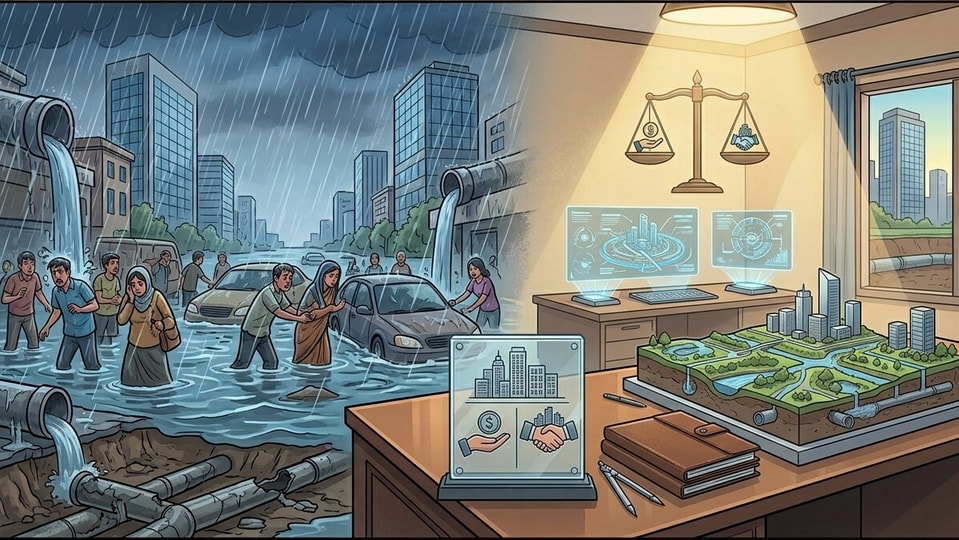
The answer is increasingly clear, the city's flooding is not simply a drainage problem. It is a consequence of decades of rapid urbanisation, concretisation, fragmented planning and the disappearance or disruption of natural water channels. It is also a financing question. Gurugram's skyline has largely been built with private capital, but the infrastructure connecting, draining and sustaining that skyline remains overwhelmingly dependent on public agencies.
That disconnect is becoming harder to ignore.
The scale of the city's recurring flooding has already forced authorities to identify vulnerable locations, build new drains, install pumps and create diversion channels.
Ahead of the 2026 monsoon, authorities had said corrective work had been completed at 158 waterlogging locations. Yet an intense spell of rain in August once again brought major roads to a standstill, with school buses and commuters stranded for hours.
The episode also exposed something more fundamental: even where infrastructure exists, different parts of the drainage network do not always work as one integrated system.
One of the clearest examples emerged after around 80 mm of rain on August 24 caused severe waterlogging on Sohna Road.
The Gurugram Metropolitan Development Authority (GMDA) found that gaps in the gate installed at the junction of Leg 3 of the Badshahpur drain and the stormwater drain, along with a delay in fully closing it, contributed to the flooding.
The gate was designed to divert excess water towards Leg 4, the stormwater drain constructed along the Southern Peripheral Road at a cost of more than ₹100 crore.
The idea behind the diversion was straightforward. Once the gate near Vatika Chowk is closed, water flowing from areas including DLF Phase 1, sectors 42, 43, 52A and 53 to 67, and villages such as Maidawas, Ramgarh, Ullawas, Badshahpur and Ghata, is supposed to be diverted into Drain No. 4 along the SPR rather than continue through the Badshahpur drain towards Sohna Road.
Also Read: Gurugram's ₹271-crore penthouse deal puts DLF's The Dahlias in league with Mumbai’s priciest homes
But during the heavy rainfall, incomplete closure and gaps in the gate meant that water continued flowing through the Badshahpur drain.
GMDA officials subsequently ordered repairs and inspections of the system. GMDA chief executive officer P.C. Meena, after inspecting affected locations including Subash Chowk, Vatika Chowk and Sohna Road, directed officials to install additional pumps at Subash Chowk and maximise diversion of rainwater along the SPR to reduce the hydraulic load on the Badshahpur drain.
The numbers illustrate the engineering challenge. The Badshahpur drain has a carrying capacity of around 3,800 cusecs, while Leg 4 has a capacity of about 1,800 cusecs. The two eventually merge around Sector 37D before carrying stormwater towards the Najafgarh drain.
But increasing the capacity of individual drains cannot, by itself, solve a problem that is spread across an entire catchment.
At the Medanta underpass and hospital road, officials found another weakness, a stormwater drain constructed across the Tau Devi Lal drain was not adequately connected to other surface and stormwater drains in the vicinity. At Subash Chowk, road gullies were blocked by garbage, preventing water from entering the drainage system.
The master stormwater drain also takes a sharp 90-degree turn because of the construction of an underpass, making the movement of water more difficult and contributing to overflow.
These are not isolated engineering mistakes. They point to the larger problem of a drainage network that has evolved piecemeal as the city expanded.
Sanjay Kumar, MNC professional and a resident of Golf Course Extension Road said, “Every monsoon, I have wondered how a city that houses some of the biggest multinational companies in the country can come to a standstill after a few hours of rain. I have personally been stuck in traffic for hours on several occasions, sometimes barely moving for kilometres, while water accumulated on roads and vehicles were stranded around us,” he said.
He further said what is most frustrating is that this is not a surprise anymore.
“We know which roads flood, we know where the bottlenecks are and we know that the same stretches become vulnerable every year. People working in Gurugram plan their lives around the weather during the monsoon because they know a heavy downpour can turn a 30-minute commute into a four- or five-hour ordeal. We need to stop treating flooding as an annual emergency and start treating drainage, roads and mobility as basic infrastructure that has to be planned for the city we have become, not the city Gurugram was twenty years ago,” he said.
Also Read: Gurgaon luxury turns into flooding nightmare: Posh apartments reel under waterlogging, power outage
Gurugram's geography makes it difficult?
Gurugram's geography makes the challenge particularly difficult. The city lies below the Aravalli ridge, with natural runoff historically moving towards the Najafgarh basin. Before large-scale urbanisation, water had multiple pathways—natural depressions, ponds, seasonal channels, agricultural fields and low-lying areas where rainwater could spread, slow down and percolate into the ground.
Much of that landscape has disappeared beneath roads, parking lots, buildings and gated developments.
As Dikshu Kukreja, urban planner and managing principal of CP Kukreja Architects, puts it, Gurugram's problem cannot be reduced to drainage capacity. The city needs to be examined catchment by catchment, with its existing drains, ponds and flood paths protected and restored. A connected blue-green infrastructure network involving ponds, wetlands, bioswales, rain gardens and permeable surfaces, he argues, can reduce the pressure on conventional drains.
That is also the argument made by Sarika Panda Bhatt, Co-Founder and Trustee of Raahgiri Foundation.
“Gurugram's chronic waterlogging is an urban design failure born of concretizing permeable earth and erasing natural drainage. Emergency pumps and concrete channels cannot fix this. The solution lies in integrating blue and green infrastructure through nature-based solutions, rebuilding streets with bioswales, expanding urban green cover, and aggressively reviving the city's lost water bodies and natural channels. We need an ecological approach to planning that restores the land's natural sponge capacity, ensuring roads don't just move vehicles, but absorb runoff, mitigate extreme heat, and recharge our depleted groundwater.”
That may be the more important debate for Gurugram's future: not simply how to move water out faster, but how to ensure that less water reaches the drainage network at the same time.
The Municipal Corporation of Gurugram (MCG) has begun looking at the problem through this wider lens. The civic body is undertaking catchment and drain mapping of Subash Chowk, internal sectors and licensed colonies to understand how rainwater moves through the network and where bottlenecks occur. A simulation model is being developed to identify drains that require repairs or capacity augmentation.
MCG commissioner Pradeep Dahiya has also indicated that the civic body wants to prioritise ecological solutions, including rainwater harvesting and groundwater recharge, rather than relying exclusively on underground storage tanks. Technical experts from IIT Gandhinagar are being consulted on long-term solutions, while the MCG has identified 273 locations for rainwater harvesting systems. Injection wells and additional stormwater lines in narrow lanes and low-lying areas are also being considered.
The question, however, is whether Gurugram can finance this transformation at the scale required.
Can developers become partners in building infrastructure?
Gurugram's peculiar development model makes this question unavoidable.
Private developers have built enormous residential, commercial and office districts, creating a city whose economic value rests heavily on real estate. But the external infrastructure required to support those developments—trunk roads, metropolitan drainage, sewage systems, water supply and regional connectivity—remains largely the responsibility of public agencies.
This creates an obvious possibility: a structured public-private partnership in which developers contribute towards infrastructure serving the larger catchment rather than merely their individual projects.
One model could involve developers within a defined urban cluster contributing to a common stormwater system. Another could be an infrastructure impact fee imposed on large new developments, linked transparently to the additional burden they place on roads, drainage and water systems.
There is also scope for special-purpose vehicles involving GMDA, MCG and developers to finance specific infrastructure corridors, while performance-based contracts could allow private companies to design, build and maintain drainage systems over 10 or 15 years, with payments linked to measurable outcomes.
But PPPs should not become an excuse for governments to surrender their responsibility.
The government must continue to control land-use planning, drainage corridors, environmental regulation, land acquisition and inter-agency coordination. Developers cannot be expected to repair a legacy problem created over decades. But if the city's future growth continues to generate enormous private gains, there is a strong case for ensuring that part of that value contributes to the infrastructure required to make the growth sustainable.
Could municipal bonds finance the next Gurugram?
The second question is whether Gurugram can move beyond dependence on annual government allocations and finance long-life infrastructure through municipal borrowing.
Municipal bonds could potentially fund large projects such as stormwater systems, detention ponds, sewage infrastructure, water networks, roads and underground utilities. Gurugram's substantial economic base makes it a logical candidate for exploring such instruments.
But borrowing should not become another way of postponing the problem.
Any bond-backed programme would need clearly identified projects, ring-fenced funds, credible revenue streams and transparent public reporting. Investors would need confidence not only that Gurugram can raise money, but that it can execute projects and maintain them for decades.
The institutional framework already exists in the form of the MCG and GMDA. The challenge is to create a bankable pipeline of metropolitan infrastructure rather than another collection of disconnected projects.
Can Gurugram learn from Japan?
The Japanese experience offers an important lesson—not because Gurugram can simply copy Tokyo, but because Japan has increasingly approached urban flooding as a combination of engineering, planning, financing, maintenance and environmental management.
Tokyo, for example, combines conventional river and drainage improvements with large underground regulating reservoirs and tunnels. One underground reservoir project is designed to connect major waterways and store around 1.43 million cubic metres of water, while other underground discharge infrastructure diverts floodwater away from vulnerable urban areas.
Japan is also increasingly using green infrastructure. Tokyo's current approach includes rain gardens and systems designed to temporarily store and infiltrate rainwater, reducing sudden flows into drains and rivers while also improving urban landscapes and biodiversity.
The lesson for Gurugram is not that it needs a Japanese-style mega tunnel tomorrow. It is that flood management must be designed at the watershed level, combining “grey” infrastructure—drains, channels, reservoirs and pumps—with “blue-green” infrastructure such as wetlands, ponds, parks, permeable surfaces and recharge areas.
This becomes particularly relevant as Haryana actively seeks Japanese investment. The state government has been courting Japanese companies, while Gurugram's Global City is being developed as a major mixed-use “live, work and play” project. Nine Japanese companies have expressed interest in investing around ₹5,000 crore in Haryana, according to the state government.
Japanese participation could therefore be viewed not merely through the lens of investment and employment, but also as an opportunity for knowledge transfer in resilient urban planning, water management, technology and maintenance.
The World Bank's 2026 work on urban flood management in Japan similarly emphasises the importance of combining grey, green and blue infrastructure with risk-informed urban planning, maintenance, community participation and public-private partnerships.
For Gurugram, the timing could hardly be better.
The city is preparing for another phase of expansion even as its existing infrastructure struggles to cope with the city it already has.
That is ultimately the real question behind every flooded road.
It is not simply why does Gurugram flood?
It is what kind of city does Gurugram want to finance and build next?
For years, the city has effectively operated on a simple equation: private capital builds the towers, while the public system tries to catch up with the roads, drains, water and transport infrastructure around them. That model may have worked during the early years of expansion, but the repeated monsoon failures show its limits.
Gurugram now needs to treat drainage as core urban infrastructure, not as an annual monsoon emergency.
That means protecting natural drainage corridors before new construction begins, making hydrological assessments integral to development approvals, restoring water bodies, creating retention and recharge spaces, integrating developer contributions into metropolitan infrastructure and building a financing model capable of supporting projects over decades rather than political or budgetary cycles.
The city does not necessarily need another drain every time it floods.
It needs a system.
And that system will require something Gurugram has historically been very good at attracting—capital—but also something it has struggled to build at the same speed: long-term public planning.
If PPPs can bring private expertise and money, municipal bonds can provide patient capital, and Japanese experience can offer lessons in integrating technology with nature-based planning, Gurugram has an opportunity to turn its annual flood crisis into a larger urban transformation.
Otherwise, the pattern will remain unchanged: rain, flooding, traffic, pumps, inspections, promises—and another monsoon waiting around the corner.


