
 E-Paper



Why Delhi-NCR’s rich are checking into 5-star branded residences
Branded residences: Real estate developers turn to hospitality brands to stand out as luxury buyers are willing to pay a premium for 24x7 hotel-like living

 Prefer HTon Google


A new class of luxury homes is emerging across Delhi-NCR as developers partner with global hospitality brands to offer buyers more than just a high-end apartment: a five-star lifestyle at home. From concierge services, 24-hour security and housekeeping to landscaping, spa and fitness facilities and, in some cases, even dry-cleaning, branded residences are bringing the service culture of luxury hotels into residential communities.
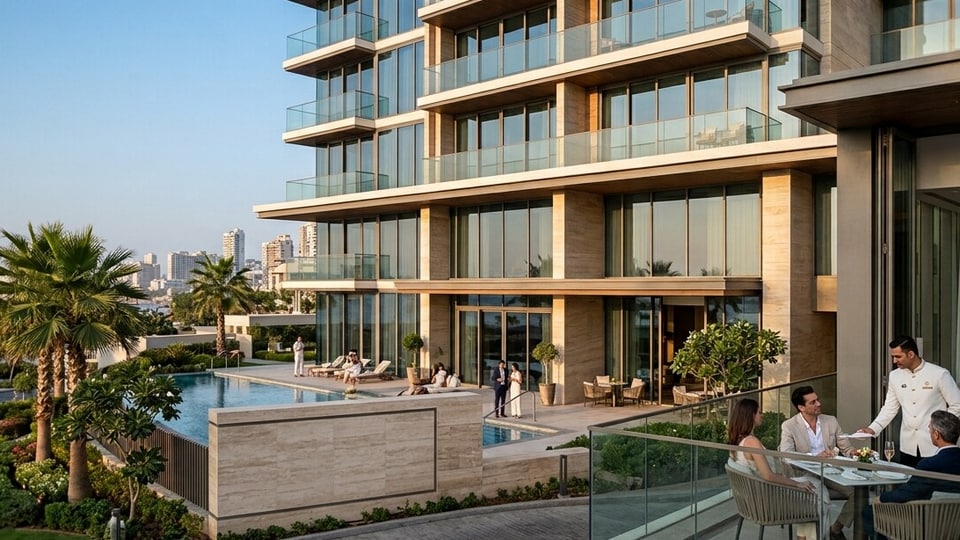
As the country's luxury housing market expands, developers are increasingly turning to hospitality brands to differentiate their projects, and affluent buyers appear willing to pay a premium for the experience. The latest example is the agreement signed between JW Marriott and Elan Group for a branded residences project in Gurugram, underscoring developers' growing appetite to associate their projects with established hospitality names.
ELAN Group and Marriott International have signed an agreement to bring a JW Marriott Hotel Gurugram and JW Marriott Residences Gurugram to Sector 106 along the Dwarka Expressway, as part of ELAN’s approximately 50-acre integrated township. The developer will undertake the construction and development of the hotel and residences, while sales and marketing of the residences will commence after obtaining the requisite RERA registrations.
Upon completion, Marriott Hotels India Private Limited will manage both the hotel and the residences. The development will include JW Marriott Residences Gurugram, comprising 3, 4 and 5 BHK luxury homes to be sold and marketed by ELAN Group, the company said.
What are branded residences?
Branded residences are luxury homes developed in partnership with a globally recognised brand. The brand lends its name, reputation and service standards to the project and, in the case of hospitality companies, typically manages or oversees residential services for a fee.
The concept is no longer restricted to hotel companies. Luxury automobile and design brands have also found a place in the market, with names such as Porsche Design and Aston Martin lending their cachet to residential projects. Fashion houses, including Armani and Missoni, have similarly experimented with branded homes.
Branded residences may appear to be a relatively new phenomenon in India, but the concept has a long history. One of the earliest examples dates back to the 1920s, when New York's Sherry-Netherland hotel opened luxury apartments overlooking Central Park. In Asia, Amanpuri in Phuket, Thailand, is widely regarded as an early example, dating back to 1988.
So, what does the buyer actually get?
For the buyer, the attraction is not simply the logo outside the building. The proposition typically combines a premium residence with a suite of hospitality-led services. Depending on the project, these may include concierge services, housekeeping, business-centre facilities, common-area maintenance, 24-hour security, landscaping, spa and wellness facilities, fitness centres and sports amenities, say hospitality experts.
The services, however, are not necessarily bundled into the purchase price. Residents generally pay an annual or recurring fee for services and maintenance. That distinction is important: the buyer is paying not just for the apartment, but for an ongoing service ecosystem, say experts.
Do hotel brands have an edge over fashion brands in branded residences?
Last year, Delhi-NCR-based Whiteland Corporation partnered with Marriott International to launch The Westin Residences, Gurugram. The project, spread across 7.78 hectares in Sector 103 along the Dwarka Expressway, involves a planned investment of ₹5,600 crore and is projected to generate a topline of ₹15,000 crore.
Sudeep Bhatt, Director Strategy, Whiteland Corporation told Hindustan Times Real Estate that the the project is scheduled for delivery around the year 2030. With unit sizes ranging from approx 2700 to 4400 sqft and a competitive starting price of approximately ₹7crore, the project offers a unique opportunity to both end users and investors."
M3M India has also partnered with a few hospitality brands such as Roseate Hotels & Resorts for M3M Jacob & Co. Residences and M3M Trump Towers in Delhi-NCR. M3M has also partnered with Oravel Stays, the parent company of OYO, to introduce SUNDAY Hotels at M3M SkyLoft in Gurugram, combining hotel and residential offerings. It has also tied up with ONE Atmosphere for its 256 fully serviced luxury suites in Gurugram.
While fashion, automobile, and luxury brands can bring considerable design value to a residential project, hospitality companies have one fundamental advantage: they know how to operate a service-led property. A fashion label can define how a home looks and feels. A hotel brand can influence how it is lived in and serviced.
Hotel companies already have the infrastructure, trained manpower, and operating systems required for concierge services, housekeeping, security, food and beverage, maintenance, and guest management. That makes their association with residential projects relatively seamless, say experts.
“Buying into a branded residence is perhaps more about a return on ego than a return on investment. Having said that, one would imagine that hospitality brands partnering with real estate developers may have an edge over non-hospitality brands. But ultimately, it depends on which developer the hospitality brand chooses to partner with," said Manav Thadani, founder chairman, Hotelivate Savills.
“Hospitality brands are arguably the best equipped to manage and deliver high-end services, which is why, going forward, they may increasingly insist on having a hotel adjacent to a branded residences project. This makes it easier to operate and deliver the level of service expected by residents,” he said.
For real estate developers, tie-ups with hospitality majors offer a strong brand differentiator and help justify the premium pricing of these projects. The association with a recognised hospitality brand can make the property easier to market and sell at a premium, he said.
Who invests in branded residences, and what should buyers keep in mind?
According to JLL's A Guide to Branded Residences for Developers and Investors, branded residences remain concentrated in the luxury and ultra-luxury segment, with high-net-worth individuals forming the core target audience. The homes can serve as either primary or secondary residences. Location plays a major role: branded residences in dense urban markets are more likely to be primary homes, whereas those in resort destinations tend to be second homes.
For prospective buyers, it’s essential to look beyond the brand tag and assess whether the project genuinely delivers differentiated product value in terms of service, design, status symbol, or living experience. Customers should conduct due diligence to determine whether the association is meaningful or merely superficial.
They should ask whether real estate is part of the brand’s core business, whether the brand has a real estate team in other countries, whether it has successfully executed projects elsewhere, and what tangible value it brings to the development, say experts.
The brand partnership should add genuine value, not just carry a premium label. Targeting the right customer profile is also important, as some brands naturally appeal to CXOs, CEOs, and influential buyers, he said. Also, the association with the brand continues for the life of the project, ensuring that the development consistently aligns with the brand’s standards and identity, they said.
“From a buyer’s perspective, branded residences are marketed as offering superior amenities, concierge services, hotel-style management, curated experiences, and better long-term upkeep features that, in theory, protect property value and support rental appeal. However, the branded tag alone does not guarantee a risk-free purchase, and prospective homeowners should evaluate these projects with careful due diligence,” said Sunil Tyagi, Managing Partner, ZEUS Law.


