
 E-Paper



Lionel Messi did not play within football's geometry; he bent it: Inside the strange physics of his genius
Lionel Messi's Argentina farewell ends a 21-year era defined by a genius who seemed to bend football's space, time and geometry around everyone who watched him.

 Prefer HTon Google


“Spacetime tells matter how to move; matter tells spacetime how to curve.” — John Archibald Wheeler
For centuries, space and time were considered separate. Space told us where something existed, and time told us when. Then came Albert Einstein and his theories of relativity; perceptions changed. Special relativity brought them together into spacetime, while general relativity showed how mass and energy shape its geometry. Wheeler later reduced this complicated idea to a single line.
Let me give you an example. In Einstein’s description, the Sun does not need to be imagined as tugging the Earth with some unseen force to keep it in orbit. The Sun’s mass bends spacetime around it, and the Earth follows that curvature. All else being equal, greater mass-energy can produce greater curvature, enough even to alter the path of light.
Deep Dive

Football has its own fixed geometry. The pitch does not grow or shrink, nor do the penalty area, touchlines, or goals. However, for more than two decades, a force named Lionel Messi bent the footballing spacetime around him, making many of those immutable dimensions seem negotiable.
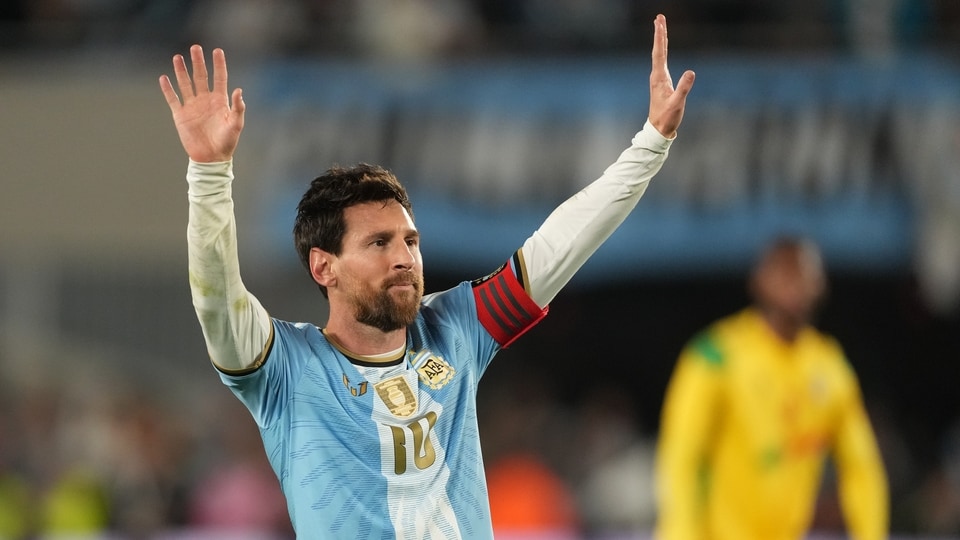
On Tuesday night, this massive force disappeared from international football. At the Monumental, Lionel Andrés Messi played his 208th and final game in Argentina’s blue and white. Even in his last appearance against Benin, he scored once and assisted twice in a 3-0 win. Messi’s 21-year international career ended with 126 goals, a World Cup title and two Copa América trophies.
When one player changed the geometry
Gravity in itself is an intriguing phenomenon. An object does not have to touch another one to influence it. Its mere presence impacts the movement and positioning of things around it. Messi could do something similar. Follow only the ball, and much of his influence disappears. You miss the defender he drags with an off-the-ball run, the space that opens when someone follows him, or the chance of Messi turning and creating an attack when the defender holds his position.
Pep Guardiola turned this feature into one of Barcelona’s biggest advantages. Rather than playing Messi as a traditional forward, he used him as a false nine, allowing him to move away from the goal. Messi’s free-roaming role created spaces that his teammates could exploit.
Over time, Messi’s role kept changing. The explosive right-winger became a false nine and then evolved into a roaming playmaker. He became increasingly involved in creating dangerous chances rather than merely finishing them. With experience and maturity came an uncanny ability to influence a move without being directly involved.
The pitch remained the same, but Messi evolved, allowing the players around him to change shape in response to his movements.
And then there was time
Einstein’s theory not only altered our understanding of space, but it also stated that space and time are linked; gravity affects both. Messi was no superhuman who could stop time, but watching him gave that illusion. Then there was the trademark walking. While everyone else sprinted around, he was almost ambling across the grass. Guardiola later explained that Messi used those moments to scan the play and gauge everyone’s position. When the ball arrived, he already knew where everyone was and what he needed to do.
Then suddenly everything accelerated. A defender who appeared perfectly positioned suddenly appeared late. Messi could pause, invite a tackle and weave his magic once the opposition committed. At his peak, he was quick, but speed alone never explained his genius. Often, his spatial awareness, his ability to identify an opening before others did, was the trick. That helped him survive the loss of some explosiveness. Legs age, but understanding sharpened by maturity and experience makes you wiser.
Argentina took longer to adjust to the change in geometry Messi brought with him. For years, there were comparisons to Diego Maradona, the frustration of international silverware remaining elusive, and the criticism that he did not play the same for his country as he did for his club. Then came two Copa América trophies, followed by the 2022 World Cup title, and Argentina understood the value of their number 10.
Also Read: Lionel Messi, Cristiano Ronaldo and the story of a final whistle
This is exactly why his final night in Argentina colours is particularly significant. Over 85,000 people came to watch him one last time, yet Messi scored only one of Argentina’s three goals and assisted on the other two. On a night all about him, Messi still influenced how the geometry changed around him.
The three-time world champions now enter unfamiliar territory. Teammates will no longer have a magician to look up to, opponents will no longer try to guess where Messi might appear, and coaches will no longer dedicate much of their tactics to how he shapes the game. The markings on the pitch will stay the same, but for the first time in 21 years, the geometry will not.


