
 E-Paper



Paraguay showed France can be rattled. Morocco should take the lesson, not the tactics
Instead of focusing only on Paraguay's dark arts, the bigger takeaway is that they exposed a blueprint that Morocco may well study

 Prefer HTon Google


Paraguay did not eliminate France. But for more than 100 exhausting minutes in Philadelphia, they showed that a disciplined low block, relentless physicality and constant disruption can still unsettle the best team in world football. And that may prove far more valuable than the defeat itself. Instead of focusing only on Paraguay's dark arts, the bigger takeaway is that they exposed a blueprint that Morocco may well study before next week's quarterfinal.
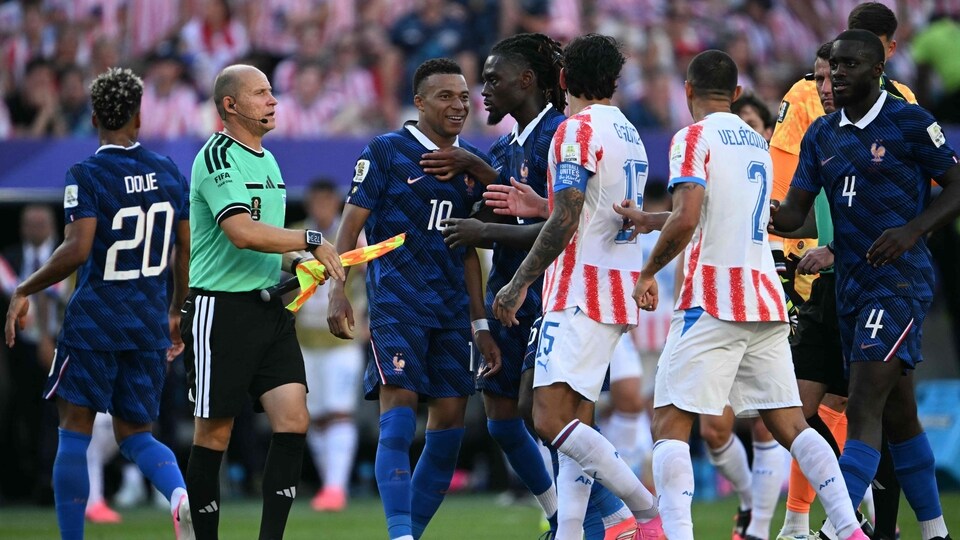
To start with the obvious, this was not a one-off strategy from Paraguay. They eliminated four-time champions Germany in the previous round playing the exact same way — deep, compact, combative, daring their opponent to break them down, then trusting the moment would eventually swing their way. The match went to the penalties, where the Latin American side emerged on top. But France survived.
In 120 minutes of play, including extra time, Paraguay had just seven shots on goal against Germany, four on target, after managing just 25 per cent of ball possession. And the one goal that Germany conceded during the run of play was during the first half, a desperately disappointing 45 minutes of play from the European giants. An unmarked Enciso headed home from Matías Galarza‘s centre as Paraguay scored their first-ever knockout-stage goal at the World Cup in six appearances. Even as Kai Havertz had put in the equaliser in the second half, Germany remained sloppy throughout.
France weren't. They had practically camped in Paraguay's half. Paraguay, who had just 20 per cent possession in the first half, failed to register a single touch inside France's penalty box. Their passing was even worse, finishing with just 54 per cent accuracy — the lowest completion rate in a World Cup knockout match in 60 years. This wasn't a team trying to play football as much as one trying to survive it by defending for their lives while pushing the boundaries of the laws of the game. The blueprint, much like in the win over Germany, was simple: sit deep, defend in numbers and frustrate France.
Did the plan actually work?
To a large extent, yes. France have arguably been the most entertaining attacking side of this World Cup. Kylian Mbappe has grabbed the headlines, but the supporting cast has been just as devastating. Ousmane Dembele has scored four goals, including a hat-trick against Norway. Bradley Barcola has chipped in with two goals, while Michael Olise has quietly become one of the tournament's best creators.
Two years ago at Euro 2024, France looked disjointed despite all their talent. This summer, they have looked fluid, fearless and devastating.
Yet Paraguay slowed them down. Dembele, who has looked every bit a Ballon d'Or contender this year, struggled to influence the game. Olise created only one genuine chance before injury time, while Barcola faded before being replaced by Desire Doue after the hour mark. For the first time in the tournament, France's star-studded attack looked human.
Where Paraguay fell short
The defensive organisation was impressive. The attacking ambition wasn't. A successful low block usually depends on punishing opponents on the counterattack after soaking up pressure. Paraguay never managed that. Mike Maignan finished the evening without making a single save. That ultimately exposed the biggest flaw in Paraguay's approach—it was designed almost entirely to survive, not to win. The battle wasn't just tactical. It was psychological.
Paraguay also tried to drag France into an emotional contest. Andres Cubas chopped down Mbappe from behind. Matias Galarza barged into him off the ball and stood over him. Gustavo Velazquez even scuffed up the penalty spot before France's decisive spot-kick. Every incident carried the same objective: frustrate France's biggest star. Mbappe refused to take the bait. Instead, he calmly converted the penalty and celebrated with a smile rather than retaliation.
What should Morocco copy?
Morocco, who dismantled Canada 3-0 to book their quarterfinal berth, were almost certainly watching closely. Next Thursday in Foxborough, they will meet France again—a repeat of the 2022 World Cup semifinal, which France won 2-0.
The blueprint is there, but it shouldn't be copied blindly. Morocco can certainly borrow Paraguay's physical intensity, aggressive duels and willingness to disrupt France's rhythm. Limiting Mbappe's space and cutting off his service remain obvious priorities. But unlike Paraguay, Morocco possess genuine attacking quality of their own. They have dangerous full-backs, technical midfielders and enough pace to hurt France on transitions. Simply defending for 90 minutes would waste those strengths.
The ideal formula lies somewhere in between: Paraguay's discipline and defensive aggression combined with the attacking ambition Morocco displayed during their remarkable run in Qatar four years ago.
If anyone is capable of turning Paraguay's blueprint into a genuine winning formula, it may well be Morocco.


