
 E-Paper



‘Bitter truth’: PM Narendra Modi calls for India to compete in more Olympic sports to boost medal tally
Narendra Modi made the remarks during a virtual interaction with athletes, students and volunteers gathered at various locations for the Khelo India Dialogue.

 Prefer HTon Google


Reiterating a point he made in his Independence Day speech from the Red Fort, Prime Minister Narendra Modi on Thursday said India’s Olympic performance can improve only if the country expands the number of sports in which it competes, particularly in disciplines where it has had little or no participation in the past.
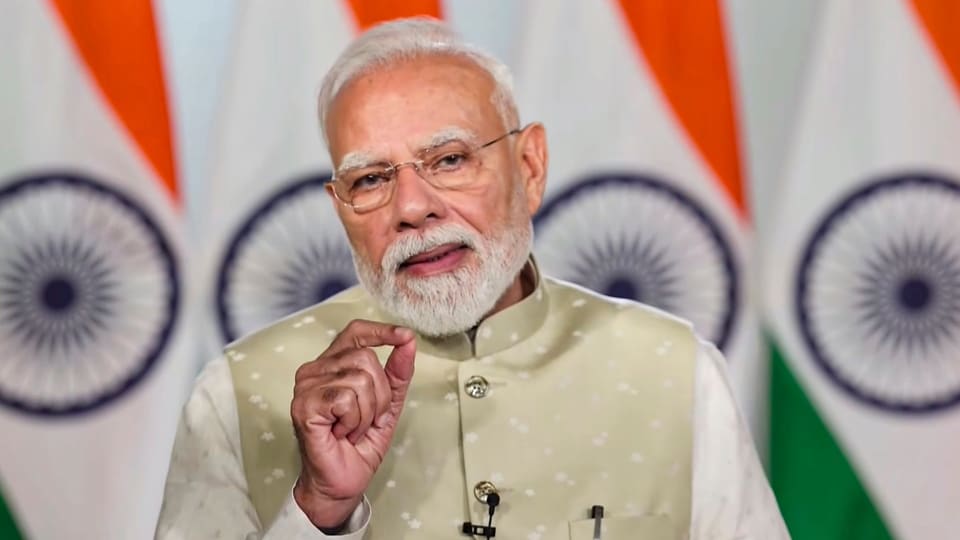
Modi made the remarks during a virtual interaction with athletes, students and volunteers gathered at various locations for the Khelo India Dialogue. He clarified that his vision for Indian sport is not limited to winning more medals, but about making sport an integral part of the nation-building process.
“In the Olympics, there are so many different sports... Indian teams don’t even participate in half of them,” Modi said, calling it a “bitter truth”.
At the Paris Olympics in 2024, India competed across 16 sports. It had featured in 16 sports at the Tokyo Olympics in 2021 as well, while the country participated across 15 sports at the Rio Games in 2016.
“We don’t even compete for a huge chunk of the medal tally. And this has been going on for decades. Other countries of the world win medals in those sports, and we don’t even participate in them.
“To increase our medal tally, we will have to master these sports as well,” he added.
Modi had first raised the issue during his Independence Day speech on August 15, when he also announced a nationwide talent-identification campaign for children aged five to 15 as part of a broader effort to widen India’s Olympic participation.
“On this 15th August, I have presented India’s sports vision for the nation from the ramparts of the Red Fort. When I talk about sports... it is not merely about winning medals.
“It is a campaign to integrate India’s sporting power and youth power together in the construction of a developed India,” he said.
The Prime Minister also underlined the role of the talent-identification programme in building a broader sporting ecosystem, arguing that children should not simply be guided towards the sport they happen to like, but towards disciplines for which their abilities naturally suit them.
“I announced a big talent hunt to identify kids from 5 to 15 years of age. We do not need to look only at which sport a child is interested in, but also at which sport they are best suited for. We have to train them accordingly.
“You will have the full support of the government in this. Our government is fully determined to build a modern sports ecosystem for the 21st century,” he said.
The comments are part of Modi’s broader vision for the 2036 Olympics, which India has formally expressed interest in hosting in Ahmedabad.
“We have decided that the 2036 Olympics should be held in India. But in 2036, in the disciplines in which India does not play today, in the disciplines in which India does not qualify, in the events that India has left aside, three-fourths of them are waiting for us. India will focus on them, and for this, we are also running a talent identification campaign,” Modi had said from the Red Fort.
“If we need athletes for 2036, then today, a talent hunt campaign will be conducted from village to village, city to city, school to school, to identify sporting talent. We have to focus on the children between the ages of five and fifteen, on our daughters. Their abilities will be assessed, and they will then receive specialised training to develop them into good athletes who can represent the country,” he had added.
The emphasis, therefore, is not simply on finding more medal winners in sports where India is already competitive, but on building a wider Olympic base over the next decade.
For Modi, the starting point is identifying sporting talent early and creating pathways into disciplines where India has traditionally had little representation.


