
 E-Paper


Deepinder Goyal claims his Temple wearable is more accurate than Apple Watch: Here's what the tests show
Deepinder Goyal's Temple wearable is now open for pre-booking in India and here's what Goyal claims about its accuracy, how it works and what buyers get.

 Prefer HTon Google


You may be interested in

67% OFF

Art and Craft India Wooden Handmade khadau for Temple Decoration | Khadau Slipper for Men & Women | Wearable Charan Paduka | mandir Puja Ghar Decoration Item | Slipper for Lord Temple (Brass Design)
 Art and Craft India Wooden Handmade khadau for Temple Decoration | Khadau Slipper for Men & Women | Wearable Charan Paduka | mandir Puja Ghar Decoration Item | Slipper for Lord Temple (Brass Design)

₹199
₹599Check Details
29% OFF

AEC Globus Go Everywhere Unisex Pince-Nez Reading Glasses +1.25 Power Nose-Resting Temple-Free Design Lightweight Full Rim Dual-Tone Frame Portable with Soft Sleeve Case for Men & Women (Mix Colors)
- AEC Globus Go Everywhere Unisex Pince-Nez Reading Glasses +1.25 Power Nose-Resting Temple-Free Design Lightweight Full Rim Dual-Tone Frame Portable with Soft Sleeve Case for Men & Women (Mix Colors)
₹707
₹995Check Details
60% OFF

Visaga Aura Antique Gold Tone Lakshmi Coin Necklace Set for Women with Pink Lotus Earrings | Traditional Temple Jewellery | Kasu Mala Design | South Indian Bridal Wedding Festive Wearable Jewellery Set
- Visaga Aura Antique Gold Tone Lakshmi Coin Necklace Set for Women with Pink Lotus Earrings | Traditional Temple Jewellery | Kasu Mala Design | South Indian Bridal Wedding Festive Wearable Jewellery Set
₹397
₹999Check Details
72% OFF

BHAGWAKART Wooden Handmade khadau for Temple Decoration | Khadau Slipper for Men & Women | Wearable Charan Paduka | mandir Puja Ghar Decoration Item | Slipper for Lord Temple | Free Size
- BHAGWAKART Wooden Handmade khadau for Temple Decoration | Khadau Slipper for Men & Women | Wearable Charan Paduka | mandir Puja Ghar Decoration Item | Slipper for Lord Temple | Free Size
₹199
₹699Check Details

Eternal founder Deepinder Goyal's Temple wearable is now open for pre-booking in India and the company is already making some big claims about its performance. Goyal says the head-worn device can measure heart rate more accurately than several popular wearables, including the Apple Watch Series 12. The claim comes from an internal study shared by the company, which compared Temple with devices from Apple, Garmin, Fitbit, WHOOP and Oura. Unlike a smartwatch that sits on your wrist, Temple attaches to the side of your forehead using adhesive patches. It is designed to track physiological signals from this region, with a particular focus on readings that could offer insights during intense physical activity. But can it really outperform established fitness wearables? Here's everything you need to know about Temple's heart rate accuracy claims, how the device works and its India price.
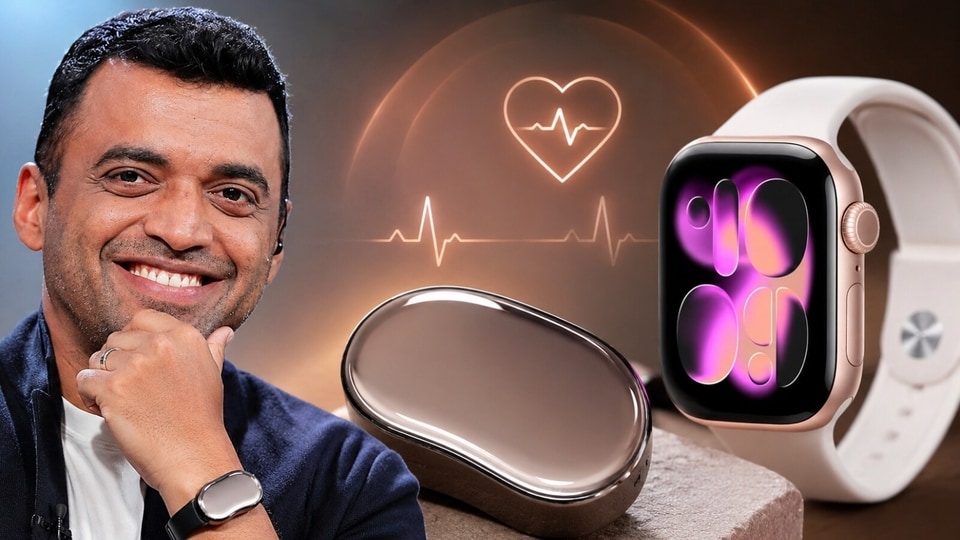

Temple vs Apple Watch Series 12: What does Deepinder Goyal claim?
In a post on X on November 1, Deepinder Goyal shared the findings of an internal study conducted by Temple to evaluate its heart rate tracking accuracy. The company compared its wearable with five flagship devices, including the Apple Watch Series 12, Garmin FR970, Fitbit Air, WHOOP MG and Oura Ring 5.
Temple used a Polar H10 chest strap as the reference device. However, instead of wearing it in the conventional manner, the company taped it to the user's chest. Goyal explained that regular chest straps can sometimes lose contact during sprints, potentially missing heartbeats. The devices were tested from resting conditions to maximum exercise intensity, with their readings compared second by second.
According to Goyal, Temple recorded lower measurement errors than the competing wearables, with the Apple Watch Series 12 coming closest. He also claimed that Temple outperformed an untaped Polar H10 chest strap in heart rate Zones 4 and 5, which correspond to high-intensity exercise.
"All the other leading wearables were well behind Temple in our study. Apple Watch Series 12 came closest. Temple also beat the untaped chest strap, the industry's benchmark, in zones 4 and 5," Goyal said.
Goyal attributed the results to two factors: Temple's adhesive-based design, which helps maintain consistent skin contact and its position over a major artery near the temple. He said the company tested the same sensor at four body locations and found the temple to be the most accurate.
However, these findings are based on Temple's internal research. Goyal said the full paper and data are available on the company's website, while an extended study by independent researchers is underway. He has also invited other researchers to replicate the results under different conditions and offered to fund such studies.
Temple wearable price in India, delivery timeline and features
Temple is positioned differently from conventional fitness trackers. It attaches between the forehead and ear using adhesive patches called Grips and uses optical sensing technology. Its proprietary BrainFlow system interprets signals from the temple region, while another metric called Entropy is designed to represent physiological strain on a scale of 1 to 250.
The company says this metric can respond to factors such as exercise, stress, sleep, digestion and caffeine consumption. However, questions remain about how frequently the device updates readings, how much information its companion app will provide and whether it can distinguish physical exertion from mental stress.
The first batch is priced at ₹85,000 in India. Temple follows a made-to-order model, so manufacturing begins after an order is placed. Deliveries are expected to take around three months from purchase and customers can reportedly request a refund until the device is shipped. The package includes lifetime access to Temple's software platform and adhesive Grips.


