E-Paper



Indian woman shares how her husband commutes from Switzerland to France for work: ‘It’s pretty smooth’
An Indian woman shared how her husband’s cross-border commute in Europe became an ordinary workday routine.

 Prefer HTon Google


For many Indians, travelling to another country usually involves airports, immigration counters, passports and careful planning. For Pooja Tiwari Pandey and her husband, Ankur Pandey, however, crossing an international border is simply part of an ordinary working week.

(Also read: ‘How do we expect to do good work?’ Bengaluru CEO says his 17 km commute took 2 hours)
The Indian couple, originally from Uttar Pradesh, moved from Bengaluru to Switzerland around three-and-a-half years ago. They now live in Basel, a Swiss city close to the borders of both France and Germany. Ankur regularly travels from their home in Switzerland to his workplace near the French-Swiss border, making a journey that Pooja says initially felt unusual but soon became part of everyday life.
Speaking to HT.com, Pooja said the couple had been settled in Bengaluru for more than eight years before moving to Switzerland. Ankur is a computer science engineer and works as a technical architect with a product-based company, while Pooja holds an MBA in HR and Marketing and is now a Switzerland-based content creator making videos about Swiss lifestyle and socially relevant subjects.
“We both come from UP, India and from past 8+ years, we have been settled in Bangalore. And we moved to Switzerland approx. 3.5 years back from Bangalore,” she said.

From Bengaluru to Basel
The couple's move to Switzerland came through Ankur's work. According to Pooja, he had been leading a project with an IT firm in India before relocating for a larger role.
“We came here on a project assignment of my husband. He was leading a project with an IT firm in India and moved to Switzerland for a bigger, brighter role and responsibility,” she said.
While the family lives in Basel, Ankur's office is located near the France-Switzerland border, close to Basel's international airport.
For the past three-and-a-half years, he has generally travelled to the office three to four times a week. His commute largely depends on Switzerland's public transport network, including buses and trams.
“He generally travels by public transport especially by Bus and Trams in Switzerland. And it takes 40 minutes for him to reach France from the home,” Pooja said.
That means Ankur can cross an international border six to eight times during a regular working week. Yet unlike the elaborate border-crossing process many people might imagine, Pooja said there is little about the journey that makes it feel like entering another country.
“Yes, every week 3-4 days so per week I would say 6-8 times he crosses internation border and its nothing unusual. Even you wouldn’t know that you crossed the border. Its pretty smooth. No police checking etc,” she said.
(Also read: 'Role was initially fully remote': Employee says company now wants 115 km daily commute)
‘It was really shocking’ at first
For the couple, who had moved from India, the idea of living in one country and routinely commuting to another initially came as a surprise.
“Yes, it was really shocking and unique experience for both of us. But here in Basel, it is common for other citizens,” Pooja said.
Basel's location makes cross-border movement a regular feature of life in the region. Pooja said their family also frequently travels to neighbouring France and Germany for shopping and other activities despite residing in Switzerland.
“Yes, its pretty common here and even we generally go to France and Germany for shopping and other activities, being a resident of Switzerland. And you can touch the border of all the 3 countries in less than 1 hour,” she said.
For Ankur, what once felt novel has now become routine. “Initially it was a bit unusual for him but now it is just a part of everyday routine,” Pooja said.
She added that the commute itself has been largely hassle-free. Asked whether border checks, strikes, traffic, weather or public transport disruptions had ever significantly affected the journey, she said they had not encountered any such incident.
“Its pretty smooth and there is no challenge as such,” she said.
While cross-border employment involves paperwork, Pooja said their arrangement is covered by the necessary formalities.
“We do have tax agreements, insurance and special permits for this type of work assignment,” she said.
(Also read: 'Sir, ₹350 a day just to get to work': Fresher tells Bengaluru CEO about rising cost of living)
She further explained, “My husband works in France border but the payment is of Switzerland so we have a special permit clause for such type of employment.”
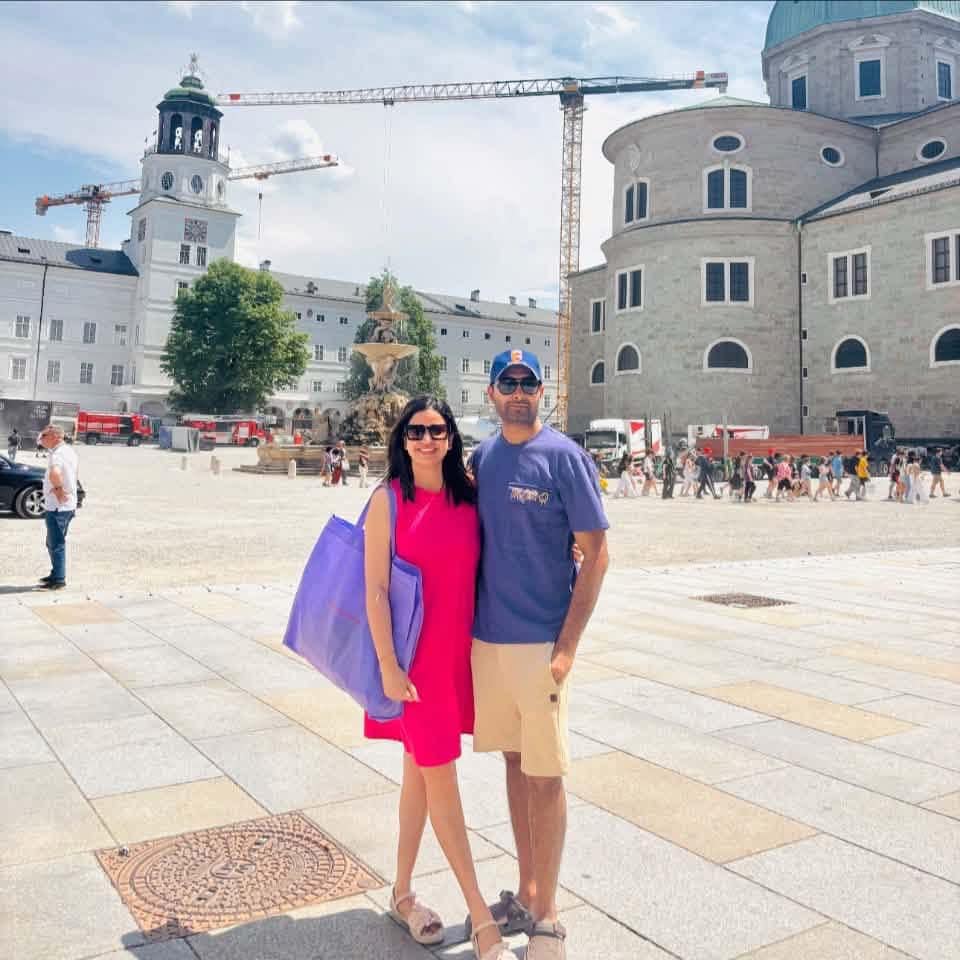
Why European borders can feel ‘invisible’
Pooja believes one of the reasons their experience attracts attention online is that the concept of casually crossing an international border can feel unfamiliar to many Indians.
“For someone from India, an international border usually means heavy security, armed guards, high fences, and strict passport checks, like at the Wagah border. Because of this, Indians often imagine European cross-border commuting as a complicated daily process full of visas, long queues, and intense checks,” she said.
She described the contrast with everyday travel within Europe's Schengen Area as one of the biggest misconceptions surrounding cross-border life.
“The biggest misunderstanding is how completely invisible these borders actually are. Inside Europe’s Schengen Area, crossing into another country is less like going abroad and more like crossing from one Indian state to another, such as driving from Bangalore(Karnataka) to Hosur(Tamilnadu) which takes max of 20 minutes of car driving,” she said.
Pooja added that in many cases, there is no dramatic sign that a person has entered another country.
“There are no border gates, no passport stamps, and no guards stopping you. Thousands of people cross international boundaries every day on local city trams, bicycles, or short train rides without ever slowing down. You often only realize you are in a new country because the language on the road signs or the currency in the shops changes,” she said.
“What seems like a high-security event in India is just a normal, boring daily commute in Europe. People simply live in one country where rent is cheaper (like France) and work in another where salaries are higher (like Switzerland), treating an international border as nothing more than a street corner,” she added.
A practical lifestyle rather than a novelty
For Pooja, Switzerland's appeal goes beyond its location. She listed infrastructure, public transport, work-life balance, taxation, salaries and security among the reasons people may choose to make the country their base while working in neighbouring regions.
“Switzerland provides better infrastructure, better transports, work life balance, less taxes, high pay and overall one of the most secure and wealthy nations in the world,” she said.
She also noted that the area near the border does not feel dramatically different culturally because of the close geographic proximity. “It’s a border area so things are approx. same,” she said.
For anyone considering a similar arrangement, Pooja said understanding the local transport system is particularly useful. The region's network of buses, trams and short-distance trains can turn what sounds like an international journey into a straightforward commute.
“Local transport maps. Trams, buses, and short trains connect these border cities continuously. Once your work permit is approved, crossing an international border becomes as ordinary as taking a metro to work back home. It is a practical lifestyle choice, not a fantasy. And I think its one of the best USP of living here in Switzerland,” she said.