

 E-Paper


HT This Day 10 September 1976: Chairman Mao Tse-Tung Dead
Chinese Leadership urges people to maintain unity
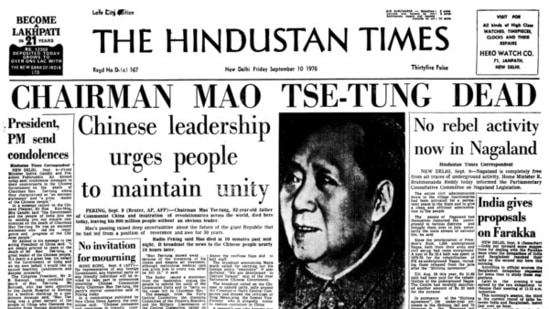
Peking- Chairman Mao Tse-tung 82 years old father of Communist China and inspiration of revolutionaries across the world died here today leaving his 800 million people without an obvious leader.
Mao’s passing raised deep uncertainties about the future of the giant Republic that he had led from a position of reverence and awe for 30 years.
Radio Peking said Mao died at 10 minute past mid night. It broadcast the news to the Chinese people nearly 18 hours later.
“Mao Tse-tung passed away…. because of the worsening of his illness and despite all treatment although meticulous medical care was given him in every way after he fell ill,” it said.
The Radio issued a statement from the leadership urging the people to uphold the unity of the Communist party and to “carry on the cause left by Chairman Mao.”
The message from the party Central Committee, the Standing Committee of the People’s Republic and the Military Commission of the Central Committee called on the people to “deepen the criticism of former Vice Premier Teng Hsiao-ping .
Teng was sacked after a power struggle following the death in January of Premier Chou En-lai.
Funeral music followed the momentous broadcast and hundreds of people many wearing black armbands began to gather in the vast Tien An Men square (square of Heavenly peace) in entre of peking.
Most looked shocked and numb.
There were few signs of tears. Above the rooftops flags slid to half staff.
The broadcast announcing Mao’s death called for carrying out his foreign policy “resolutely”. It also declared: “We are determined to liberate Taiwan” seat of the rival Nationalist Chinese Government.
The broadcast called on the Chinese to uphold unity rally around the Communist party Central Committee and deepen the criticism of Teng Hsiao-ping the former Vice Premier who is allegedly trying to restore capitalism in China.
A Peasant’s son who became one the the 20th century’s greatest revolutionaries Mao not only deeply influenced the lives of his countrymen, but also became a model for revolutionaries in many of the backward regions of the earth.
A classical port, calligrapher, hard-headed politician, guerilla strategists and audacious thinker headed the long struggle which ended with the triumph of Communism in China and then broke with the Soviet Communist Party in a schism that split the communist world.
His passing raises the compelling question of how long his own brand of communism called Maoism- will survive in China. Much will depend on how those who follow him interpret and apply his ideals and teachings.
A believer in the masses and permanent revolution, Mao spear headed many revolutions during his long and turbulent lifetime. In one, he trampled upon and sought to destroy the rule of the centuries-old elite- the landlords rich merchants and intellectuals- whose privileges were defended by 25 centuries of Confucian thinking.
He aimed to turn over this power to the poor peasants, city workers and soldiers.
Besides ripping up the tightly sewn fabric of Chinese rule, he tore great rents in its long dormant society insisting that the new proletarian overlords revolutionise their personal lives. He tried to make them into a new kind of human, skilled in warfare in farming, in industrial labour and in politics.
His own version of Marxism was salted with nationalism, influenced by ideas from the Chinese past and grounded in the long suffering peasant.
The last visiting foreign dignitary to see Mao was Pakistan's Prime Minister Zulfikar Ali Bhutto who met him for about 20 minutes on May 27, at that time a diplomatic source said Mao coughed several times during the meeting and it was officially announced that he had a "bad cold.”
In fact it was much more serious than that, and the state of his health forced the Central Committee to decide on June 16 that he would not receive distinguished foreign visitors.
The term "no longer" was not used. The official communique said Chairman Mao was well advanced in years and that he was still "very busy with his work "
Since then on several occasions, official sources have tried to be reassuring, indicating unofficially that Mao was still in good health.
On Sept. 1, the New China News Agency, reporting on a conference of relief teams who fought the Tang Shan earthquake, stressed that Chairman Mao was still in Peking.
This was apparently intended to answer speculation that Mao might have gone to the province after the quake. It was a question of showing that Mao, the great leader, whom the Chinese have never called the "father of the nation" but who was loved as such and even venerated as a living God, was still at their sides, supporting them in their hardships after the tragedy.
Mao was the last great Chinese historic figure to die this year following his long-time comrades from the beginnings of the Chinese Revolution in the 1920's, Chou En-lai and Marshal Chu Teh.
Chou, Premier since 1949, died of cancer on Jan. 8 and Chu, father of the Red Army, on July 6.
Mao last appeared before his people on May Day 1971.
For just a few minutes he sat on the ornate rostrum which overlooks Peking's main Square of Heavenly Peace to watch a fireworks display.

