
 E-Paper


Bangladesh is no longer a development superstar
Corruption has led its banks to the verge of insolvency


 Prefer HTon Google


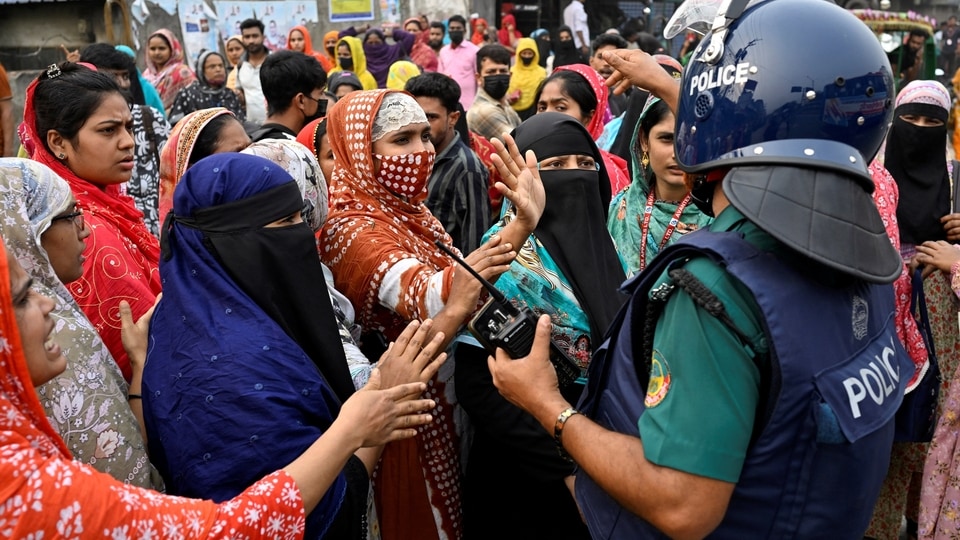
EKANTTO, THE owner of a cafe in Dhaka, has not been able to withdraw money from the bank for a year now. “Everytime I went to the office there were no answers,” he says. He was only told that the bank has a “liquid shortage”—and he is not alone. Depositors at half a dozen institutions have complained they cannot get hold of the funds they had squirrelled away to see their children married or parents buried.
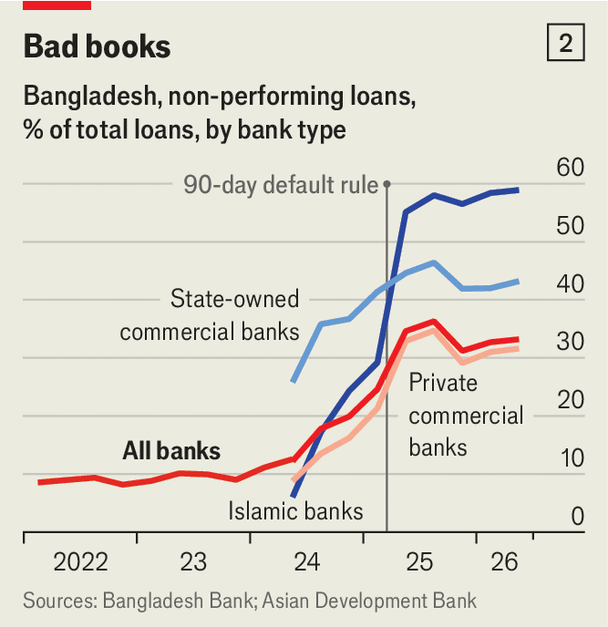
Large parts of Bangladesh’s banking system are on the edge of insolvency. That is partly due to looting under the autocratic regime of Sheikh Hasina Wajed, which held power for 15 years before being toppled by student-led protests in 2024. Corruption has saddled banks with bad loans, many of which will never be paid back. Oligarchs who both ran and borrowed from the banks have been jailed or have absconded. The result is that non-performing loans (NPLs) are now worth around a third of the banking sector’s total loan book; in India, by contrast, the number stands at 1.7%; in Pakistan, 5%. As a result, the sector as a whole is insolvent: capital-to-risk-weighted assets, a measure of net worth, is a negative 3.8%.
This threatens an unfavourable resolution to the “Bangladesh paradox” of excellent economic outcomes and terrible political ones in the world’s eighth most populous country, home to 180m people. Officials in America’s State Department described the country as a “basket case” at the time of its independence in 1971: poor, prone to flooding and exporting little to the rest of the world beyond refugees. Yet it became a surprising development success story. It grew rapidly, reduced poverty, and improved poor health and lacklustre education outcomes. It did so despite poor governance and weak institutions: Bangladesh has pinballed between flawed democracy and military coups.
The newly elected government is struggling to cement its authority. The Bangladesh Nationalist Party (BNP), the historic rival of Sheikh Hasina’s Awami League, replaced a technocratic interim government following elections in February. The BNP now faces an economic squeeze both from the banking system and strikes in the garment sector, Bangladesh’s most important and successful export industry. And it is struggling to maintain order. After Sheikh Hasina said she was planning to return to the country in December, over 50 improvised bombs exploded in the capital; the government says the Awami League is behind them. She is probably bluffing (she has been sentenced to death in absentia for her role in a bloody crackdown), but if she does return she could well become a focus for protest against the new government.
Banks are where the economy meets Bangladesh’s torrid politics. “The inheritance of the kleptocratic way of plundering the banks, that’s what we are dealing with,” says Debapriya Bhattacharya, who wrote a paper for the interim government on looting during Sheikh Hasina’s regime. Bad loans are concentrated in two kinds of banks (see chart 1): Islamic ones, which follow religious prohibitions on interest, and state-owned ones, which are controlled by the Ministry of Finance. Cronies of the Awami League were appointed to senior positions in both. The country’s regular commercial banks are doing better.
Take Islami Bank, one of the country’s biggest lenders. It had ties to Jamaat-e-Islami, an Islamist opposition party banned under the Awami League, and was forcibly taken over by S Alam, a conglomerate, having been accused of terrorist financing, which it denies. S Alam’s owner, Mohammed Saiful Alam Masud, is an ally of Sheikh Hasina. Around half the bank’s loans were subsequently made to S Alam companies. Since Sheikh Hasina was forced from power, Mr Masud, who is a Singaporean national, has disappeared from public view. Jamaat-e-Islami argues the original charges against the banks were trumped up to hand the business over to favoured cronies of the Awami League. Mr Masud denies any wrongdoing.
On the positive side, some of the increase in NPLs is thanks to greater transparency. In 2019 the Bangladesh Bank, the central bank, allowed borrowers to repay 2% of the principal of outstanding loans and then defer any further payments for a year and gain a decade to pay off the balance. Once the 2% payment was paid the loans no longer counted as non-performing. In 2020, the IMF warned that the true proportion of NPLs could be up to twice the official figure of about 10%. In 2025, under the interim government, the definition changed to include loans that were 90 days overdue, the standard international definition. Now the NPL ratio stands at 33%.
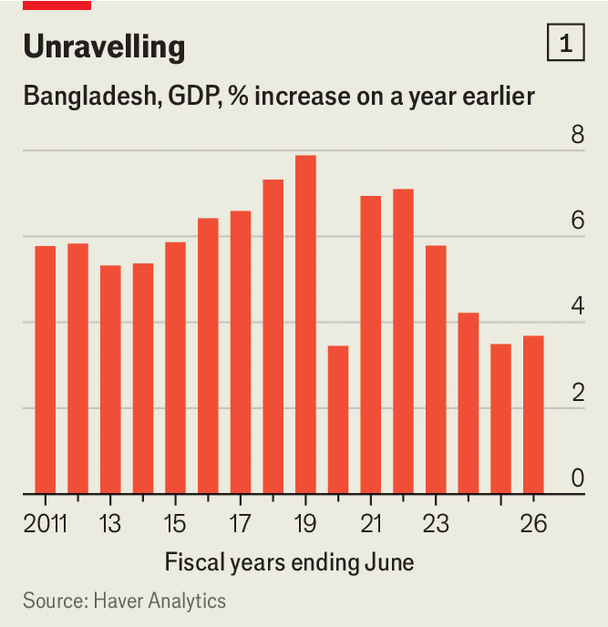
Yet the banking crisis risks squashing development. Private-credit growth has fallen from around 10% in 2025 to 4.5% this year, the lowest in 33 years. Economic growth is forecast to be only 3.7% this year (see chart 2), down from the 6.5% that was typical before Sheikh Hasina’s fall (the interim government claimed this was overstated). The slowdown is not solely due to financial problems. Energy shortages, during the early months of the Iran War, led to factory closures. Now production is hampered by strikes. The World Bank thinks that the poverty rate will grow for the third year in a row in 2026, a reversal of decades of decline.
So far the central bank has pumped $6.2bn (1.2% of GDP) of emergency support into the banks. That is unlikely to be enough. Moody’s, a rating agency, estimates that the sector needs recapitalisation worth 10% of GDP over several years
There are also worrying signs that the new government is dragging its feet. In June it introduced an interest rescheduling for some distressed borrowers. Another new rule limits how much banks can charge borrowers in interest, preventing lenders from properly pricing risk. “We are not kicking the can down the road,” says Amir Khosru Mahmud Chowdhury, the finance minister. “We are trying to clean up the balance-sheet. And if there is a good asset which needs support, which can be extended a little bit, [we will] be able to give them space to pay it back.”
In the absence of substantial support from abroad, the government has few resources with which to recapitalise the struggling banks.Tax receipts are low, due to widespread avoidance. The government collects just 7% of GDP as revenue. That is a pittance even for South Asia; Pakistan, for example, collects around 10%. The government is also running a deficit of 3.3% of GDP, partly to pay for subsidies for food and fuel, meaning it is dependent on banks (mainly private, well-capitalised ones) to finance its spending. That, as well as the central bank’s emergency liquidity support, is pushing up the money supply and therefore fuelling inflation.
Bangladesh’s stagflating economy can no longer sail on separately from its politics. One economist suggests that oligarchs linked to the BNP have been waiting for 15 years for their turn to loot and will not be denied for long. That may give them a reason to clean up the banks, and offer a route to reward a new set of cronies. As a former official puts it: “Fundamentally, nothing has changed in Bangladesh.”


