
 E-Paper



Over 10% rise in population in border regions of Tibet: China
According to China’s census data, Tibet’s permanent resident population is around 3.64mn, an increase of 645,900 or 21.52% in the last decade.

 Prefer HTon Google


The population living along the border areas of the Tibet Autonomous Region (TAR), parts of which are disputed with India and Bhutan, has increased by over 10%, the region’s Communist party chief said on Thursday.
“The population living at the border regions in Tibet has increased 10.5%,” Wu Yingjie, the Communist Party of China (CPC) chief of TAR was quoted as saying by state media at a ceremony in Lhasa marking the 70th anniversary of what Beijing calls the “peaceful liberation” of the mostly-Buddhist remote Himalayan TAR region.
Wu did not elaborate on the numbers but added that 21 border counties in TAR are now under direct supervision and aid of central government departments.
Wu’s specific views on the importance of the TAR’s border areas of China found support from one of CPC’s top leaders, Wang Yang, at the function in Lhasa.
FOCUS ON HARMONY AND STABILITY
Stressing harmony and stability in Tibet and national security and stability in the border areas, Wang, member of the CPC’s seven-member Politburo Standing Committee, the top party organ, said officials and the general public of all ethnic groups should be mobilised to “forge an ironclad defence against separatist activities”.
According to China’s latest census data, Tibet’s permanent resident population is around 3.64 million, an increase of 645,900 or 21.52% in the last decade.
India shares 3,488km of border with China that runs along the union territories of Jammu and Kashmir and Ladakh and the states of Himachal Pradesh, Uttarakhand, Sikkim, and Arunachal Pradesh; on the Chinese side, it is mostly TAR.
Border area consolidation is among the four major policies that Beijing is implementing in Tibet, the other three being stability, development, and protection of ecology.
The TAR party chief’s statement gives credence to reports that say China is bolstering its presence all along the TAR border, fortifying the remote regions not only by building critical civil-military dual use infrastructure but also building villages and populating them.
China for one claims Arunachal Pradesh as part of southern TAR and has been rapidly building infrastructure including the recently laid-out high-speed train line along its side of the disputed border.
Satellite pictures show new villages, which have also come up across the Sikkim border in TAR, a strategic location for India.
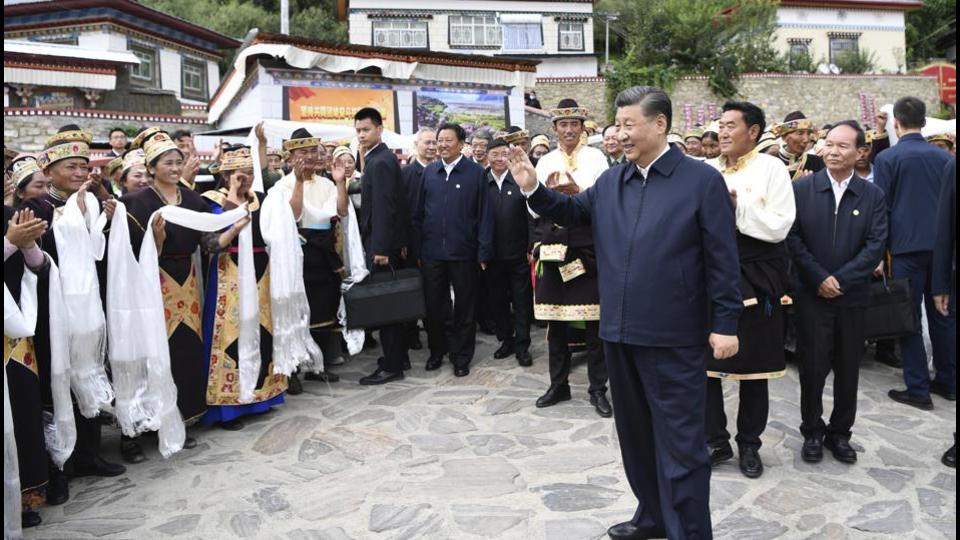
In July, Chinese President Xi Jinping visited the TAR, the first time as the country’s leader beginning his three-day tour at a strategic border city near the Sino-India Arunachal Pradesh boundary.
Xi first visited Nyingchi in southeast TAR, near the McMahon Line dividing India and China, before he took an electric train on the newly inaugurated strategic railway route to Lhasa, the regional capital. The new railway route is of strategic significance as it terminates close to the disputed border with India.
SINICISATION OF TIBET
All-round efforts are needed to ensure Tibetans speak standard spoken and written Chinese and share the cultural symbols and images of the Chinese nation, Wang, the Politburo Standing Committee member who oversees policy towards ethnic minorities, said at the same function on Thursday.
“He demanded all-round efforts to teach standard spoken and written Chinese language and foster and share the cultural symbols and images of the Chinese nation among all ethnic groups,” the Xinhua news agency said in a report from Lhasa.
Wang called for efforts to ensure that religions in China are Chinese in orientation and guide Tibetan Buddhism in adapting itself to socialist society. “No one outside China has the right to point fingers at us when it comes to Tibetan affairs,” Wang said.
“Any attempt or manoeuvre designed to separate Tibet from China is doomed to fail,” he said.
Beijing says the India-based Dalai Lama is a dangerous separatist and instead recognises the current Panchen Lama, put in place by the party, as the highest religious figure in Tibet. As a mark of the party’s rule over Tibetan Buddhism, Wang presented the Panchen Lama with a commemorative plaque at the ceremony.
The event held at the square in front of the Potala Palace, once the residence of successive Dalai Lamas and now a World Heritage Site, in Lhasa was telecast live and featured a four-storey high portrait of President Xi towering over the audience.


