

 E-Paper


The Risks State and Local Elections Pose for Wall Street and the AI Trade
Investors are watching races in key states for pushback against the AI infrastructure build-out.


 Prefer HTon Google


For Wall Street, the highest stakes in this year’s Election Day are at the lower levels of government.
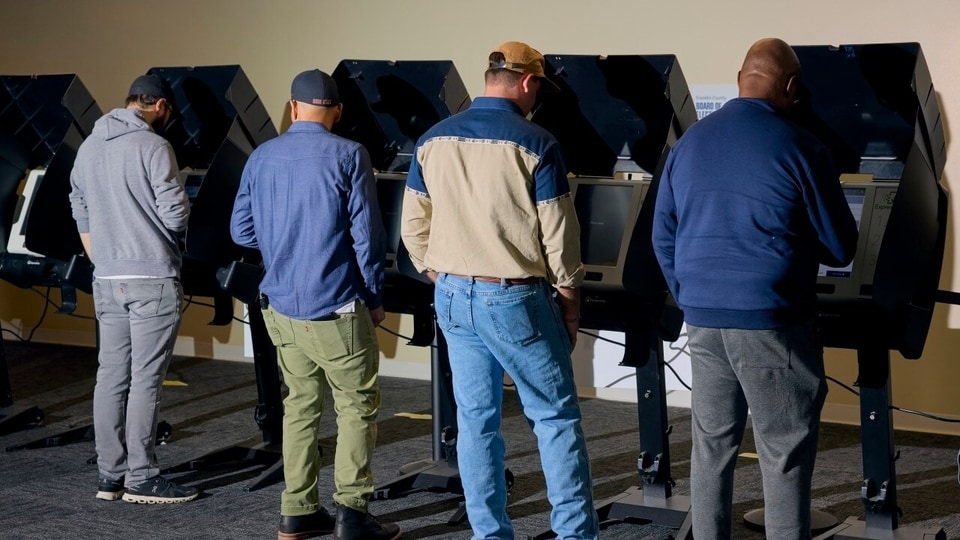
Investors are eyeing closely Tuesday’s state races for what their outcomes will mean for data-center projects crucial to the AI build-out. And while voters will determine which party controls Congress next year, it is the governor’s races in Texas, Ohio and Georgia—and the dozens of local referendums on data centers that will appear on ballots—that are just as likely to upend the AI trade and the stock market as a whole.
Governors are “on the front lines of AI/data center regulation,” RBC Capital Markets analysts wrote Monday. Prediction markets currently expect Democrats to win governor’s races in Georgia and Nevada, both of which are currently run by Republicans.
Deep Dive

On Monday, the investment bank Jefferies hosted a client call focused solely on key political races in Texas and how they might affect investors. Roughly a quarter of U.S. data-center capacity projected to come online by 2030 is in the Lone Star state, and an upset win from Regina Hinojosa, the Democratic nominee for governor who supports an immediate data-center moratorium, could put 13.3 gigawatts of announced projects at risk, the bank projects.
Bipartisan pushback to data-center construction is one of several factors making investors nervous about AI-related stocks in recent weeks, and uncertainty over state policies isn’t helping companies persuade investors to lend them heaps of cash to finance the AI infrastructure build-out. In Texas, companies from Oracle to private-asset manager Blue Owl to land owner Crusoe are deeply involved in the AI build-out.
The tech selloff continued to kick off the week, with the Nasdaq composite slumping 1.1%. Fears about a financing crunch have dinged the AI trade lately, pushing the Nasdaq to its worst month since March 2025. The S&P 500 fell 0.5% while the Dow Jones Industrial Average added 0.4%, or 214 points.
Stocks like Oracle, Intel and Advanced Micro Devices were among the S&P 500’s biggest losers Monday. Apple shares fell almost 2% before the iPhone-maker reported slightly better-than-expected revenue after Monday’s close. The stock was little changed in late trading immediately following the company’s report.
Meanwhile, companies are holding off plans to raise billions of dollars in higher-yield debt sales. One reason: For the past month, their bankers have been urging them to hold off until the midterm elections bring greater clarity to the regulatory outlook, a senior investment banker said. Assuming the nation doesn’t deliver a universal rebuke of data centers, the banker said, debt sales should pick up again before the end of the year. Some analysts argue that any new curbs on data centers will mostly shift development between states rather than slow the build-out overall.
Federal policies that threaten data centers will be difficult to implement, because President Trump has stated he won’t sign any bills limiting AI expansion and Democrats can’t achieve a veto-proof majority in both chambers of Congress, J.P. Morgan analysts told clients on Monday. For investors, gridlock can be a good thing.
“Legislative constraint has historically coincided with stronger equity-market returns,” said Jason Pride, chief of investment strategy at Glenmede. He added that S&P 500 returns have averaged 7.7% when no single party controls the White House and Congress.
Traders are bracing for volatility in the short run. Options traders are positioning for around a 1% swing—up or down—in the S&P 500 on Nov. 4, the day after the election, the largest single-day move of the month, according to Stuart Kaiser, head of U.S. equity trading strategy at Citi.
The elections have sparked hedging in some corners of the market, including cryptocurrencies, AI-related stocks and major indexes such as the S&P 500.
Danny Kirsch, head of options at Piper Sandler, said he’s noticed some clients hedging their bitcoin bets, buying put options in ETFs like the iShares Bitcoin Trust ETF. Many investors view a Democratic sweep of the House of Representatives and Senate as negative for cryptocurrencies, because Trump has been a big crypto supporter.
“Most of the hedging is around a Democratic sweep,” Kirsch said.
Kirsch is planning on signing on after around 8 p.m. on Tuesday night while the election results trickle in, ready to take options orders from clients on indexes like the S&P 500 and VIX volatility gauge.
In addition to stock futures and options, prediction markets loom large over the midterm elections. In 2024, prediction markets traders appeared to get the presidential election right, and called it better than traditional polls. This year, some traders plan on jumping into the market on election night, glued to their trading screens while the state-by-state results come in on television.
Shane Sigsbee, a former poker pro and sports bettor who has waded into prediction markets, primarily bets on sports at Imawhale TX PM, the company he launched. He will be closely monitoring the election results, and how heavy trading around the election is. If they are active enough, he’ll enter and look to take advantage of price differences across venues.
“I might dabble in it,” Sigsbee said.
Some rookie investors have been getting nervous. Around 21% of individual investors surveyed by Schwab for its recent retail client sentiment report said that the political landscape in D.C. is their top concern right now, surpassing worries about a potential AI bubble or even inflation.
Still, many investors who position around the elections end up letting their personal political preferences taint their portfolios, which can be a losing wager.
Those who stay invested around the election are often rewarded. Parag Thatte, an equity strategist at Deutsche Bank, looked at fourth-quarter results for the S&P 500 in years with midterm elections. He found that in 21 of the past 23 stretches, the S&P 500 notched gains, averaging a roughly 7% rise.
Write to Jack Pitcher at jack.pitcher@wsj.com and Gunjan Banerji at gunjan.banerji@wsj.com


