
 E-Paper


Did Dr. Jennifer Tufts show negligence in Lindsay Clancy's treatment? Key takeaways from blistering cross-examination
Dr. Jennifer Tufts defended her qualifications as Lindsay Clancy's attorney raised concerns about her postpartum care.

 Prefer HTon Google


Lindsay Clancy's previous psychiatrist on Monday underwent a rigorous cross-examination as Clancy's defense attorney aimed to undermine her qualifications, diligence, and the comprehensiveness of her care in addressing Clancy's postpartum mental health issues.
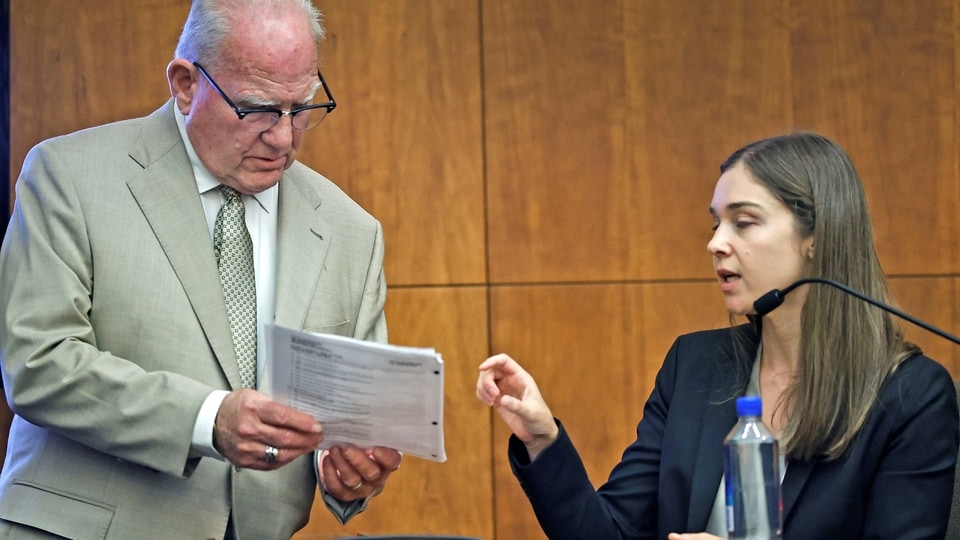
Attorney Kevin Reddington highlighted that Dr. Jennifer Tufts had only been practicing independently — and fully credentialed — for approximately one month prior to her engagement with Clancy in September 2022.
In response, Tufts asserted that she had treated numerous postpartum patients during her residency and had received specialized training for this demographic, which included a focused elective with a perinatal psychiatrist.
Lindsay Clancy trial: Kevin Reddington grills Jennifer Tufts
Reddington focused on postpartum psychosis, a serious condition that Clancy claims she suffered from when she took the lives of her three children in January 2023.
- Tufts stated that she had not treated any patients with postpartum psychosis in the month leading up to her sessions with Clancy, noting that it is "a very rare disorder." However, she concurred with Reddington that postpartum psychosis is a "legitimate" diagnosis that may lead patients to hear voices in their minds, as Clancy reported she experienced.
- Judge William Sullivan overruled prosecutors’ objection as Reddington noted that Tufts is a named defendant in “a very large lawsuit,” likely referring to Clancy’s malpractice suit against several of her mental health care providers. Clancy’s ex-husband, Patrick Clancy, has also named Tufts and others in a separate wrongful death lawsuit. “And you know that the outcome of this case is very, very major to the outcome of your lawsuit?” Reddington asked. “I don’t actually know that,” Tufts shot back.
- Reddington then questioned Tufts on whether she would view it as negligent or misleading to promote her expertise in perinatal mental health while she was still newly graduated from her residency. “I do not believe that I have been negligent,” Tufts responded.
- During his interrogation, Reddington consistently pointed out that Tufts had only interacted with Clancy through remote means throughout her treatment, never meeting in person until the murder trial. He implied that telemedicine may be inadequate or incapable of fully capturing a patient’s mental distress, a claim that prosecutors countered during their subsequent redirect examination.
- Reddington also seemed frustrated as Tufts recounted her reliance on Clancy's statements regarding her symptoms and medical history, without consulting her family or other healthcare providers. For instance, when questioned about Clancy’s prior use of a selective serotonin reuptake inhibitor, or SSRI antidepressant, Tufts stated that Clancy “said that she took it for a period of time. She didn’t mention any side effects.”
“Oh, she didn’t tell you that she had side effects. I see,” Reddington sniped. “So when a patient comes to see you with a month under your belt, and they’re sick, and they’re looking for help, you wait for them to volunteer facts to you?”
- Tufts asserted that Clancy provided "a lot" of information during their sessions and was capable of advocating for herself in the months to come. “She knew very well what her medical history was and was able to provide that for me,” the psychiatrist added.
- In response to another inquiry from Reddington, Tufts indicated that she did not utilize the Edinburgh Postnatal Depression Scale, opting instead for a different assessment to evaluate Clancy's depressive symptoms. “It’s not my choice; that’s the practice at Aster [Mental Health] of what we use,” Tufts stated when responding to a subsequent question from the prosecutors.
- Reddington pointed out that Clancy had been assessed with severe depression according to the Edinburgh scale. When inquired about the type of therapy she administered to Clancy, Tufts responded, “I listened to her. I listened to her concerns and provided support. I tried to provide her with hope that eventually, things would improve.”
- She justified her choice to prescribe Clancy the SSRI antidepressant Zoloft, characterizing it as "a top choice, a first-line medication" and a “very effective medication for generalized anxiety disorder.” Meanwhile, Reddington highlighted the U.S. Food and Drug Administration's “black box warning” for Zoloft, which cautions about a possible increase in suicidal thoughts among certain demographics.
- During a particularly intense line of questioning, Reddington took issue with Tufts' documentation regarding the side effects Clancy experienced after previously using Zoloft following the birth of her second child. Tufts defended her actions, clarifying that Clancy's earlier side effects did not appear severe, and thus she did not find it necessary to record the specific symptoms.
- Tufts also testified that she recommended Clancy stop taking Zoloft in October 2022 when Clancy reported feeling “awful” after approximately a week on the medication. At that time, Tufts confirmed that Clancy's side effects included insomnia, diarrhea, loss of appetite, depressed mood, and mental fog, among other symptoms.


