
 E-Paper



Two survivors give Nepal’s death valley something to cheer about
A 15-year-old boy was pulled out alive from the debris of a five-storey building in Kathmandu on Thursday, six days into the devastating earthquake which flattened large parts of the Himalayan country and left nearly 5,500 dead.


Rescuers pulled a 15-year-old boy alive on Thursday from the rubble of a Kathmandu guesthouse devoured by last week’s earthquake, evoking cheers from hundreds of onlookers to a rare moment of joy as Nepal struggles to build its future over the ruins of its history.

Caked in dust, Pemba Tamang was wearing a New York shirt and a blue neck brace as he was carried out on a stretcher after he reportedly beat back death for five days by eating jars of ghee and drinking water dripping from his clothes.
“The boy was lodged under two crossbeams,” YP Gautam of Nepali armed police, who was involved in the rescue operations, told HT. “We drilled a hole and passed a bottle of water which he finished in one gulp. Then we gave him a bottle of juice.”
A second survivor was located buried under a collapsed building in Nepal’s capital as rescue workers got the woman out after a painstaking 10-hour-long operation, but officials said the chances of finding more people alive were fading fast.
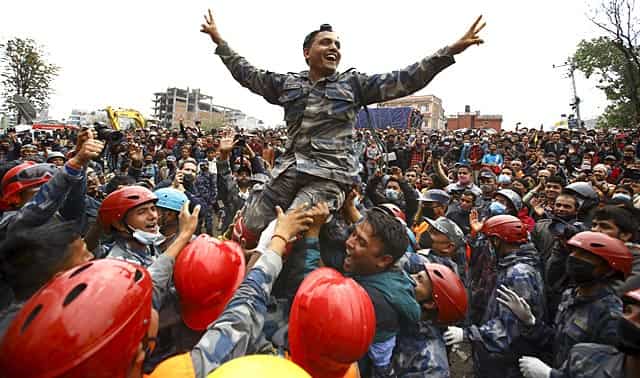
Members of the Nepalese Armed Police Force carry their officer as they cheer after successfully rescuing earthquake survivor Pema Lama. (Reuters)
Close to 5,500 people have died in the 7.9-magnitude earthquake, while emergency teams have mainly been hauling bodies from the debris, a task made more perilous by over 70 aftershocks and inclement weather.
Aid was finally reaching some of the country’s remote towns and villages cloaked by the mountains, but authorities said providing security to teams carrying relief material was the latest challenge as tempers flare among distraught citizens.
“People are in need but when you don't have enough for everyone it is for us to prioritise. In a crisis this big, such things will happen, but eventually we will reach everyone," said Col Anoop Jung Thapa of the Nepali army.
The quake-hit Nepalese capital was limping back to order, with shops and banks opening in several areas, electricity being restored in some parts and supply of essential items like milk and petrol also picking up.
Assuring all possible help to the neighbouring nation, President Pranab Mukherjee told the Nepalese ambassador that India strongly feels for the people of his country and hopes that the situation there will soon return to normalcy.
Pakistani premier Nawaz Sharif called up Prime Minister Narendra Modi and expressed his grief on the casualties in India due to the earthquake and appreciated New Delhi’s efforts in the rescue operations in Nepal.
“Got a call from PM Nawaz Sharif. He expressed condolences on the loss of lives in various parts of India due to the earthquake,” Modi tweeted on Thursday. “I thank him for his kind words.”
India, the first country to respond to Saturday's devastating earthquake in Nepal, had flown in 280 tonnes of relief material to help millions of people in the neighbouring nation.
The goods flown into Kathmandu and Pokhara in 28 sorties of C-17 Globe Master, IL-76 and C-130 aircraft include drinking water, food items, medicines, tents, tarpaulins and blankets, officials said.
(With agency inputs)



