
 E-Paper



Caltech’s Anima Anandkumar says speed just part of AI’s story in science, stresses accuracy | HTLS 2026
She believes scientific modelling is about going from microscopic to macroscopic scales, from atomic to planetary scales, and even to cosmological scales.

 Prefer HTon Google


Anima Anandkumar, California Institute of Technology (Caltech) professor, believes speed is only a part of the artificial intelligence (AI) story, and that AI also allows for better accuracy and reliability in scientific modelling.
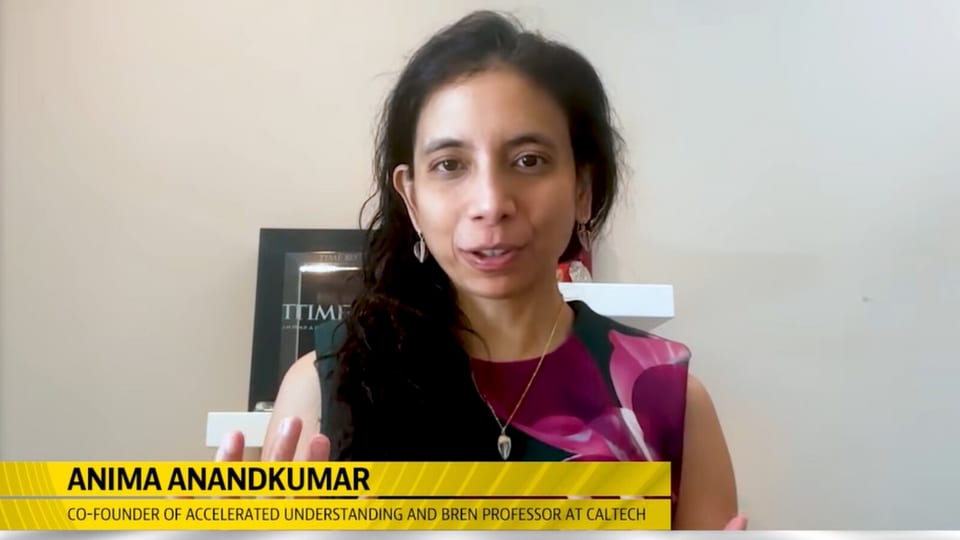
"It's not just that it's faster with less reliable predictions. In fact, it's more accurate, more reliable at this point—what AI can do—compared to traditional models," she said on Thursday at a virtual session of the 24th Hindustan Times Leadership Summit.
Anandkumar, a Bren Professor of Computing and Mathematical Sciences at Caltech, also explained why AI models are considerably better than traditional systems, when asked if the technology is opening new possibilities for scientists.
"With traditional forecasting, for each new prediction you had to solve all the physics equations from the ground up to come up with an answer. There's no learning. There's no use of historical patterns, or of the laws of physics, in a way that helps speed that up. That's what AI is doing: it's learning from historical data and doing it faster," she said.
Anandkumar, who has made pivotal contributions towards AI and its use in scientific modelling, added that the "speed-up also helps us create better risk assessments of extreme events" like a hurricane, enabling scientists to create a number of predictions that present statistical estimates—which, in turn, improve the process itself.
Anandkumar's mission is to build AI that can simulate and understand the physical world. She invented neural operators, a deep-learning framework, for learning multi-scale phenomena that frequently occur in nature, and later used those to train an AI-based high-resolution weather model.
Instead of needing supercomputers to break down the atmosphere into billions of tiny mesh blocks for calculations, a neural operator relies on mathematical calculations to convert physical environments into frequencies.
The Fourier Neural Operator (FNO), the framework that Anandkumar and her team developed, forms the foundation of the Nvidia Earth-2 open source suite of AI models designed to forecast weather, climate and atmospheric physics a thousand times faster than traditional supercomputers.
Anandkumar, who previously worked at NVIDIA, also said "a lot of scenario generation" can be done "because our models are so cheap they can run on a local desktop".
"They don't need a big supercomputer like the traditional models. Anybody can run them. That helps us create really big statistical ensembles and come up with better assessments of the risk of extreme events."
In her session, Anandkumar, named by Time among the most influential people in AI this year, also explained that “there are a lot of physical processes that are very difficult for us to have good intuitions about”, including weather and nuclear fusion, and how AI is turning out to be a game-changer.
“Scientific modelling is about going from microscopic scales to macroscopic, from atomic scales to planetary scales and even maybe cosmological scales, much beyond our planet. Those kinds of processes require us to understand the physics behind them because the laws of physics guide how these processes work,” she said.


