
 E-Paper



Frontier language models, 'autonomous AI scientist', and more: Anima Anandkumar at HTLS
She said that consequential breakthroughs would come from some scientific discoveries in the next few years, with AI connecting several disciplines.

 Prefer HTon Google


Local languages and accessibility are important when it comes to frontier language models, Anima Anandkumar, Bren Professor of Computing and Mathematical Sciences at the California Institute of Technology, said at a virtual session of the 24th Hindustan Times Leadership Summit on Thursday.
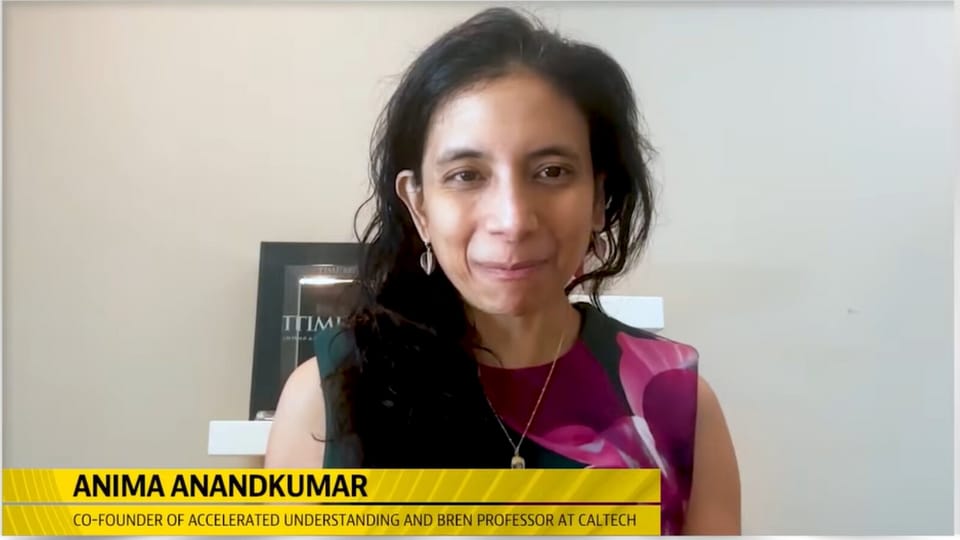
“I saw a lot of startups—and not necessarily only in the language model space,” she said, pointing to space, batteries and similar hard engineering as India’s competitive strength in the age of artificial intelligence (AI). “That is also the real strength that we should not lose track of,” she added.
A distinguished alumna of Indian Institute of Technology (IIT) Madras, she added that it’s important to think in a broader way and have investments across the board, instead of just focusing “on one thing”.
“Language models are great, but they're not the only thing to invest our focus on. When it comes to the frontier language models, I think the important thing to keep in mind is local languages and accessibility, and that's something uniquely India can do," Anandkumar, who has made pivotal contributions towards AI and its use in scientific modelling, said.
She encouraged investments in technical research, in humanities—and “really grow that knowledge.”
“UNESCO recognised Arthashastra as one of the treasures from India. And I have a really interesting connection: my great-great-grandfather discovered Kautilya’s Arthashastra more than a century ago. Using AI…to understand our rich history, our rich culture, our local traditions is important,” she said.
R Shamasastry, a Sanskrit scholar and librarian, rediscovered Kautilya’s Arthashastra, an ancient Indian Sanskrit treatise on statecraft, economic policy and military strategy, in 1905 and later translated it, from a manuscript preserved on fragile strips of dried palm leaf.
Anandkumar believed that consequential breakthroughs will come from some scientific discoveries in the next few years, with AI connecting several disciplines.
“I think the magic [is] that you will just see all kinds of very unexpected connections being made,” she said, adding that those could "accelerate everything".
At the same time, she also took aim at one of AI’s buzziest ideas, the “autonomous AI scientist”, a term that refers to AI systems or agentic frameworks that can carry out part or all of the scientific research process without human intervention. She called it “extremely overhyped”.
If a language model claims to have discovered 100,000 novel materials, it does not solve the scientist’s problem—it adds to it, according to Anandkumar.
She noted that unverified AI-generated ideas, which are prone to hallucinations, simply shift a massive burden onto experimental teams without guaranteeing successful outcomes.


