
Sign in

MP: Sindh HC gives Pakistan govt 10 days to respond in Geeta’s case

The Sindh high court in Pakistan has issued notices to the federal government of Pakistan on petition on the repatriation of Geeta, the deaf-mute woman who was stranded in Pakistan for 15 years, to India. The court has sought a report on the matter in 10 days.

Updated on: Feb 2, 2016, 18:30:54 IST
Hindustan Times | By , Bhopal
Share
Share via
  • facebook
  • twitter
  • linkedin
  • whatsapp
Copy link
  • copy link

The Sindh high court in Pakistan has issued notices to the federal government of Pakistan on petition on the repatriation of Geeta, the deaf-mute woman who was stranded in Pakistan for 15 years, to India. The court has sought a report on the matter in 10 days.
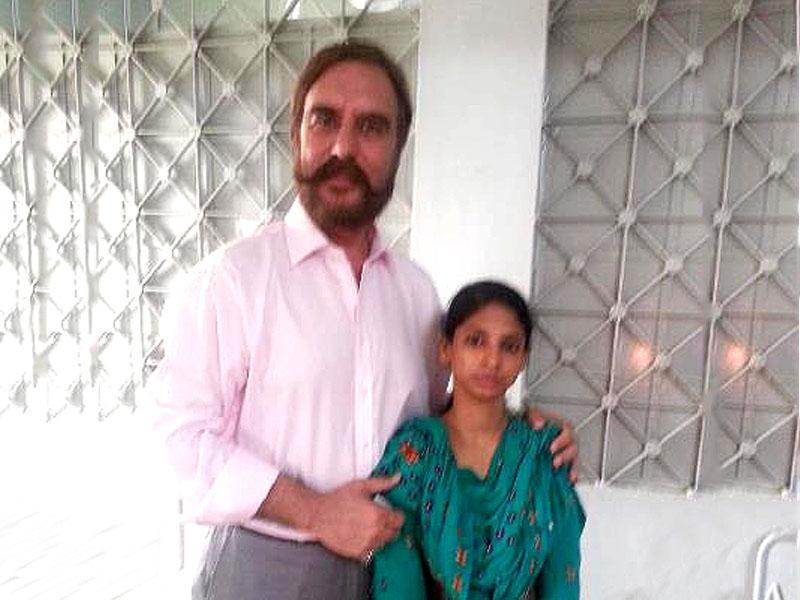
Rights activist Ansar Burney with Geeta, the Indian woman stranded in Pakistan for 15 years. (HT File Photo)

A Pakistani human rights group, led by Ansar Burney, had filed a petition in the court by demanding that Geeta, 23, be sent back to Pakistan, following India’s failure to establish her nationality. The Pakistan government had sent the girl to India in October last year. Geeta is presently lodged at a shelter home in Indore.

Talking to HT, Pakistani human rights activist Burney said: “Now, the federal government has to clear its stand on Geeta. She was sent to India even before her parents were traced.”

He maintained that Geeta was made “victim of a public relations exercise between India and Pakistan.”

“While the Pakistan government, without confirming the identity and nationality of Geeta handed her over to India, it has not taken any action to bring Mohammed Ramzan back to Pakistan, despite knowing his identity,” he said.

The 15-year-old Pakistani boy, who crossed into India from Bangladesh, is lodged in a Madhya Pradesh shelter home.

The secretary, ministry of interior, secretary, foreign affairs, and provincial government of Sindh have been made respondents in the case.
  • Shruti Tomar
    ABOUT THE AUTHOR
    Shruti Tomar

    I have spent over a decade chronicling Madhya Pradesh’s political and social landscape, covering politics, investigative journalism, crime, human interest, and government policy, blending sharp insight with ground‑level depth. I have closely tracked three assembly elections, three Lok Sabha elections, leadership transitions in MP while exposing governance lapses, tender irregularities, and flawed policy rollouts. My reports have revealed gaps in the Cheetah project, irregularities in medical education, rigging in recruitment exams, and loopholes in policy implementation. In crime reporting, I have moved beyond FIRs to map systemic patterns — from organised crime networks and gender‑based violence to custodial accountability — balancing urgency with sensitivity. My journalism is defined by a commitment to human interest. I have profiled the marginalised Bancchda community, documented atrocities against tribal groups, and highlighted efforts to preserve their culture through heritage liquor and revival of spiritual practices. I have reported on farmers struggling with failed MSP promises, giving voice to those often reduced to statistics in policy files. Passionate about field reporting, I have reported on rampant sand mining in Chambal and Narmada, pharmaceutical companies supplying medicines under altered names, the dire condition of schools and colleges, the plight of commercial sex workers, and skewed sex ratios in specific districts. Beyond deadlines, and as HT’s state correspondent and assistant editor in Madhya Pradesh, I engage with ministers, farmers, students, and activists, believing the best policy stories begin with a single human voice. A postgraduate in Journalism and Mass Communication, I also hold a diploma in sports journalism.Read More