
 E-Paper



Interview: Deana Heath and Jinee Lokaneeta
The co-editors of Policing and Violence in India speak about the use of force and the emergence of new technology in the suppression of dissent

 Prefer HTon Google


Your book grew out of a workshop series at the University of Liverpool and Jawaharlal Nehru University between 2016 and 2019. What went into making it accessible for non-scholarly readers?

We started with the premise that the book needed to include insights into the cutting-edge research on policing and violence in India that has emerged over the past decade or so, and reveal the work that human rights lawyers and activists, and others, have been doing, and to bring these into dialogue. However, when we started getting chapter drafts and doing interviews for the book, it became apparent that we were all skilled at talking to our own particular audiences but less so to a general public, since we all had our own language and approach to the issues that we explore. It took time and effort on everyone’s part to get us all speaking the same language and making that as accessible as possible.
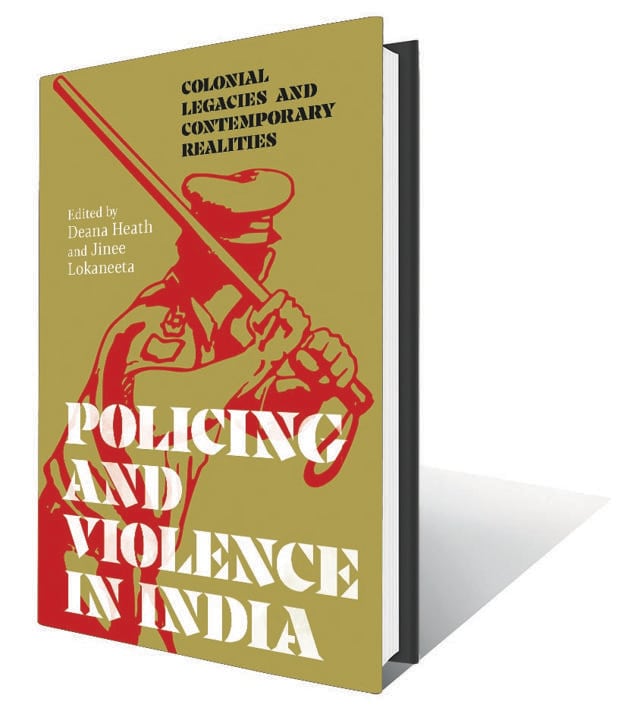
There is a long tradition of human rights groups in India, that have brought out insightful fact-finding reports, and lawyers, who have done incredible litigation that doesn’t always connect with the academic or popular realm. A number of former detainees have written powerful memoirs and prison diaries, and so have some police officers who have attempted models of democratic accountability. The attempt in our book was to connect all these efforts in a unique format with primarily essays as well as shorter discussion pieces and interviews.
Is the term ‘police brutality’ understood differently in India, the UK and the US?
This is an important but often overlooked question. A lot of global attention focuses on police brutality in the US, particularly since the 2020 murder of George Floyd and the global Black Lives Matter movement though there is a long history of focusing on police brutality especially since the 1960s. There, the term refers to systemic racism, racialised violence, and constitutional rights rooted in a history of settler colonialism and institutionalised slavery, with responses centred on structural accountability and reforming or defunding armed institutions.
The UK lacks that specific domestic settler-colonial past, but as a former imperial power, it shares deep-seated issues with systemic racism. Yet, the concept of “police brutality” has expanded to encompass violent misogyny, corruption, and intense scrutiny over protest powers, use-of-force accountability, and the handling of violence against women and ethnic minorities.
In India, the term “police brutality” rarely carries the same discursive weight. Instead, the focus is often on idioms like “custodial violence”, “encounter killings”, or “state repression” or “state violence”. Because the police were developed during the British colonial era to uphold imperial authority and suppress dissent, the very concept of unlawful police violence continues to be largely obscured. Daily and custodial abuses have become normalised as an inherent tool of state governance rather than recognised or prosecuted as a breach of the law.
That said, in formulating a term such as “custodial violence”, civil liberty and democratic rights groups emphasize the specific nature of violence as occurring in state custody, opening up the question of state violence as being broader than the police. “Police brutality” as a term focuses more on the institution and individual police while custodial violence opens up the possibility of focusing attention on the responsibility of the state in ensuring safety in custody – whether in prisons, police stations or on the streets. Custody jurisprudence as inaugurated in the 1997 DK Basu v State of Bengal that created guidelines such as an arrest memo, and a right to a medical exam, also recognised the significance of such rights immediately after arrest to ensure safety.
What similarities and differences do you notice between police crackdown on nonviolent protests under British rule, and protests after India’s Independence?
Post-Independence India, as in the case of India under British rule, has relied heavily on pre-emptive criminalisation, colonial-era statutes like sedition laws, and heavy-handed force to suppress dissent, in addition to sharing the fundamental objective of protecting state power and socio-political hierarchies from popular challenge. However, significant differences mark the post-colonial era, not least that police crackdowns have come to operate under the framework of a democratic constitution, which forces the state to rhetorically justify its actions through the lens of national security, public order, and sovereignty. Furthermore, contemporary crackdowns increasingly leverage modern technologies, such as facial recognition, digital surveillance, and telecommunication shutdowns, that far exceed the technological capacities of the colonial state.
We should add the tremendous challenge to police violence and state repression more generally by civil liberty and democratic rights movements especially after the Indian Emergency (1975-77) when you see the emergence of the Andhra Pradesh Civil Liberties Committee (APCLC), the Association for the Protection of Democratic Rights (APDR),the Committee for the Protection of Democratic Rights (CPDR), People’s Union for Civil Liberties (PUCL), and People’s Union for Democratic Rights (PUDR) alongside the Association of Parents of Disappeared Persons (APDP) in Kashmir or The Naga People’s Movement for Human Rights (NPMHR) and international human rights groups such as Amnesty International. These groups, their members and other activists have been targeted for this work.
What efforts are being made with respect to police reform in India, especially to address custodial violence faced by LGBTQ+ people, Dalits and Muslims?
Efforts toward police reform in India — championed largely by civil rights lawyers, activists, and grassroots organizations — include pushing for judicial compliance with landmark Supreme Court directives such as mandatory CCTV installations in police stations and strict arrest procedures. However, systemic impunity remains a formidable barrier, particularly when addressing custodial violence targeting vulnerable groups like Dalits, Muslims, and LGBTQ+ individuals. Legal infrastructure and bureaucratic hurdles often work to shield perpetrators rather than deliver justice, which makes institutional reform an ongoing, uphill battle.
One of the ironies of police reform in India has been that some of the landmark cases such as the 2006 Prakash Singh vs. Union of India case have been initiated by the police themselves. The focus here is more on ensuring autonomy of the police from political interference, which is definitely a challenge. However, that has also meant that accountability for police violence has remained even more elusive than usual and definitely the impunity is far greater for the violence committed against the most marginalized in society and increasingly against those who dissent.
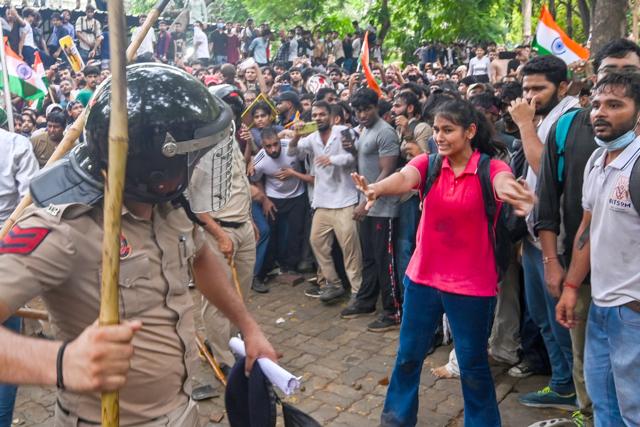
Given the use of pellet guns and facial recognition technology during protests related to the NEET-UG paper leak, what scholarly directions are you drawn to?
We approach such a question as a historian and a political scientist respectively. When it comes to history, it’s valuable to think about how contemporary technologies, such as facial recognition and pellet guns, represent an evolution of the technological authoritarianism rooted in colonial surveillance and penal apparatuses. This could involve tracing how modern digital policing repurposes colonial logics of exceptionalism, in which targeted populations are stripped of civil protections under the guise of public order and national security; and how software, algorithms, and surveillance databases are seamlessly mapped onto older imperial structures to render state violence more pervasive, invisible, and legally insulated than ever before.
It is, of course, extremely fascinating that technology also comes with its claims of modernity and scientific progress and sometimes as more “humane” or non or less lethal than other methods. Yet, as we know, in addition to questions of validity and reliability of these claims, facial recognition technology raises serious concerns regarding legal ethics and privacy.
Groups such as Internet Freedom Foundation have pointed to how surveillance technologies are a violation of a right to privacy as established by prominent cases such as Puttaswamy v. Union of India (2017). Pellet guns, while brought in ironically as non-lethal or less lethal, are of course an exposure of the arbitrariness and brutality of the Indian police and Rapid Action Force. Yet, both these techniques have gained much more mainstream attention since the Jantar Mantar protests as the students courageously faced the brutality, ridiculed the police, and also brought up the question of how normalised the use of pellet guns was previously in Kashmir.
How do you look at your own work in the context of how campus protests in solidarity with Palestine are being crushed by the police in the US and UK?
Viewing contemporary campus crackdowns in solidarity with Palestine across the US and the UK alongside our own work underscores how Western liberal democracies have come to deploy authoritarian policing tactics when student movements challenge institutional endowments, financial investments, and corporate or defence research ties, particularly demands for divestment from weapons manufacturers and military contractors.
While US institutions have frequently opted for spectacular, militarised police raids and mass arrests, UK universities have relied more on a quieter mix of administrative surveillance, private security, and punitive academic measures like suspensions and campus bans. Such developments demonstrate that the impulse to crush student dissent is not an isolated anomaly, but part of a globally interconnected architecture of state and institutional control.
This has brought the question of solidarity for Palestine more centrally to universities, especially among students and faculty. Students continue to find ways of organising under difficult conditions and faculty are trying to find ways of supporting students as well as ensure accountability for police crackdown and administrative control over free speech and protests.
What would enable a wider embrace of restorative justice over punitive action across the world?
Transitioning from punitive action to restorative justice requires dismantling deeply entrenched cultures of state impunity and retributive violence. This shift is illuminated by our book’s core themes. A systemic transformation relies on cultivating political will to prioritise community safety over militarised policing, re-educating legal and security institutions to centre healing, accountability, and repair of harm rather than incarceration as the primary response to social conflict, and amplifying grassroots movements that successfully demonstrate the viability of alternative, community-based models of justice.
We started the book at the peak of the Black Lives Matter movement in the US, which echoed in India as scholars and activists focused on the brutal deaths of Jeyaraj and Bennix in 2020. The Criminal Justice and Accountability project has adopted caste as a central lens to understand the Indian police and there has been successful litigation in the Sukanya Shantha case against the use of caste-based labour practices within prisons. Through the pandemic, we witnessed even more brutal police violence across the world with the police playing a particular role in determining who was worthy of living and of exercising rights.
The campus crackdown during the encampments in the US reminded us that not even universities exist as available spaces for solidarities with Palestine. The most recent youth-led protests at Jantar Mantar, Delhi were a reminder of the continued use of police violence against any protests (alongside targeting of protestors more generally). Yet, we have also witnessed a very visible challenging of police violence in mainstream discourse whether in courts, amongst the youth or the opposition. While these efforts alone will not lead to a move to more restorative justice, it opens up the spaces for conversations of accountability, challenging impunity and moving towards models of restorative justice.
Chintan Girish Modi is a journalist, educator, literary critic and arts writer based in Mumbai.


