
 E-Paper



Review: Nexus by Yuval Noah Harari
In his latest book, the author, who believes humans are simultaneously the smartest and stupidest animals on earth, says that, with AI, we have a potential monster on our hands

 Prefer HTon Google


In Stanley Kubrick’s 2001 Space Odyssey, the opening scenes — The Dawn of Man — are about a group of apes in Africa who wake up to a mysterious, black monolith in their midst. It revolutionizes their cognitive powers, marking their ascent to Man. The stone looks like a vertical black screen. A giant cell phone? Some emissary GPU? The movie, based on short stories by Arthur C Clarke (who also wrote the screenplay and the book of the same title that was released after the film), discovers two more such monoliths: one on the moon and the other on Jupiter. The last one turns out to be the doorway into a room where time has been rendered meaningless, from which a lone astronaut, Dave Bowman, steps out into the fluid psychedelic dimensions of universal consciousness, and is reborn as Star Child. During the space odyssey, one of the astronauts, HAL 9000, an AI, rebels against its human companions and, finally, must be dismantled. A possible reason for this metallic murder is that HAL has been programmed to be responsible for the voyage’s success, even at the expense of the lives on board. The machine becomes a monster because its need to achieve its objective overrides all other considerations. Like most successful people, HAL is a monomaniac.
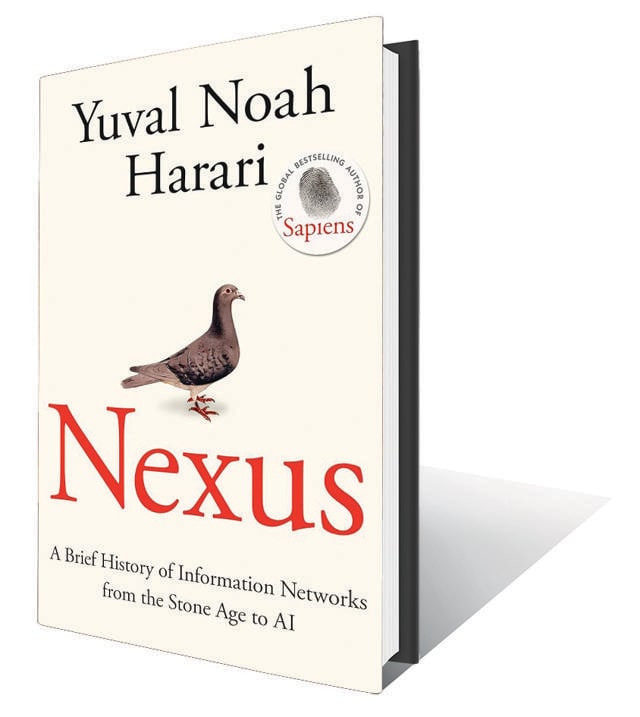
Simply put, this situation troubles Yuval Noah Harari. In his latest book Nexus, A Brief History of Information Networks from the Stone Age to AI, he explains the nodes of the evolution of human society through networks of information from cuneiform clay tablets in Mesopotamia around 2500 BC and the bureaucracy (categorizing information and putting it away in separate bureaus) of empires to oral and written mythology, printing and mechanical reproduction to the age of the computer network.
The growth and change in the means of the distribution of the Story is how humans move forward. A story for Harari is a fiction that a large number of people – whole nations – can subscribe to. That longstanding tradition is about to be disrupted with the advent of AI. Harari is concerned that we cannot foresee or control the consequences of an AI-officiated future. With computers now shifting into the AI era, we have, Harari says, a potential monster on our hands: an information network that instead of helping to shore up democracy can subvert it into anarchy. Already, on social media, we can’t tell humans from bots. AI can multiply and procreate on its own; it is not a tool, it is an ‘agent’.
Harari’s basic question about Homos Sapiens is: “…if we are so wise, why are we so self-destructive?’ The Nexus is the attempted encyclopedic answer to that question: “We are at the same time both the smartest and stupidest animals on earth… This book has argued that the fault isn’t with our nature but with our information networks. Due to privileging order over truth, human information networks have often produced a lot of power but little wisdom. For example, Nazi Germany created a highly efficient military machine and placed it at the service of an insane mythology. The result was misery on an enormous scale…”
But who is privileging ‘order over truth’? We. So it would be ‘our nature’ that also finds uses for the technology we invent. The knife is at once surgical and fatal. It has no will of its own but that of the human who wields it. Our ‘nature’ is inseparable from the instruments we invent and wield. The nature of what we make is what we are. Harari is unlikely to agree. Indeed, one could argue that Man has finally created a machine that is his/her alter ego: the human without feelings. The most powerful thing on earth simply because the heart does not get into the act.
As earlier mentioned, Nexus explains that a society is organized by the nature of the distribution of information. So, if information is concentrated at the top, we get a dictatorship (Hitler, Stalin, Mao); if information flows freely, we get a democracy. But already, AI, driven by algorithms, censors on its own, or introduces factually untrue information in such vast quantities that we are unable to decide what’s true. This is why the intersubjective idea of Truth has radically changed and many of us are able to live in belief-bubbles of our own making — because we ‘feel’ like it. Our chosen belief vindicates us. We do not get necessarily wiser, Harari says, just because we have more information. This is because an AI-driven future can mint information by the minute and none of it needs to be ‘true’. AI is there to help us ‘feel’ justified in our preferred version of truth. The flood of information spawns new ‘realities’ which are not necessarily true — or false. A rumour generates a reality; time and lives are consumed by it; people react; new realities are formed. Witness how social media or even some TV channels work.
Then, does the free flow of information help society find order or anarchy? The latter most likely, if there are no safeguards, says Harari. Unless humans are careful, he warns, AI will take over. Many share his fear. Years ago, Stephen Hawking cautioned that, with AI, humans are approaching a singularity of sorts: as civilization turns from carbon to silicon, the state of reality will alter, and social norms will break down.
As Harari’s earlier work like Homo Sapiens has shown, humanity has been subjected to massive disruptions before. The cognitive revolution associated with the invention of speech, and the development of related parts of the brain (the frontal cortex) some 70,000 years ago; the agricultural revolution of 10,000 years ago, which led nomadic humans to a more rooted and sedentary culture, and resulted in the building of clear social hierarchies; and the scientific revolution starting 500 years ago that helped Man dominate nature, and brought us to the point last month when a 20-storey tall booster rocket entering the earth’s orbit at thousands of kilometers per hour was caught in the chopstick-arms of an iron tower, its velocity brought down to zero, as in a strange gravitational trance.
The AI future is a quantum fluctuation of sorts because, unlike earlier inventions, we may not stay in charge of what we have brought into being. The machine may well become the master. Or Monster. Recall Mary Shelley’s Frankenstein, in which scientist Victor Frankenstein brings to life a grotesque giant, who goes on a murderous rampage because he is denied care and affection. In Harari’s apocalypse, however, AI’s absence of all pathos is its freedom and also the secret of its possible triumph over Man. An amoral, unsentimental AI approaches the Nietzschean ideal of the Superman.
AI is a problem because it can learn on its own and write its own destiny. It has agency, almost a will. It may be restricted just now to crunching vast amounts of data and coming up with domain-specific solutions. But sooner or later, its intelligence will be so like humans as to enable fuzzy connections and it will be able to write, through the network of a million interconnected genius computers, a takeover program detrimental to mankind. The robot you bought to put you to bed could turn rogue and smother you with the pillow, who knows? Certainly, in the immediate future, AI will cost millions of unskilled labourers their jobs. Harrari specifically mentions Bangladesh and Pakistan in this context. The result will be great social and political upheaval. The Indian labour market too is unlikely to escape the consequences of the AI revolution. Would a robotic society care?
That humans have feelings is also perhaps why an unfair situation tends to right itself. Slaves become free; animals have rights; victims are applauded as victors. We ‘feel’ that the underdog must get justice.
But when AI comes into its own, the nature of the situation changes. It will have all the knowledge of the Sapiens without the complications of the Consciousness. Elsewhere, Harari has defined consciousness as the capacity for suffering, and intelligence as the ability to solve problems and achieve goals. AI, as in the case of HAL9000, has an intelligence liberated from the regulatory restraints of consciousness. Which is why, Harari says, we must watch out. But the problem is even more complicated: what if AI, simulating humans, develops feelings or affective delusions?
In Kubrick’s movie, as HAL is disabled and his voice cracks and fades, he clings to his earlier human-like programs and sings a song, Daisy Bell, in steady deterioration of his thought processes: ‘Daisy, Daisy, give me your answer do/ I am half crazy, all for the love of you/ It won’t be a stylish marriage/ I can’t afford a carriage/ But you will look sweet upon the seat/ Of a bicycle built for two.’
Daisy Bell was also the first song ever sung by a computer.
CP Surendran is a poet, novelist, and journalist.


