
 E-Paper



Coal isn’t safe even its two big growth markets – India and China | Opinion
Already in retreat elsewhere, coal is beginning to taste defeat at the margin in the two key battlegrounds of India and China.

 Prefer HTon Google


BP’s latest review of the world’s appetite for energy, published this week, contained a startling chart indicating that coal’s grip on electricity generation has not changed in 20 years. I wrote on Thursday on how, while true at a headline level, there were clear signs of a shift occurring at the margin when you looked at growth in different types of power generation rather than just absolute totals.

That becomes even clearer when you back out the big two growth markets: China and India.
To recap, here’s how the world’s mix of power generation has shifted in terms of which fuels and technologies account for the growth each year:
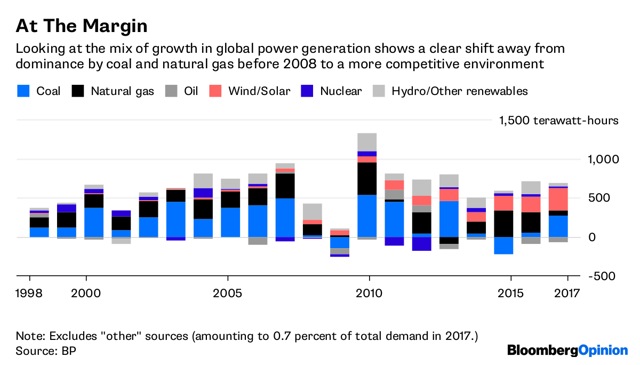
China and India account for about 60 percent of the growth in electricity generation over that period. Take them out of the equation, and the picture for the rest of the world shifts in important ways:
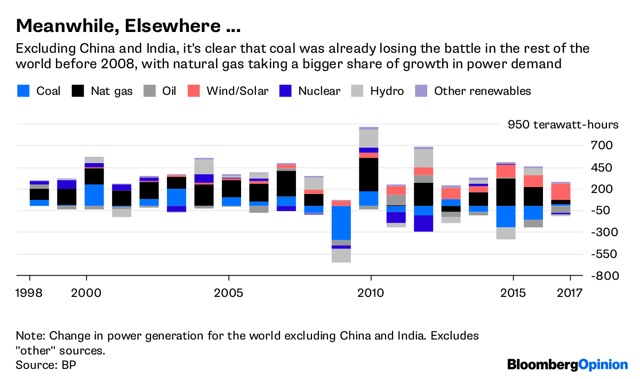
What’s clear is that, in terms of claiming the incremental terawatt-hour, coal was already in a knife-fight with natural gas in the decade leading up to 2008 in the rest of the world. After that, it went into structural decline as wind and solar power started to pile on, too.
Conversely, China and India have played an outsize role in providing whatever support thermal coal has had in this period. The two charts below show a simplified breakdown in the growth of power generation by fuel or technology over different time periods for the two countries:
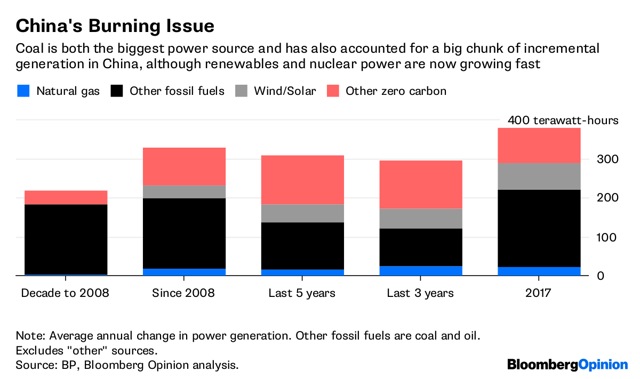
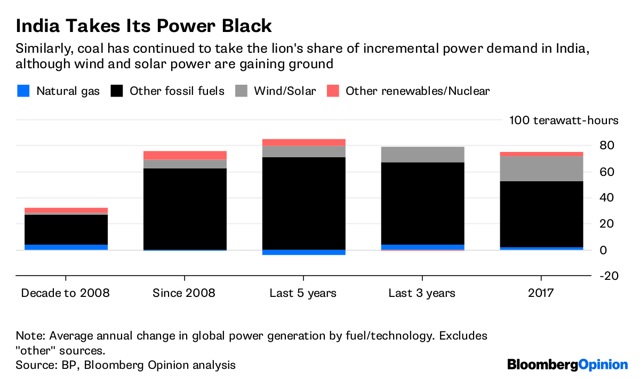
Besides the general continued strength of coal in both markets, the other striking aspect there is the weak position of natural gas. More expensive there than in much of the rest of the world, gas struggles to compete as a generation fuel versus cheap domestic coal and, increasingly, competitive renewable sources.
What’s also clear is the sheer difference in size: China’s growth in power demand was five times that of India’s last year. Put both countries in the context of the wider world and it becomes clear that, as with so much else, China is the central actor in this drama:
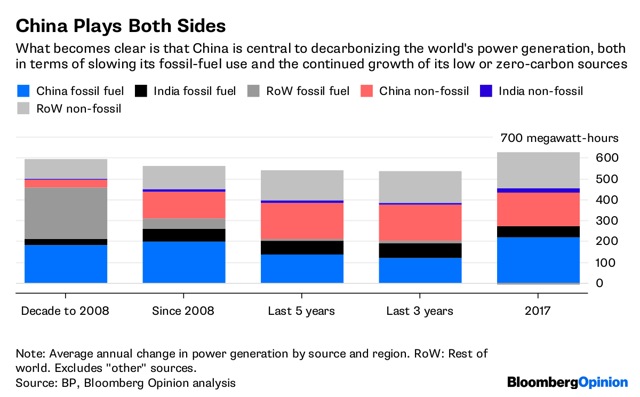
On that front, while China’s coal-burn leaped up last year, this was partly due to short-term pricing effects and unusually weak hydropower generation. The broader trend has been for coal to take less and less of incremental power demand, especially compared to the supercycle period before 2008, as those three and five-year averages show.
More importantly, policy objectives to reduce smog and overcapacity plus falling prices for renewable sources have led to hundreds of gigawatts of proposed coal-fired capacity to be cancelled or delayed over the past five years. That doesn’t undermine coal’s prospects completely; China may yet commission another 120 gigawatts of capacity over the next three years, according to Bloomberg New Energy Finance.
Nevertheless, slowing the creation of coal-burning capacity should mean that the balance of power continues to shift broadly away from the most carbon-intensive sources of power toward renewables in China (and India has good reasons to emulate this.) Already in retreat elsewhere, coal is beginning to taste defeat at the margin in these two key battlegrounds. Bloomberg Opinion
This column does not necessarily reflect the opinion of the editorial board or Bloomberg LP and its owners.


