
 E-Paper



Is your credit card worth what it costs?
Credit cards offer convenience, but high interest rates and the temptation to pay only the minimum dues can turn them into expensive and long-term debt

 Prefer HTon Google


The count of active credit cards has grown fivefold over the last 10 years to 107 million, according to a white paper published by TransUnion CIBIL in June 2026. The report further concludes that, over the last decade, the average credit card balance per consumer increased from ₹31,000 to ₹65,000. Alongside that, the share of customers holding three or more cards increased from 12% to 22%. RBI data also shows that aggregate credit card outstanding increased from ₹2.7 lakh crore to ₹3 lakh crore in the two years leading up to August 2026.
While credit cards may not represent the highest debt in a consumer’s wallet, they may be the most expensive: the annual percentage rate (APR), or annual interest charge, can range from 36% to 45%. A standard credit card offers an interest-free credit period of up to 50 days. However, if you don’t clear all your dues by the payment due date, new purchases also lose the interest-free credit period.
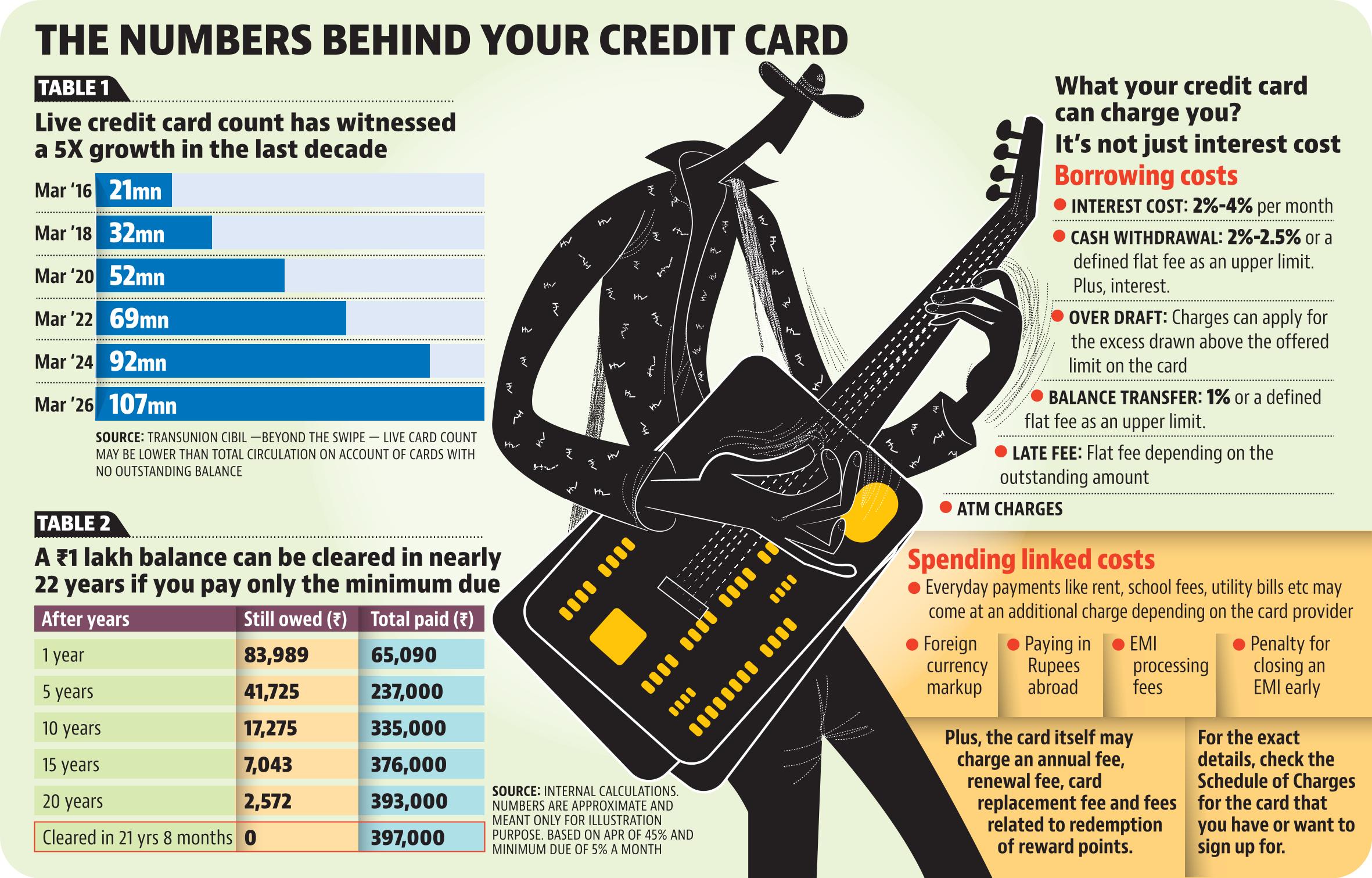
Consider this: let’s assume you have an outstanding balance of ₹1 lakh on your credit card, which charges 45% annual interest or 3.75% monthly interest. You are able to pay only the minimum amount due, which is 5% of your balance plus interest. If you include the 18% GST on interest, your first minimum payment likely has just one rupee in every four going towards reducing your debt principal. After 10 years of paying only the minimum amount due every month, without adding any new credit to this balance, you are likely to have repaid roughly ₹3.35 lakh and still owe a principal of about ₹17,000.
Now compare the rewards points you earn and redeem, free airport lounge access, airline miles, free hotel stays, dining vouchers and insurance cover you get with the cost of not paying your dues in full. For some, without the right discipline, using a credit card may become less about access and more about affordability, or the lack thereof.
Here’s how to make sure your card works for you and not against you.
Limit your monthly utilisation
Keeping your monthly spending within 30% of your assigned limit helps keep your spending in check and also helps your credit score. Lenders view high utilisation as a sign of financial stress, which can weigh negatively on your credit score.
Plus, credit card limits may be much higher than your monthly income. Don’t let the limit define how much you should spend. If you do end up spending more than 30% of your card limit regularly, you can be proactive and repay some portion mid-cycle to reduce your utilisation.
Always repay by the due date
Once you miss the due date, late charges will apply and can be as high as ₹1,200 on some cards, depending on the amount due. Not only is the monthly interest rate high, but you will also have to pay 18% GST on the late charges and interest. These are additional costs you incur if you don’t pay on time. Plus, paying only the minimum amount due can lead to a very long repayment cycle spanning decades. Hence, if the total amount due is too large, try to pay a higher fixed amount every month than the minimum amount due to clear the debt faster.
According to Ritesh Srivastava, CEO and founder of FREED, a debt resolution and loan management platform, “The minimum payment trap is one the biggest pitfalls of credit card borrowing. consumers should aim to repay as much of their outstanding balance as possible. to put this in perspective, on a credit card outstanding of ₹1 lakh at an APR of 45%, even if you repay 7% of the outstanding balance every month, it would take approximately 10.7 years to clear the entire amount.”
Paying a fixed ₹10,000 every month can resolve your debt in 14 months, as a higher principal is deducted with each payment.
Calculate the reward benefit
Rewards are shrinking, but credit card interest still runs as high as 45% a year. The last few years have seen a frenzy to own credit cards to make the most of reward points, but not everyone is able to successfully chase that goal. Credit card rewards come in many forms. They may offer cashback, general reward points, travel miles or vouchers. Check not only the multiplier on reward points and cashback, but also the conversion rate of reward points. For example, you may get 5x rewards for every spend, but if the conversion of those points is less than 1:1, the benefit you derive from them will be limited. Many leading banks that issue credit cards have now actively devalued their rewards programmes or added conditions that make rewards, lounge access or cashback harder for customers to obtain.
For example, Axis Bank recently devalued its credit card rewards by removing or restructuring reward links with key hotel and airline partners.
The rewards and benefits were never in your control, despite owning the card. Don’t get carried away by the promise of free benefits; always check the details before signing up for a new card.
“Overspending to qualify for or earn reward points or free benefits through a credit card is not uncommon. But spending ₹10,000 extra to earn ₹200 in cashback is, in reality, a loss of ₹9,800 – because you never needed to spend in the first place. Benefits such as ‘spend ₹X more to unlock a voucher’ are the classic version. Rewards should be the by-product of spending you were going to do anyway, never the reason to spend,” says Arijit Sen, a Kolkata-based SEBI-registered RIA.
For unsurmountable debt, seek active resolution
Despite everything, if you still find yourself stuck in a credit card debt spiral, it’s wise to seek help and work actively towards reducing this debt. You can begin by using surplus funds lying in your bank account to close the gap on your credit card outstanding. Always remember that, at 3.75%-4% monthly interest, it’s probably the most expensive debt you carry. If you are unable to repay it fully, you can look for a loan against your fixed deposits or gold, or even take a personal loan to repay the outstanding on your card. These are also loans and will come at a cost, but one that is much lower than your credit card interest cost.
Ultimately, the bigger impediment is not the interest cost or the other charges; it’s really about mending behaviour. Credit cards are designed to offer you liquidity with an interest-free credit period of approximately 20-50 days. They allow you to spend your future earnings today without any additional cost, provided you exercise control and discipline. Without these, the cost may be too high to bear.
“Personal loans are increasingly becoming the preferred choice for first time access to credit, credit cards credit cards continue to be widely used. credit card defaults account for approximately 30% of the stressed loans enrolled on FREED’s platform,” says Srivastava.
Unlike a personal loan or a loan against an asset or security, a credit card allows you to utilise additional liquidity at no cost, albeit for a limited period. Once the card is in your hands, the control is up to you. Swipe only what you can pay today from your bank balance, and pay the full bill every month.“I’d add two guardrails: keep utilisation under about 30% of the limit, and set auto-pay for the total due, not the minimum,” says Sen.


