E-Paper



Tech is expensive, but is there light at the end of the tunnel?
Two trajectories will define your next tech purchase—either the prices will be much higher, or you’ll get much less in terms of specs and performance

 Prefer HTon Google


Consumers who have never paid ₹1,999 per month for a ChatGPT Plus or ₹2,399 for a Claude Pro subscription for the privilege of an artificial intelligence (AI) chatbot are paying for the AI boom anyway. In late 2026, the prices of technology, including smartphones, laptops, televisions and home appliances, are at their highest point in the past few years. This is a clear scenario where consumers are paying because of AI, even without actually paying for an AI chatbot. Analysts tell HT that a bleak scenario is expected through 2027 as well.
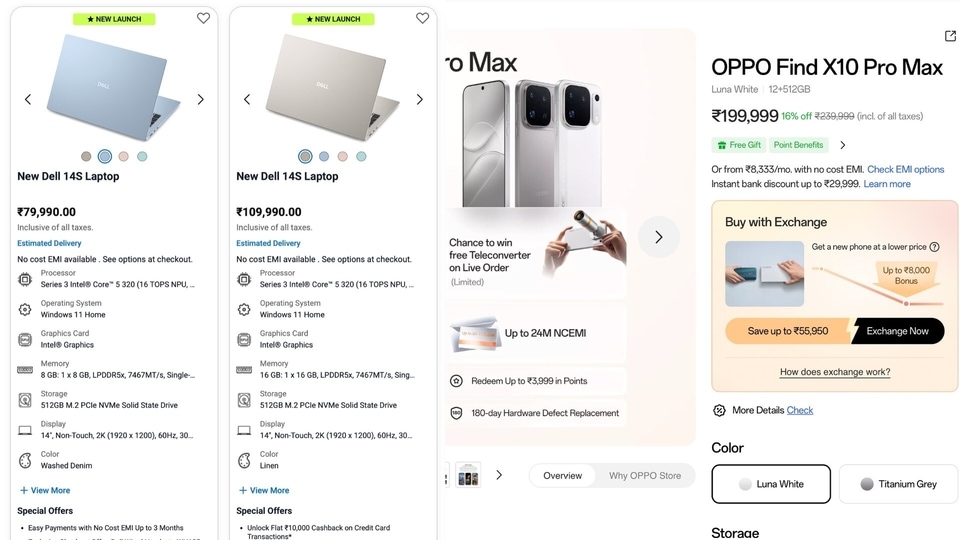
Former Apple CEO Tim Cook had already warned that skyrocketing memory and storage prices, driven by heavy AI infrastructure backorders, have created an unsustainable scenario, akin to a “100-year flood,” as he calls it. Apple became the last phone maker to pull the trigger on price hikes a couple of months ago. To illustrate the landscape, here are some prices of key recent launches. An Oppo Find X10 Pro Max flagship costs ₹1,99,999 (while there was no 'Pro Max' last year, the Oppo Find X9 Pro flagship launched at ₹1,09,000). A Dell 14S mid-range laptop with an Intel Series 3 Core 5 320 chip and 8GB memory costs ₹79,999 (a couple of years ago, similar specs would be under ₹50,000). That's an illustration of the inflation.
“Consumers are increasingly paying an indirect AI tax. They may not be purchasing AI services or paying for AI subscriptions, but the massive investment in AI infrastructure is creating a supply-demand imbalance in memory semiconductors, pushing up the cost of everyday electronic devices,” Tarun Pathak, Counterpoint's Research Director, tells HT.
Last week, chipmaker Qualcomm reported fiscal Q4 handset revenue of $5.14 billion, down 26% year-on-year, and adjusted revenue fell 7% to $10.44 billion. The next-quarter revenue ranges between $10.4 billion and $11.2 billion. Rising memory and storage costs are pushing phone makers to raise prices, which reduces demand, and the effect has now reached Android’s biggest chip supplier.
Qualcomm, Android’s biggest chip supplier, is also raising its smartphone and computing chip prices to offset higher input costs, so buyers may see further pressure on phone prices, especially in price-sensitive markets. Its pivot now rests on a reiterated $5 billion data centre revenue target for fiscal 2027, as Qualcomm’s Chief Financial Officer and Chief Operating Officer Akash Palkhiwala made it clear during the earnings call that “we're thinking flat to slightly down for the handset market” in 2027.
This week, Smart Analytics Global (SAG) indicated in their latest Smartphone 360 data that global smartphone shipments declined 19.9% YoY to 257.6 million units in Q3 2026, and they expect the downturn to deepen to negative 24.4% in Q4 26. Things will not improve in the first quarter of 2027. India marked one of the highest smartphone shipment decline rates, down 23.4% YoY to 35.9M units in Q3.
“In the broader consumer electronics industry, we believe smartphones will be the most impacted by the increase in memory prices, driven by their large total addressable market and relatively higher RAM and NAND requirements. The PC and tablet industry is likely to be the second most impacted segment for similar reasons. The third most impacted segment is likely to be consumer IoT, including products such as smartwatches and televisions,” Abhilash Kumar, Lead Research Advisor (Director), at SAG, tells HT.
It is no different for the PC space. With the consumer PC market shrinking—research firm IDC pegs this to a global decline of 20.1% in Q3 26 year-on-year—chipmaker Intel says they are reallocating some of the chipmaking capacity from client to data centre chips. “The industry continues to navigate one of the most significant supply shortages in history, driven by the unprecedented demand for Super Intelligence," said Lip-Bu Tan, chief executive of Intel, during the company's latest earnings call.
Is the consumer industry proving secondary to memory, storage and chip foundries? Unfortunately, that is the reality.
“Given the higher commercial attractiveness of AI-related demand, memory manufacturers prioritised these customers, leading to an increase in memory prices for the consumer electronics segment. This eventually translated into higher component costs for smartphone, PC, and other electronics manufacturers,” says SAG’s Kumar. “AI data centre operators approached global memory manufacturers such as Micron, SK Hynix, and Samsung. The demand was strong, and the commercial terms offered are lucrative. Memory manufacturers started prioritising AI data centres over consumer electronics products. This created a supply-demand mismatch, with demand from both segments continuing to grow against limited supply.”
The affordability versus longevity paradigm
In India, a big worry is that a ₹15,000 smartphone now costs considerably more, or that the specifications previously available at ₹15,000 are no longer achievable. The specifications and performance gains that budget and mid-range Android phones had seen in recent years are being wiped out.
“The bigger concern is the loss of value for money in the mass-market segment. To contain price increases, brands are compromising on specifications, with a shift from OLED to LCD displays, lower RAM configurations, a comeback of 32GB and 64GB storage variants, and greater adoption of cost-effective Unisoc chipsets. Rising prices are also encouraging consumers to delay upgrades or opt for refurbished smartphones. Ultimately, consumers are paying more but often getting fewer specifications than they could a year ago,” says Counterpoint’s Pathak.
He explains that in 2025, the sub- ₹15,000 segment accounted for around 45% of the Indian smartphone market, but its share is projected to fall below 25% in 2026, while the ₹15,000–30,000 segment is now emerging as the balancing act, expected to capture nearly half the market. Recent launches including the Boltt Ace 5G, the Lava Virat V1 5G and the OnePlus N6 Lite, point to the Unisoc chip trend that Pathak references. All these phones are around the ₹15,000 price point, and in our experience, deliver significantly compromised performance.
It is not just affordable phones that are facing a different scenario. Pathak points out that in India, the smartphone average selling price or ASP, is expected to reach around $370 by the time 2026 draws to a close, which would mark an increase of 16% YoY. In 2027, that will cross $400, a reflection of the sustained increase in device prices. SAG also expects double-digit smartphone ASP growth through 2027.
Consumers are facing a two-sided cost pincer. While AI data centres have starved the consumer electronics supply chain and inflated the bill of material (BOM) significantly—the impact felt most on products such as affordable laptops which now have to make do with lesser 8GB memory instead of a push towards 16GB for instance—smartphone and PC makers are attempting to justify the higher price tags by aggressively marketing AI functionality. For that to work, tech companies must match a baseline in terms of memory, storage and the neural processing unit (NPU) chips. All that ironically drives up the cost for the customer.
Is that light at the end of the tunnel? No.
Chances of it being an approaching train seem much higher at this point. Two trajectories will define your next tech purchase—either prices will be much higher than you expect, or the price will be somewhat rationalised but you’ll get much less in terms of specs and performance.
Counterpoint’s Pathak believes that while a return to pre-AI boom memory prices looks unlikely in the near term even though semiconductor manufacturers are expanding capacity, continued AI infrastructure demand will keep memory prices elevated through 2027. “We could see some moderation in NAND prices during the second half of 2027 as additional supply becomes available. However, DRAM, particularly memory used in AI infrastructure and mobile devices, is likely to remain under pressure for longer,” he says.
SAG’s Kumar points to a new dynamic at play. He believes a potential source of relief could be the emergence of additional memory suppliers, particularly Chinese memory manufacturers such as CXMT. “If these players are able to significantly scale up their production from their levels in early 2026, they could offer the industry a credible alternative to the existing three major memory vendors,” he says. While that would certainly help improve overall memory supply and potentially provide consumer electronics manufacturers with some relief, SAG does insist that it is highly unlikely memory prices will return to their original levels.
“This is true for several other industries as well, where price increases are rarely reversed, particularly when prices have surged as much as more than three times their initial levels. Therefore, what we can realistically expect is for memory prices to stabilise rather than return to the levels seen in late 2025,” he says.
The hope now is that 2028 will offer an escape route from this dark tunnel. Even then, consumer tech pricing has always exhibited downward rigidity. Once consumers become used to ₹1,50,000 flagship phones and ₹50,000 laptops as usable entry-level price points, any deflation in component pricing will become a thicker margin for brands. That will give them some flexibility to launch ‘discount offers’ from time to time. Yep, that light at the end of the tunnel may actually be an improvement in specs at these prices, rather than your expenses reducing.