
 E-Paper



BJP puts personal loss at heart of Punjab anti-drug campaign
Ahead of the 2027 assembly polls, the BJP’s 4,000-km Nasha Mukt Punjab Yatra turns local grief into a political referendum on the AAP government.

 Prefer HTon Google


Chandigarh: A passport-size photo of a dead son. A mother who has lost three children. Another who says she has lost six. A former soldier who fought wars on the border but could not save his own son from narcotics.
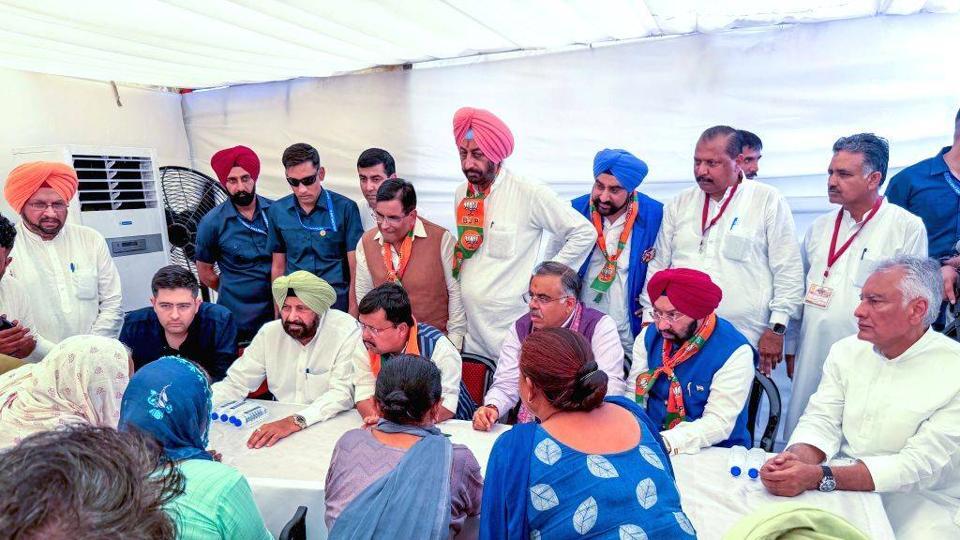
These are the faces the BJP is putting at the centre of its largest statewide political push in Punjab ahead of the 2027 assembly elections.
The party’s four-pronged Nasha Mukt Punjab Yatra is ostensibly a campaign against substance abuse, but the political messaging is unambiguous: The BJP is seeking to make the drug crisis a referendum on the performance of the Aam Aadmi Party (AAP) government while positioning itself as the sole force capable of tackling the problem.
Covering nearly 4,000-km across all 117 assembly constituencies through four simultaneous yatras, the campaign began on September 18 and will culminate in Jalandhar on September 30, where Union home minister Amit Shah is scheduled to address a rally. With the drug crisis remaining a deeply emotive issue across the state, the timing of the yatras—coming less than six months before the 2027 polls—places the issue firmly at the centre of Punjab’s political conversation.
Personal tragedy as political strategy
According to internal BJP records, party leaders have interacted with about 1,100 families who have lost members to drugs, aiming to reach 2,000 families before the campaign ends.
The outreach follows a strictly calibrated protocol: Whenever a central leader joins the yatra, affected families are brought into a special enclosure behind the main stage. Their testimonies are recorded by the BJP’s central office team and subsequently integrated into campaign speeches and video clips to highlight local severity.
Rather than relying purely on statistics regarding seizures, arrests, and supply lines, the party is focusing mothers, widows, and siblings on stage—allowing survivors to articulate the impact of addiction through personal loss.
In Bathinda, a 61-year-old woman recounted to Union agriculture minister Shivraj Singh Chouhan how she lost her three sons—aged 18, 21, and 27—to chitta (heroin). In Ludhiana’s Jagraon, Shindo Bai, who lost six sons to drugs, broke down during the BJP’s Mawan Mangdian Jawab (Mothers Demand Answers) outreach programme.
“Chitta is available in the streets like sugar,” Shindo Bai said. “It started with my eldest son. No one was saved. Within 13 years, they were all gone. Chitta consumed everything. Poor households have been hit the hardest,” she said.
In Mohali, a widow carrying a passport-sized photograph of her 21-year-old son met Delhi leader Aashish Sood along with other affected families. “My only son was my only hope in life,” she said, recounting how he was found dead near Phase 10 just months after becoming addicted. She alleged that despite repeated requests for an investigation, local police discouraged her from linking his death to drugs.
Slogans vs ground reality
Punjab BJP general secretary Rajesh Bagha, who oversees the campaign, confirmed that over 800 drug-affected families were contacted in the initial leg alone.
“Our aim is to reach 2,000 families. The BJP’s outreach is not merely for political gain; it is a serious effort to expose the true scale of the problem on the ground,” Bagha said.
To amplify these accounts online, the party commissioned an AI-generated theme song centered on maternal grief:
“Kime dussan behne main Punjab di kahani, dussan je laggi eh dassi nahi jaani. Mere bhatke puttan nu tussin naiyon taleya, chitte chandre ne putt mera khaa leya, jo chitte dudh naal paleya. (How do I tell the story of Punjab, my sister? If I start, it cannot be told. You did not stop my sons from going astray; evil chitta has consumed the child I raised on milk.)”
For 62-year-old Gurmail Singh, a military veteran from Gurdaspur, the electoral contest is secondary to his personal loss. He met BJP national president Nitin Nabin before the first yatra flagged off from Madhopur in Pathankot. He recounted informing the police about local drug peddlers, only to be told that no action could be taken without video evidence of a transaction.
“I fought wars on the borders, but I lost on the home front,” said the veteran, whose 28-year-old son died of an overdose in 2023. “This isn’t just chitta—it is more dangerous than Osama bin Laden. Punjab did not suffer as much damage during terrorism as chitta has caused.”
He said that families had asked Nabin for a concrete, long-term policy rather than temporary promises: “Otherwise, nobody will be left to guard Punjab’s borders.”
At the campaign’s launch in Chandigarh, a 23-year-old woman from Muktsar who lost her brother echoed the demand for systemic reform over political posturing. “There are hundreds of elderly parents who have lost their sons to chitta and have no one left to care for them,” she said, adding: “We want real accountability from the government. Mere slogans against drugs are just another cruel joke.”
As the BJP seeks to expand its footprint in Punjab ahead of 2027, the drug crisis offers the national party a direct connection to an intensely local grievance. Responding to criticism that the yatra is purely an electoral move, state BJP chief Kewal Singh Dhillon maintains that the effort extends beyond party politics: “This is a social movement. Our goal is to build a mass movement across Punjab to eradicate drugs entirely.”


