
 E-Paper



Free power takes steam out of solar energy push in Punjab
Punjab lags behind several neighbouring states, according to data tabled by the Union ministry of new and renewable energy in the Lok Sabha on Wednesday

 Prefer HTon Google


Punjab has been slow to embrace the green energy wave, with only 17,496 of the over 73 lakh domestic consumers in the state opting for Centre’s flagship PM Surya Ghar: Muft Bijli Yojana since the scheme’s launch in February 2024.
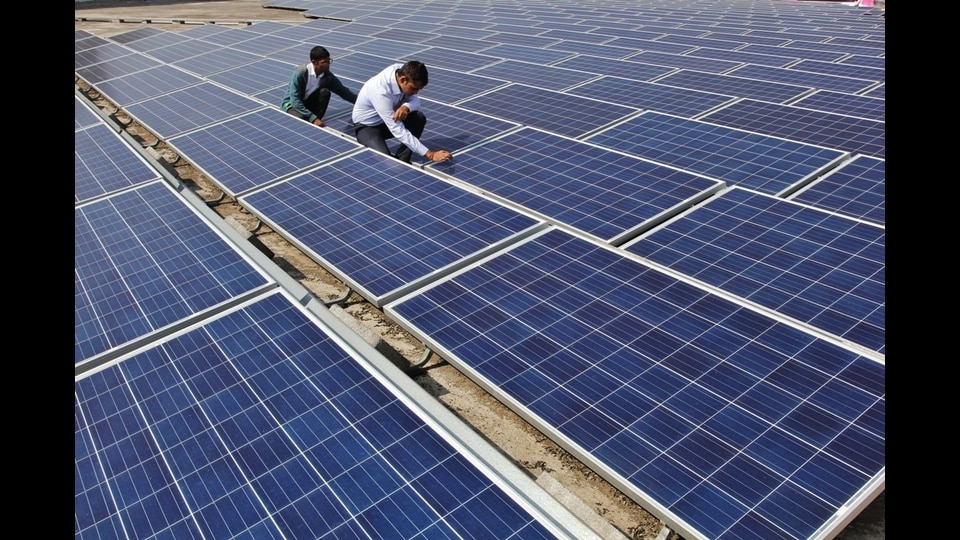
The state lags behind several neighbouring states, according to data tabled by the Union ministry of new and renewable energy in the Lok Sabha on Wednesday.
Officials of the Punjab State Power Corporation Limited (PSPCL) attribute the slow adoption largely to the state’s policy of providing 300 units of free electricity to domestic consumers, saying the subsidy has diminished the financial incentive for households to invest in rooftop solar systems.
The ministry informed the Parliament that Punjab received 26,904 applications under the scheme, resulting in installations with a cumulative capacity of 78.18 MW.
The Centre has released ₹112.62 crore as Central Financial Assistance (CFA) to beneficiaries in the state.
The figures place Punjab well behind states that have witnessed an expansion of residential solar power.
Gujarat leads the country with 7.73 lakh installations, followed by Uttar Pradesh (7.15 lakh) and Maharashtra (7.02 lakh). Kerala (3.10 lakh) and Rajasthan (2.77 lakh) have also registered substantially higher adoption despite having smaller populations or lower per capita electricity consumption than Punjab.
Punjab also trails several neighbouring states in rooftop solar adoption, although the gap varies significantly.
Haryana has emerged as a front-runner with 1.17 lakh rooftop installations—nearly seven times Punjab’s total—along with an installed capacity of 384.96 MW and central subsidies exceeding ₹741 crore.
Uttarakhand has also recorded a robust response, crossing 97,000 installations. While Himachal Pradesh has installed 11,992 rooftop solar systems—fewer than Punjab—it has achieved this despite a much smaller population and difficult hilly terrain, highlighting a relatively stronger per capita adoption.
Nationally, as of July 31, 2026, 76.81 lakh applications have been received under the scheme, leading to the installation of 41.19 lakh rooftop solar systems benefiting 49.62 lakh households. The Centre has disbursed nearly ₹27,856 crore in subsidies
Inderjit Singh, chief engineer (Thermal Design), PSPCL, said Punjab’s relatively slow adoption of rooftop solar was largely due to the state’s 300 units of free electricity scheme.
“Most domestic consumers pay little or no electricity bill, reducing the benefit of installing a rooftop solar system,” he said.
Singh added that PSPCL, along with the Punjab Energy Development Agency (PEDA), was stepping up awareness campaigns and holding regular meetings with empanelled vendors to accelerate the scheme’s implementation.
Scheme in place since Feb 2024
The PM Surya Ghar: Muft Bijli Yojana was launched in February 2024 to promote residential rooftop solar systems by offering upfront subsidies to households.
Any residential consumer with a grid-connected electricity connection can apply through the national portal “https://pmsuryaghar.gov.in/” using their electricity connection number, with subsidy disbursed directly to their bank account.
The initiative empowers households to generate their own electricity, reduce monthly power bills while contributing to a cleaner environment.
Under the scheme, a subsidy of ₹30,000 is provided for the installation of up to a 2 kW rooftop solar plant, ₹18,000 per kW for an additional capacity up to 3 kW and ₹78,000 for systems larger than 3 kW.
A 2-3 kW plant is suitable for a household consuming 150 to 300 units a month and an above 3kW plant for over 300 units.
In Punjab, the programme is being implemented by PEDA in coordination with PSPCL, though the state government does not provide an additional state-specific top-up subsidy.
While PEDA functions as the state’s nodal renewable energy agency, PSPCL is responsible for processing applications, granting technical feasibility approvals, facilitating net metering, inspecting installations and commissioning rooftop solar systems.


