
 E-Paper



Patiala’s Punjabi University gives in, announces complete rollback of fee hike
The university administration said it decided to withdraw the increase in tuition/course fees, registration fees and hostel fees, and retain the fee structure from the previous academic session.

 Prefer HTon Google


Yielding to students’ weeks-long agitation, Punjabi University on Sunday announced a complete rollback of the fee hike for the 2026-27 academic session following a meeting with the protesting students.
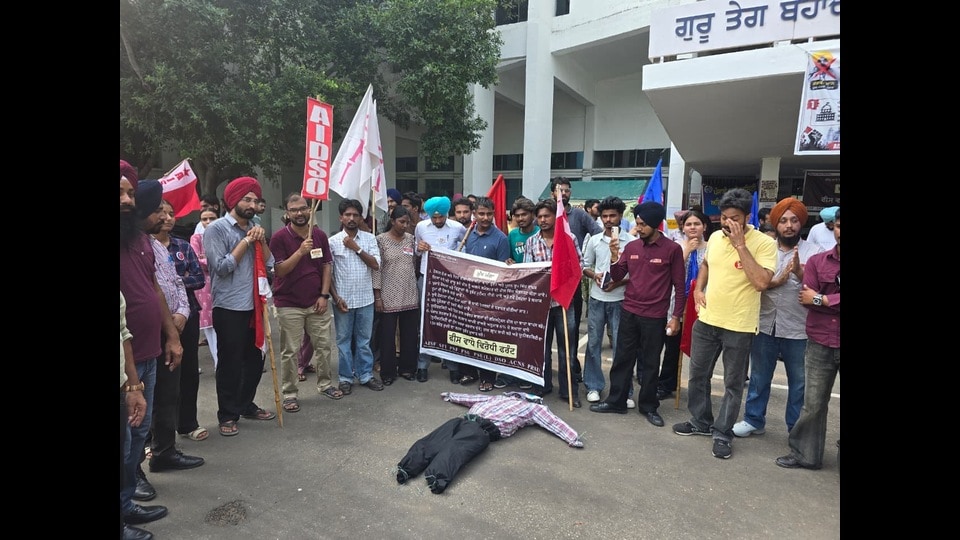
The university administration said it decided to withdraw the increase in tuition/course fees, registration fees and hostel fees, and retain the fee structure from the previous academic session.
Punjabi University vice-chancellor Jagdeep Singh said keeping in view the university’s long-standing commitment to providing accessible and affordable higher education, the administration decided to completely roll back the proposed fee increase.
“Student welfare and academic interests are the university’s highest priorities. Although the university is currently facing serious financial challenges, it remains committed to ensuring that no eligible student is deprived of quality higher education due to financial hardship,” said Singh.
Welcoming the decision, Gurdas, one of the student leaders spearheading the agitation, said, “This is a victory for students. Our fight was for affordable education and it will continue.”
He maintained that the students will not call off their agitation until the university issued an official notification regarding the rollback.
First increase in 5 years
Students had been protesting for 19 days since the university announced a major revision of its fee structure on August 12.
The increase, the first in five years, averaged at nearly 17%, although the increase varied sharply across courses and fee heads. Students alleged that tuition fees in some courses had increased by as much as 657%, while hostel fees had gone up by around 30% to 42%.
Officials said the fee structure had remained largely unchanged for five years despite rising operational and other costs. Opposed to the hike, a cohort of student organisations came together under the banner of the Fee Hike Opposition Front and launched an indefinite stir outside the Vice-Chancellor’s office.
Students had also raised concerns over the university’s financial condition, poor hostel facilities, shortage of hostel accommodation and delays in the payment of salaries to teaching staff. They demanded that the Punjab government waive the university’s outstanding loan of around ₹150 crore, on which the university was reportedly paying nearly ₹14 crore annually in interest.
After eight days of sustained protest, the university administration had announced a partial rollback on August 18. This, however, failed to satisfy the protesters, who insisted that the entire hike be withdrawn.
Punjabi University, a fully state-run institution, caters to over 14,000 students across undergraduate, postgraduate and doctoral programmes.
The university offers courses across a wide range of disciplines, including humanities, social sciences, sciences, commerce, management, computer science, engineering, law, education, physical education, performing arts, fine arts, languages, and journalism and mass communication.
University gets new registrar
Punjabi University on Sunday appointed Ajita Singh, a professor from the department of sports science, as its new registrar. Singh is currently holding the charge of the IAS Training Institute at the varsity. She has previously also served as the university director of sports.
She will assume the new charge on September 1, replacing Davinder Pal Singh, whose tenure ends on August 31.


