
 E-Paper



Delhi HC rejects Umar Khalid’s bail plea, says allegations ‘prima facie true’
Denying Khalid’s bail application, the HC said that the planned protest was “not a typical protest” which is normal in political culture or democracy but was “one far more destructive and injurious geared towards extremely grave consequences”.


New Delhi The Delhi high court on Tuesday rejected the bail plea of former Jawaharlal Nehru University (JNU) student Umar Khalid in a case related to the alleged conspiracy behind the February 2020 riots in the Capital, saying that the allegations against him were “prima facie true”.
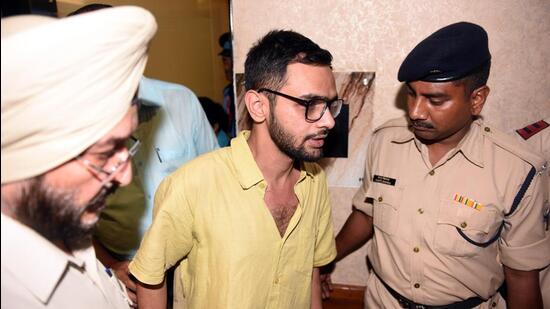
Khalid was arrested on September 13, 2020 by the Delhi Police special cell and is currently lodged in judicial custody. On March 24, a trial court had denied him bail, following which he approached the high court in April for relief.
Denying his bail application, a bench of justices Siddharth Mridul and Rajnish Bhatnagar said that the planned protest was “not a typical protest” which is normal in political culture or democracy but was “one far more destructive and injurious geared towards extremely grave consequences”.
“These protests & riots prima-facie ‘seem to be orchestrated’ at the conspiratorial meetings held from December, 2019 till February, 2020,” the court said.
“…on the in depth and considered perusal of the charge sheet, the accompanying documents and in view of the discussions herein above, only for the limited purpose of the present bail; this court expresses the inescapable conclusion that allegations against the appellant (Khalid) are ‘prima facie true’ and hence, the embargo created by Section 43D (5) of UAPA applies squarely with regard to the consideration of grant of bail to the appellant. Thus, the appellant’s application seeking regular bail is rejected,” the court said in a 52-page judgment.
The court said that “acts which threaten the unity and integrity of India and cause friction in communal harmony and creates terror in any section of the people, by disturbing the social-fabric is also a priori a terrorist act”.
The bench said that Khalid’s name found “recurring mention from the beginning of the conspiracy till the culmination of the ensuing riots”, adding that he was in constant touch with the co-accused, including Sharjeel Imam, who arguably is at the “head of the conspiracy”.
It noted that there exists a string of commonality which runs amongst all the co-accused, while also asserting that both Khalid and Imam were members of the same WhatsApp group. It said Khalid participated in various “conspiratorial meetings” at Jantar Mantar, Jangpura, Shaheen Bagh, Seelampur, Jaffrabad and Indian Social Institute on various dates prior to the riots.
“It is also an admitted position that the duo (Khalid and Imam) participated in the Jantar Mantar protest. There are statements of various protected witnesses that speak to the presence of the duo at several meetings including in the one held at the office of PFI,” the court said.
The court noted that as per the “pre-meditated plan”, there was an intentional blocking of roads to cause inconvenience and disruption of essential services to the residents of north-east Delhi, thereby creating panic and an alarming sense of insecurity.
The court said that if the charge sheet and the material collated during investigation are taken on face value, there appears to be a “premeditated conspiracy for causing disruptive chakka-jam and pre-planned protests at different planned sites in Delhi, which was engineered to escalate to confrontational chakka-jam and incitement to violence and culminate in riots in natural course on specific dates”.
“The attack on police personnel by women protesters in front only followed by other ordinary people and engulfing the area into a riot is the epitome of such pre-mediated plan and as such the same would prima facie be covered by the definition of ‘terrorist act’,” the court said in its judgment.
The court said that call detail records (CDR) and the CCTV footage analysis “depicts that there had been a flurry of calls that happened post riots amongst Khalid and other co-accused.
Referring to the alleged inflammatory speech delivered by Khalid at Amravati, Maharashtra on February 17, 2020 during a protest against the Citizenship Amendment Act (CAA) and National Citizens Register (NRC), the bench said that it cannot turn a blind eye to other incriminating materials against Khalid in the case.
“The fact that there is no denial that on February 17, 2020, Khalid delivered a speech at Amrawati, Maharashtra referring to the visit of Donald Trump, President of the United States of America, which according to the prosecution heralded the riots of North-East Delhi. The manner in which the administration initially rejected permission for Khalid’s speech and thereafter how the speech came to be delivered clandestinely on that very day is something which gives credibility to the accusation of the prosecution,” the court said.
During the bail arguments, the court had questioned Khalid on the use of the “inquilabli salam” (revolutionary salute) and “krantikari istiqbal” (revolutionary welcome) at the beginning of his speech, which he had used as a greeting to invite the spirit of revolution.
Khalid’s counsel Trideep Pais contended that revolution can also be non-violent, adding that there was no immediate violence after his speech.
However rejecting this argument, the court said that the call to revolution does not have to affect only the immediate gathering, adding that the call of revolution may affect many beyond those who were visibly present.
Mentioning Maximilien Robespierre, who was at the vanguard of the French revolution, and former Prime Minister Jawaharlal Nehru, the court observed that revolution by itself isn’t always bloodless and that is why the prefix “bloodless” is used with the term “bloodless revolution”.
“This court is of the view that possibly, if Khalid had referred to Maximilien Robespierre for what he meant by revolution, he must have also known what revolution meant for our freedom fighter and first prime minister. The very fact that Pandit Jawaharlal Nehru believed that democracy has made revolution superfluous after independence and how it meant the complete opposite of a bloodless change,” the court said.
Further explaining “revolution”, the court said that “Revolution itself isn’t always bloodless, which is why it is contradistinctly used with the prefix - a ‘bloodless’ revolution”.
“So, when we use the expression “revolution”, it is not necessarily bloodless. This court is reminded that although the activity of “revolution” in its essential quality may not be different but from the point of view of Robespierre and Pandit Nehru, in its potentiality and in its effect upon public tranquility there can be a vast difference,” the court said.
Khalid, Imam, and several others have been booked under provisions of the anti-terror law Unlawful Activities (Prevention) Act or UAPA and of the Indian Penal Code for allegedly being the “masterminds” of the February 2020 riots, which had left 53 people dead and over 700 injured. The violence erupted during the protests against CAA and NRC.
Khalid has argued that neither he has a “criminal role” in the violence in north-east Delhi nor any “conspiratorial connect” with the other accused in the case.
Maintaining that there was nothing illegal in raising such issues, Pais argued that Khalid’s Amravati speech -- which forms the basis of the allegations against him -- not only had a categorical call for non-violence but also did not lead to violence anywhere.
“The only overt act attributed to me (by the prosecution) is the speech (in Amravati)... that was a public event. That did not lead to violence anywhere. To simplify and say ‘oh that speech in Amaravati was targeted towards Delhi’ (is not right). Donald Trump went to Ahmedabad also (and there was no violence there). We have the liberty to travel anywhere to India and make speeches if we want to,” Pais told the court.
Pais accused the prosecution of “making stuff up as it went along” and contended that parts of the Delhi Police charge sheet have no basis and the conspiracy alleged by the prosecution should be “towards violence in Delhi” and not “raising issues of injustice”.
However, opposing the bail plea, the Delhi Police had said that the speeches made by the accused had a common factor, essence of which was to create a sense of fear in the Muslim population of the country.
The prosecution specifically referred to the speeches made by Khalid, Imam and Khalid Saifi to argue that they were all connected with each other at the relevant time as a part of conspiracy to orchestrate the 2020 communal riots.
Stay updated with all top Cities including, Bengaluru, Delhi, Mumbai and more across India. Stay informed on the latest happenings in World News along with Delhi Election 2025 and Delhi Election Result 2025 Live, New Delhi Election Result Live, Kalkaji Election Result Live at Hindustan Times.


