
 E-Paper



Delhi’s green divide: As parks shrink for many, the rich stretch their legs
South and New Delhi have the most number of parks, each with 6% of district area dedicated. Northeast Delhi has just 1.2% park cover, according to a 2022 report

 Prefer HTon Google


At around 12.30pm, seven-year-old Abu Katada is getting ready for school. His father packs his bag while Abu describes a typical day: school, tuition, home, and sleep.
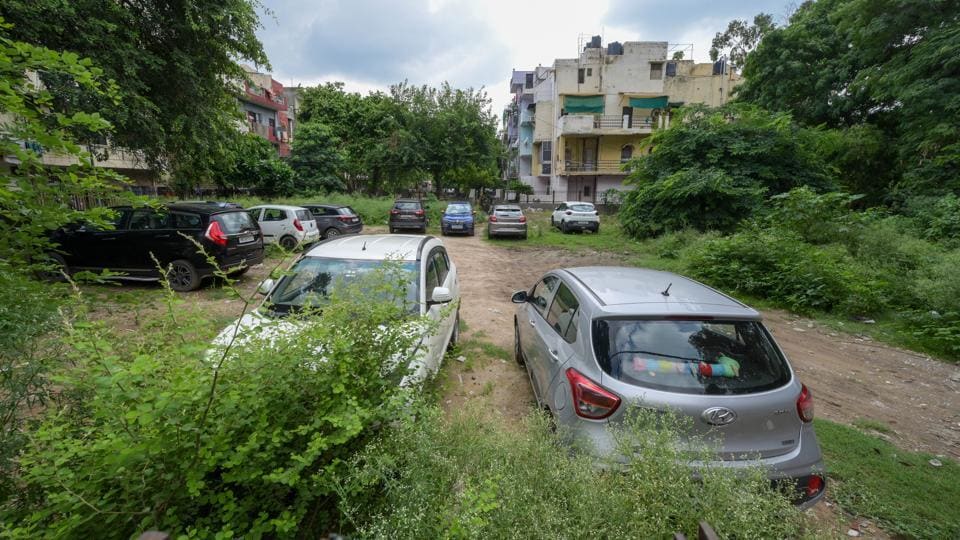
When asked when he plays, he simply shrugs. “If there’s no space, how will we play? The lanes are too small, and it’s dangerous,” he says. Parks don’t even feature in his world.
Abu lives in Ajit Nagar in Shahdara — one of the many neighbourhoods in Delhi where green spaces are either too far, poorly maintained, or simply don’t exist. From the packed tenements of northeast Delhi to the concrete sprawl of west Delhi, the city’s parks — once considered democratic breathing spaces — are becoming enclaves for the privileged.
Further south, in Jamia Nagar, the view is much the same. “It affects our health,” says 23-year-old Mohammad Faizal. “There are hardly any trees or green spots. Life just passes us by.”
This is a city that boasts Lodhi Garden and Sunder Nursery — historical parks where monuments jostle for space with verdant blooms and birdsong competes with camera shutters — and the wooded Sanjay Van, a forest in the middle of a metropolis. But for many, these are postcard spaces, not neighbourhood ones.
A 2022 report by the Centre for Youth Culture Law and Environment (CYCLE) maps the stark divide: parks are mostly concentrated in south Delhi, New Delhi, south-east Delhi, west Delhi, and east Delhi — with south and New Delhi having the most number of parks, each with 6% of district area under park cover.
In contrast, north-east Delhi — where Abu lives — has just 1.2% park cover. North and south-west Delhi fare marginally better with a park cover of 2.3%.
The absence of green cover isn’t just a cosmetic concern — it has tangible, life-altering consequences. A Greenpeace India audit of 50 parks in Delhi, which assessed surface temperatures in 40 of them, found that shaded green areas were on average 12°C cooler than exposed concrete surfaces. In some cases, the difference was as much as 18°C, with shaded zones recording a high of 35°C compared to 53.3°C in uncovered areas — underscoring the critical role of vegetation in regulating urban temperatures.
The HT team visited several neighbourhoods across these districts to document the parks people do have — and those they don’t. What emerges is a striking cityscape of inequality. In many parts, satellite images reveal nothing but a sea of grey: buildings pressed tightly together, with barely a patch of green in sight.
“In west Delhi, the clusters of Mundka, Prem Nagar, and Kirari cover about 19 square kilometres, housing nearly 900,000 people — but there are hardly any parks,” says environmental activist Diwan Singh.
Residents echo that sentiment. “This place is called Swaran Park, but there isn’t a single park here. People stay indoors — because there’s nowhere else to go,” says 72-year-old Ved Singh, who grew up in the area. “We call it “narkh (hell)” park now.”
The disparity is not just visual — it’s measurable. “Areas with the highest tree cover have lower population densities. Meanwhile, high-density settlements have almost no vegetation,” says Raj Bhagat, geoanalytics expert with the India Resources Trust. In one pocket of Mustafabad, he notes, the ratio was one tree to 400–500 people.
In east Delhi’s Laxmi Nagar, 35-year-old Kartikey Pathak lays it out plainly: “There’s one park nearby, but that’s not enough. There are hundreds of houses here. This area is not fit for children or elders. We are just surviving here.”
Ironically, east Delhi ranks third in overall park cover at 6.3%, but as with other “green” districts, the distribution is highly uneven.
South-east Delhi, which tops the city’s park coverage at 8.1%, offers another case in point. Most of its greenery lies in the northern part of the district — the institutional and wealthier zones. In Jamia Nagar, Shaheen Bagh, and Okhla, residents say parks are almost non-existent.
“The nearest one is two kilometres away,” says a shopkeeper from Jamia Nagar, who declined to be named. “Children can’t go alone. Older people are forced to take their strolls in the narrow, congested lanes — and even that’s dangerous because of traffic.”
The absence of greenery, residents say, affects far more than physical health, it also takes a mental toll.
“If we had parks nearby, people would be more motivated, happier,” says Pathak. “People need time amid greenery. That’s how you recharge.”
Even in neighbourhoods where parks do exist, upkeep is another issue.
“I have a big park outside my house — but I can’t use it,” says Paras Tyagi, founder of CYCLE. The 4.5-acre ground in front of his home in Budhela, Vikaspuri is dusty and bare. “It’s supposed to be maintained by the Municipal Corporation of Delhi, but it’s used only for weddings. After each function, there’s litter everywhere.”
In Jahangirpuri, 27-year-old Shiva Mathur says “almost every block has a park”, but 80% of them lie unused. “There’s no grass, just dirt and trash. What’s the point?”
The Greenpeace audit also highlighted the lack of basic amenities in many parks. Of the parks surveyed, 39 had no drinking water facilities for visitors, 36 lacked water bodies, 32 were shut at night, and 37 were closed at some point during the day — pointing to limited accessibility and inadequate infrastructure in public green spaces.
“Parks offer several kinds of relief — rest, recreation, health benefits, and resilience against air pollution and heatwaves,” the report noted. A majority of Delhi’s residents are missing out on all of it.
And the gap may soon widen. The Delhi Development Authority has begun ticketing entry to some parks. The Municipal Corporation of Delhi is also moving toward outsourcing park maintenance — a move that activists fear could further privatise access.
In the city’s gridded power map, trees and playgrounds are increasingly becoming the preserve of the well-off. The rest adapt — to dust, heat, and the slow dulling of spirit.
Back in Shahdara, Abu is asked again why his day consists only of school and sleep. He laughs, the question itself absurd to him. “What else will I do?” he says.

Stay updated with all top Cities including, Bengaluru, Delhi, Mumbai and more across India. Stay informed on the latest happenings in World News along with Delhi Election 2025 and Delhi Election Result 2025 Live, New Delhi Election Result Live, Kalkaji Election Result Live at Hindustan Times.


