
 E-Paper



Elevated road over Delhi Ring Road: PWD to check its feasibility
Public Works Department (PWD) minister Parvesh Verma has directed officials to conduct a feasibility study for the project

 Prefer HTon Google


The Delhi government is considering an ambitious ₹7,000-8,000 crore elevated corridor stretching 80 kilometres above the existing Ring Road to tackle worsening traffic congestion on the capital’s arterial routes.
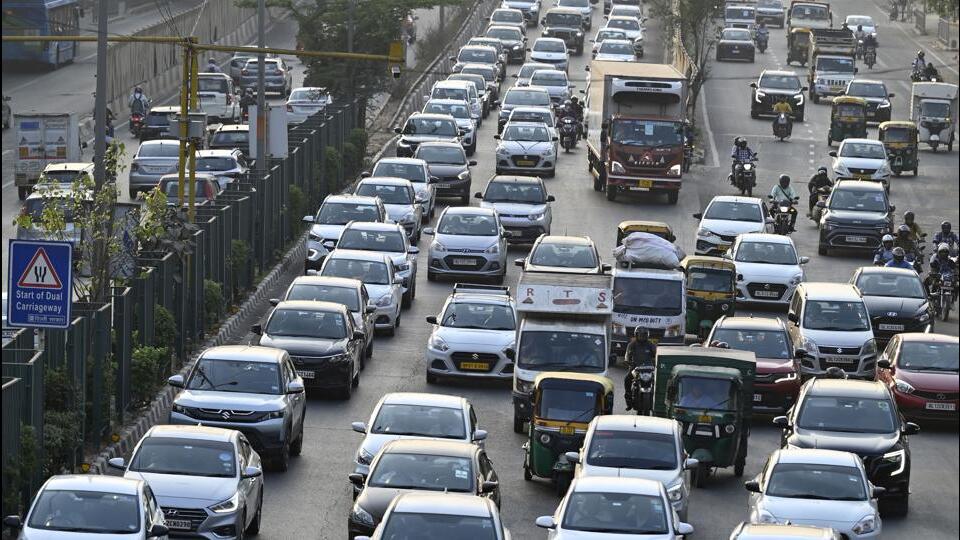
But experts who heard of what appears to be a very nascent plan said such a move could instead create construction chaos and fail to address the root causes of Delhi’s traffic woes that are better addressed by improved public transport.
Public Works Department (PWD) minister Parvesh Verma has directed officials to conduct a feasibility study for the project, which would create a third layer of road infrastructure above current ground-level roads, flyovers and Metro lines.
“Delhi’s road network has reached its limit and we are working on possible solutions to the traffic issues,” Verma told HT. “We are planning an uninterrupted, signal-free, elevated corridor that will allow faster cross-city travel and reduce load on existing roads.”
The proposed elevated road network — at present merely an idea --- would span the entire 55-kilometre Ring Road and include extensions towards Gurugram, Indira Gandhi International Airport and Noida.
The project would be executed in multiple phases, depending on technical and financial viability.
According to PWD officials, the elevated structure would rise 15-20 metres above existing infrastructure. “Minimal land acquisition will be required since the alignment is proposed over existing public infrastructure. Once the feasibility is done, we will have more detailed information on the land needed for the project,” a senior PWD official explained.
ALSO READ | Delhi’s 3rd Ring Road to open by August
The corridor would feature limited exits to ensure smooth movement for long-distance commuters and commercial vehicles, which currently contribute to daytime bottlenecks. Officials are also examining seamless connections to other expressways, including the Urban Extension Road-II, DND Flyway and NH-48.
S Velmurugan, senior principal scientist at the Central Road Research Institute, said the concept had merit but required careful engineering. “Historically, the Ring Road was always meant to be an elevated corridor. The decision to build it at grade level, with piecemeal flyovers later, compromised its efficiency.”
However, Velmurugan cautioned that construction could create chaos without proper planning. For instance, loops like the one near AIIMS “will be difficult as a lot of vertical development has already been done along the Ring Road. Origin destination study of traffic flow is also needed to ensure ramps only at required places,” he said.
“The current alignment serves millions of commuters daily and is lined with hospitals, markets and residential colonies. Without proper diversion routes and traffic management, this project could turn into a nightmare during execution.”Experts can take years, considering the scale of the project.
The Ring Road, designed to ease pressure on central Delhi, currently links the four corners of the capital, and passes through critical areas including AIIMS, Lajpat Nagar, Ashram, Sarai Kale Khan, Rajouri Garden, Punjabi Bagh, Azadpur and Dhaula Kuan. It connects key residential, commercial and institutional zones across South, West and North Delhi, crossing over major intersections and 10 Metro corridors. Despite more than 25 flyovers on the Ring Road and Outer Ring Road, traffic remains congested throughout the day.
PWD officials confirmed they are studying how to construct above existing Metro infrastructure, making it the highest tier of road infrastructure in some stretches. The department will engage consultants for a detailed project report following initial feasibility findings.
ALSO READ | Agencies identify key traffic issues, remedies for Ring Road in south Delhi
While the project is expected to take several years from planning to execution, the government believes it will have a transformational impact on mobility. The proposal comes amid renewed focus on sustainable urban transport, with ongoing efforts to promote electric buses and improve last-mile connectivity.
However, officials acknowledge that with rising car ownership and Delhi’s expanding population, new road infrastructure remains unavoidable in certain corridors.
Experts instead stressed on investing in a robust public transport for resolving the problem of traffic and congestion in Delhi.
“This is a chicken and egg problem. If you give more roads, there will be more cars. Land is limited, so for how long can you keep adding layers? If so much money is spent on giving people a robust public transport system with last mile connectivity and informal transit options, it will be an actual solution to the traffic mess,” said Sarika Panda Bhatt, urban mobility expert and co-founder of Raahgiri Foundation.


Stay updated with all top Cities including, Bengaluru, Delhi, Mumbai and more across India. Stay informed on the latest happenings in World News along with Delhi Election 2025 and Delhi Election Result 2025 Live, New Delhi Election Result Live, Kalkaji Election Result Live at Hindustan Times.


