

 E-Paper


Delhi govt begins Yamuna defoaming work, clears ₹91L for froth study
₹68.46 crore has been allocated for a permanent Chhath ghat near Kalindi Kunj, modelled on the Hathi Ghat at ITO.

 Prefer HTon Google


With another bout of froth formation reported in the Yamuna over the past few days, the Delhi government has resumed sprinkling defoaming agents in the river near Kalindi Kunj ahead of Chhath Puja, continuing an annual practice that experts stressed addresses only the symptoms of a much deeper pollution problem.
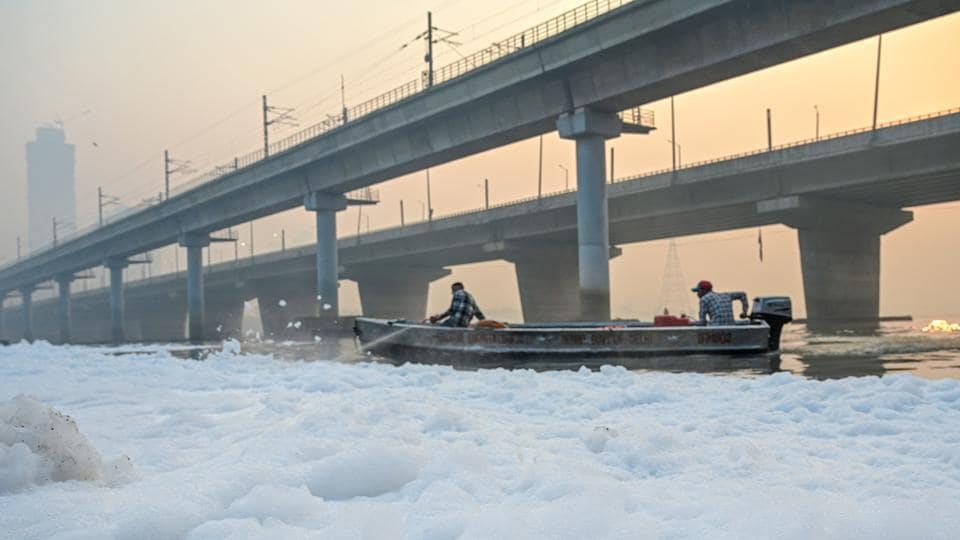
To find a lasting solution to the toxic foam in this stretch – an issue that triggers a political showdown every year before the festival – the Delhi government has commissioned a structural feasibility study of the Okhla barrage by the Irrigation Research Institute (IRI), Roorkee.
The government has entrusted the work to Uttar Pradesh’s irrigation and water resources department, providing it ₹91 lakh to examine possible changes to the slope of the barrage’s outfall points to minimise the churning of water, officials said.
Separately, ₹68.46 crore has been allocated for a permanent Chhath ghat near Kalindi Kunj, modelled on the Hathi Ghat at ITO.
Also Read | DJB plans ₹149 crore sewer line through Yamuna floodplain to curb sewage overflows
How vertical lift gates create froth
According to officials from the Delhi government’s irrigation and flood control department, the Okhla barrage has 27 gates, of which 19 are vertical lift gates, each approximately 5.1 metres high. Water cascades down from these gates into the river.
“When water falls into the river from a height of over five metres, it creates significant turbulence, which increases the formation of foam. Between October and December, the water level in the Yamuna drops, and the river consists primarily of discharge from drains containing surfactants, phosphates, and organic waste which further accelerates the formation of foam,” an official said.
The proposed study, to be conducted by the UP irrigation department in collaboration with IRI-Roorkee, will examine structural changes to reduce the height from which water falls and, consequently, the turbulence. The Delhi government has already transferred ₹91 lakh for the exercise, officials said. HT has seen a copy of the communication regarding the study.
Also Read | Delhi LG: Clean Ganga only possible with clean Yamuna
The froth, in this section of the river, forms when soap-like surfactant molecules in polluted water are agitated. The churning at the barrage intensifies foam formation, while lower winter temperatures make the bubbles more stable, allowing the foam to persist.
Sources of surfactants include detergents in untreated domestic sewage, industrial pollutants, wastewater from dhobi ghats and organic matter released by decomposing water hyacinth trapped near the barrage, officials said.
Bhim Singh Rawat, Yamuna activist and member of the South Asia Network on Dams, Rivers and People (SANDRP), said the Parliamentary Committee on Yamuna flagged the issues of surfactant and slope in 2023, but no work has been done so far.
“Treating symptoms during the festive season serves political aims but does not address the root cause. Additionally, a massive amount of chemicals is being sprayed into the river during defoaming drives, which will impact downstream ecology. Changing the barrage slope will not reduce the water’s pollution level; it may just impact the froth’s visibility.”
He added that creating a ghat and filling it with potable water will not help the river in any way. “Last year around Chhath, the river’s flow was increased by diverting water from canals at Hathnikund. It shows that if there is political will, we can increase the environmental flow in Yamuna. We need to focus on increasing e-flow, improving STPs and preventing pollutants and surfactants from entering river streams,” he added.
Also Read | Accumulated sludge, water from drains causing ammonia level spikes in Yamuna river, says pollution board
A study by The Energy and Resources Institute (TERI), commissioned by the Delhi government last year to identify the sources of froth, also flagged the poor functioning of the city’s sewage treatment plants (STPs) and common effluent treatment plants (CETPs). It found that the facilities were not adequately handling toxic sewage and industrial effluents, or effectively removing several surfactants.
Experts have stressed that changes to the barrage and the use of defoaming agents cannot replace interventions at the sources of pollution.
‘Plan to construct a permanent, modern Chhath ghat’
The land along the riverbank downstream of the Okhla barrage, near Kalindi Kunj, belongs to the Uttar Pradesh government, officials said.
“There is a plan to construct a permanent, modern Chhath ghat here, modelled after the ITO Hathi Ghat. The Delhi government has committed to providing ₹68.46 crore to the Uttar Pradesh Irrigation Department for this project,” an official said.
The Delhi government has also written to the UP irrigation department, asking it to expedite the project, the official added.


Stay updated with all top Cities including, Bengaluru, Delhi, Mumbai and more across India. Stay informed on the latest happenings in World News along with Delhi Election 2025 and Delhi Election Result 2025 Live, New Delhi Election Result Live, Kalkaji Election Result Live at Hindustan Times.


