
 E-Paper



Not just Yamuna, backflow from dozens of drains flooded Delhi
The water level in the Yamuna River has started to recede, but there is a possibility of more rain.

 Prefer HTon Google


The road leading to ITO and Rajghat were among new parts of the city to go under waist-deep waters after drains that emptied into the Yamuna began flowing back on Friday, even as the swollen river itself began receding but only by fractions of a metre every hour.
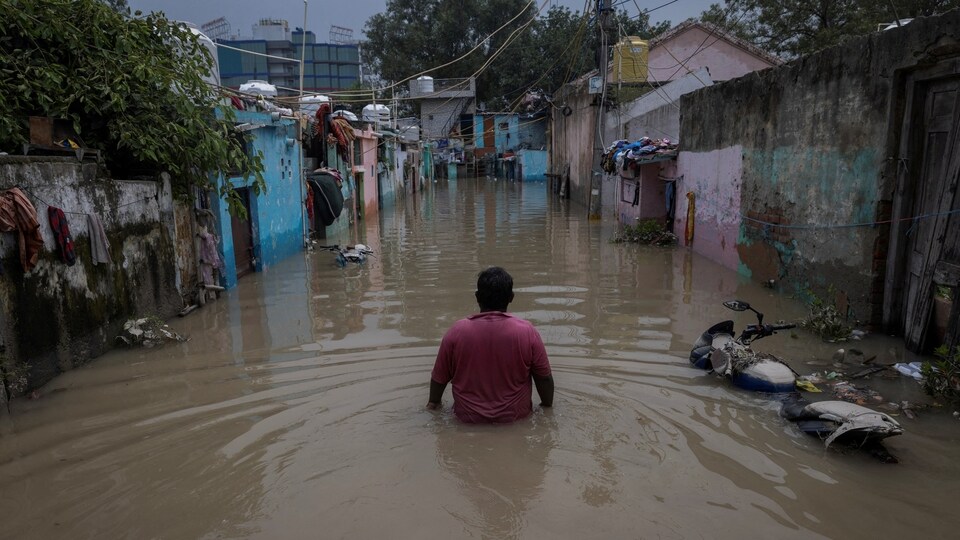
Since last weekend, an unusually intense monsoon has poured misery onto the city, first by waterlogging streets on July 8 and 9, when the city received 125% of its monthly quota of rain in just two days. The heavy rains in the hill states then swelled the Yamuna to record levels, 208.66m on July 13, which swept over embankments and reached the farthest into the city it has in over four decades.
Also read: Delhi locals flee inundated homes, clutching their pets
At least 23,000 people have been evacuated, with losses to homes, businesses and earnings running into crores, and two of the city’s four arterial links with its populous eastern localities across the river lying mostly snapped.
Then came Friday, when the city’s proverbial cup of woes spilled over to the doorsteps of the Supreme Court, the memorial of Mahatma Gandhi, and the busiest intersection of the city, ITO, as water in at least half a dozen drains back flowed, creating pools of muddy, stinking water.
This led to massive traffic spillovers on other connections to central Delhi from east Delhi, Noida and Ghaziabad as Vikas Marg and the Ring Road from Nizamuddin Bridge to ITO were cut off.
“There will be relief in store for the citizens of Delhi in the coming few hours as the water levels in the Yamuna river have started to recede. Last night it was 208.66 metres and today it is 208.38 metres. But there is a possibility of rain tomorrow,” said chief minister Arvind Kejriwal, adding that he was hopeful of the flooding in the river — the trigger for the most acute problems at present — to relent.
Yamuna receded to 207.98 metre at 10pm on Friday, down from the peak of 208.66 metre — highest in recorded history — at 8pm on Thursday. According to projections, it was set to fall further, but still remain at least two metre above the danger level on Saturday.
Weather officials of the India Meteorological Department issued a yellow alert for the weekend, saying they expected light to moderate rain which, experts separately added, could worsen the flooding.
“Normally, such spells are not sufficient to lead to an increase in the water level, but we are likely to see waterlogging across the city as most drains are currently full and have no outlet. The stormwater drains could start spilling out, with them taking longer than normal to drain out,” said Bhim Singh Rawat, a Yamuna conservation activist and member of the South Asia Network on Dams, Rivers and People.
Officials and personnel of the Indian Army were racing to fix a broken flow regulator at Drain No. 12, where the water backflow from the river had reached the country’s top court. “To prevent water from flowing into the city, we are trying to create a dam,” said Saurabh Bharadwaj, Delhi’s flood control and irrigation minister, adding that sacks would be stacked up to achieve this.
The two power centres in the Capital — the lieutenant governor’s office and the elected government led by the chief minister — clashed over Drain No 12.
Delhi LG VK Saxena and CM Kejriwal visited ITO to take stock of the repair work for which the Delhi government later called in the Indian Army. LG Saxena and irrigation and flood control minister Saurabh Bharadwaj has a bitter exchange on camera when they were interacting with the media after inspecting the situation.
As the LG and CM addressed the media on Friday morning, Bhardwaj said the support from NDRF teams came late. “Thank you, the situation would have been better had the NDRF reached the spot last night itself. I kept calling the teams for help all night but did not get any response till the morning. Meanwhile our teams worked all night without a wink of sleep,” he said.
Responding to the comment, the LG said: “I would like to tell you that this is not the time to resort to a blame game or point fingers at each other. I, too, can say a lot of things…”
Before the worsening on Friday, the floods had already touched the rear ramparts of the Red Fort and inundated one of the city’s main bus terminals at Kashmere Gate. The Ring Road, built partly over land reclaimed from what used to be floodplains a century ago, was shut for the thirdday on Friday near Kashmere Gate.
Aam Aadmi Party MP Sanjay Singh alleged that the BJP has “manufactured floods” to defame the Arvind Kejriwal government. “In case of a flood, water is released from Hathnikund towards Uttar Pradesh, Haryana and Delhi in balanced quantities. But from July 9 to 13, all the water was released towards Delhi. Had water been released equally towards all the three states, the areas of Delhi, Haryana and Uttar Pradesh adjacent to the Yamuna would have been safe,” Sanjay Singh said at a press conference.
Executive engineer of the Haryana irrigation and water resources department Sandeep Kumar said the CWC water sharing-formula is adopted only when the flow of water comes down below 1 lakh cusecs. According to the formula, in that scenario, 15,000 cusecs is discharged into western canal and 2,000 cusecs into eastern canal and remaining flows into main Yamuna.
“If the flow of water exceeds 1 lakh cusecs, there will be no flow into the western and eastern canals and the entire water is to be discharged into the main Yamuna as two canals cannot withhold the high flow of water,” he said.
Delhi BJP chief Virendra Sachdeva said the Delhi government has not done work on cleaning the Yamuna and the drains, due to which the river has a shallower bed. “Arvind Kejriwal should understand that political leaders do not decide when and how much water will be released from any barrage or dam, but technical administrative officers take such a call,” Sachdeva said.
Kejriwal did not react directly on the political blame game but said the BJP should not engage in politics at this time. “I do not want to respond to whatever the BJP is saying,” he said during ITO inspection.
Citizens in worst-hit areas said they were marooned. “The flood water has completely submerged multiple colony roads near Lala Lajpat Rai Park in Mukherjee Nagar. It is difficult for us to walk out. The situation has not improved even though water is reportedly receding. It has raised the fear of disease also,” said Neelima Shankar, a resident of the colony.
Also read: Water from Haryana barrage sent to Delhi ‘intentionally’: AAP's Sanjay Singh
Among the important buildings still affected are Central Revenues Building housing the Income Tax Department office, the School of Planning and Architect, the old headquarters of the Delhi Police, and the Public Works Department (PWD), Mukherjee Nagar police station, Sushrut Trauma Centre, Delhi government observation home and Blind School in Kingsway Camp, Kashmere Gate ISBT.
There was, however, some respite on the horizon with regards to the water supply situation. Kejriwal said the Okhla water treatment had been restarted as the river’s level relented.


