
 E-Paper



Can highways be kept blocked perpetually: SC on farmer stir
A bench of justices Sanjay Kishan Kaul and MM Sundresh added that while a section of society may have some feelings against a particular policy of the government, occupation of highways cannot go on forever.

 Prefer HTon Google


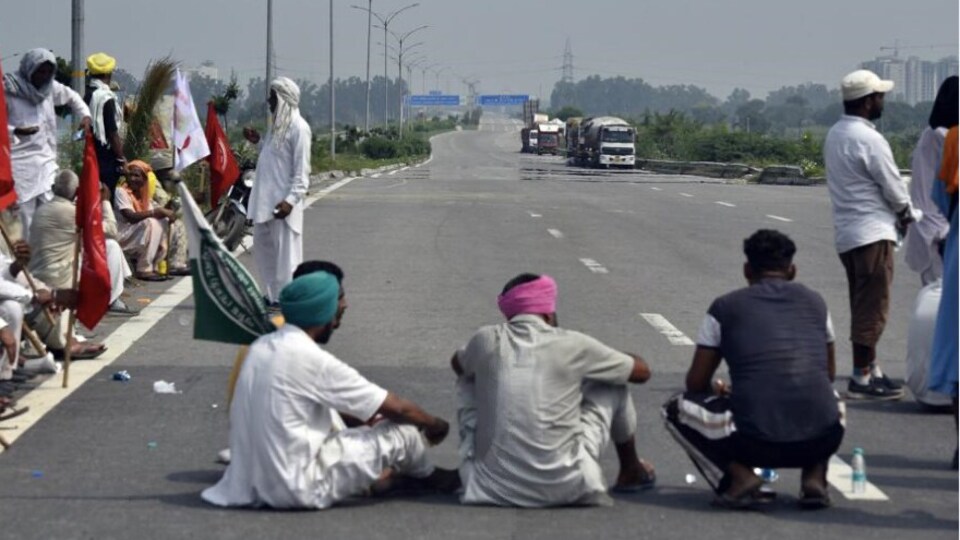
The Supreme Court on Thursday said public roads and highways cannot be “perpetually” blocked, taking a dim view of the Union and state governments’ inability to resolve the protracted problem of farmers blocking highways as part of their ongoing protests against the three contentious farm laws. Main highways into and out of Delhi have been partially blocked since last November inconveniencing local residents as well as travellers.
A bench of justices Sanjay Kishan Kaul and MM Sundresh emphasised that it is the “duty” of the executive to implement the law on ensuring agitations do not block movement on public roads before such protests start being viewed as an incentive by one section of society or another.
“Courts have to lay down the law. We laid down the law and how to implement the law is the business of the executive. The court has no means to implement it. Now, you cannot tell us to do something. You have to implement the law,” the bench told solicitor general Tushar Mehta and additional solicitor general KM Natraj. The law officers were appearing for the Central government and the Delhi Police.
As Mehta agreed with the court that it is the responsibility of the executive to implement the law, the bench continued: “On a lighter side, if we were to encroach upon your domain, you will say the judiciary is transgressing into the executive’s turf, but understand the problem at hand has several ramifications.”
The bench added that while a section of society may have some feelings against a particular policy of the government, occupation of highways cannot go on forever.
“It cannot be a perpetual problem. Let us assume they have grievances. Then there are some other sections which are stuck on the roads. They have their own set of grievances. Method of redressal of grievances can be through debate; or in the parliament; or even by way of protests; but if it is found to happen perpetually, where does it end?” it asked the law officers.
The court pointed out that such protests also create financial issues such as loss of toll on the highways. “Tomorrow, you will have people saying that since you are giving such benefits to one section of people (protestors), we will also not pay toll etc,” it added.
Thousands of farmers are camping on the borders of Delhi, Haryana and Uttar Pradesh, and on highways along these states since November last year, protesting three controversial laws that aim to liberalise the farm economy. Traffic at many points have been diverted, adding to commuting times, besides affecting commercial activities along these routes.
Petitioner Monicca Agarwaal, who works in an information technology firm and is a single mother, approached the top court, complaining it is taking her almost two hours, instead of 20 minutes, to travel from Noida to Delhi due to frequent blockades and protests. She contended that directions by the apex court in several cases to keep roads clear, including the Shaheen Bagh protest in 2019-20, are not being followed.
During the proceedings on Thursday, S-G Mehta informed the bench that a three-member committee has been formed to resolve the logjam and it invited the farmers’ groups too but they refused to join on the grounds that they are not parties to Agarwaal’s petition. Mehta requested the bench to also make a few farmers’ organisations parties to the case on his oral request.
But the bench asked the S-G to move a proper application in this regard, specifying how making these farmers’ groups parties to the case will facilitate resolution of the issue.
Mehta agreed to do so and said that such an application will be filed by Friday. The court, on his request, agreed to hear the case on Monday.



