
 E-Paper



This way to Kucha Mir Ashiq
The shops go deep into this lane, says a Hindi notice on a banner clamped to the entry gate


The shops go deep into this lane, says a Hindi notice on a banner clamped to the entry gate. Another calls it the oldest wholesale and retail market, “at your service since 1970”, and lists its specialities, including wedding cards, paper bags, dry-fruit boxes and shagun envelopes. Pasting posters is forbidden, warns a notice lower down. Just above it, somebody has pasted a poster.
Welcome to Old Delhi’s Kucha Mir Ashiq. Facing Chawri Bazar, it is the 236th street in our weekly series exploring the present and past of the Walled City’s streets.
A kucha was traditionally a lane inhabited by people who shared an occupation. Here, most shops deal in wedding cards. Even a shuttered shop has wedding cards propped up outside it. This afternoon, the lane is buzzy with business. Two men appear, each balancing a hefty white parcel on his head.
A few steps inside the gate, Rajesh Sharma of Tanu Paper Bags is sitting under a cluster of paper bags. He says he is the sixth generation of his family to live in Kucha Mir Ashiq.
Who was Mir Ashiq?
Mir Shah was his name, says the bag merchant. A romantic, Mir Shah would walk up and down the street singing ditties and reciting poetry. And so he came to be called Mir Ashiq. An ashiq, of course, is a lover.
One of the lane’s most esteemed residents, Dr Razi Zahoor Qureshi, has another account. He says the lane takes its name from Ashiq Ali, a nobleman who lived in the neighbourhood around the turn of the 19th century. Dr Qureshi lives in one of the lane’s more spacious residences, Kue Wala Ghar, with his wife, Dr Safia, their son and their daughter-in-law. All are doctors. In the old days, the address on letters to their house began with the city, Dehli. Then came Shah Bulla’s banyan, a tree just outside the street, then Mir Ashiq’s kucha, then the house with the kua, or well. Only at the end came the recipient’s name.
Dr Qureshi’s late brothers, Haji Mian and the poet Aamir Dehlavi, lie beside each other in Dilli Gate Qabristan. (Aamir Dehlavi was an ashiq-mijaz by temperament. At siesta time, he used to play old Hindi love songs on his radio.)
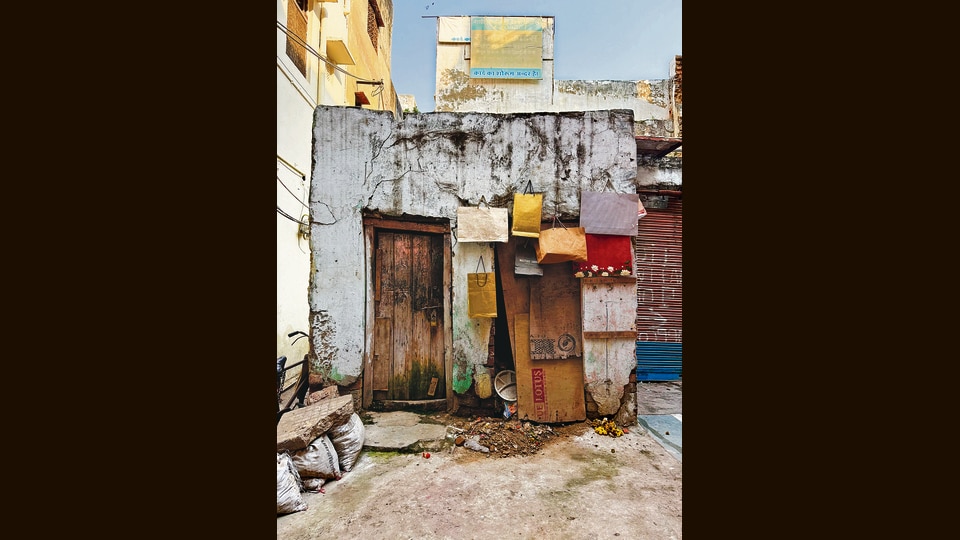
Do keep walking through the kucha. A glass-fronted card showroom is glowing under a wall where peeling plaster has exposed the bricks. Even a severely derelict wall is doubling as a shop window, with colourful paper bags hanging beside a padlocked wooden door—see photo. At the Shiv Mandir, a scooter is parked below a picture of blue Shiv. Just acrosss, a monkey is leaping across balconies.
The lane turns. A man is going ahead with a cooking gas cylinder on his shoulder, through a passage barely wider than his load. There is another turn, and a long stretch of darkened desolation. You keep walking and walking. And walking. Then, all at once, daylight. It is Gali Choori Wallan.

Stay updated with all top Cities including, Bengaluru, Delhi, Mumbai and more across India. Stay informed on the latest happenings in World News along with Delhi Election 2025 and Delhi Election Result 2025 Live, New Delhi Election Result Live, Kalkaji Election Result Live at Hindustan Times.


