E-Paper



Yamuna level nears historic low of 667 feet, Delhi starts to feel the pinch
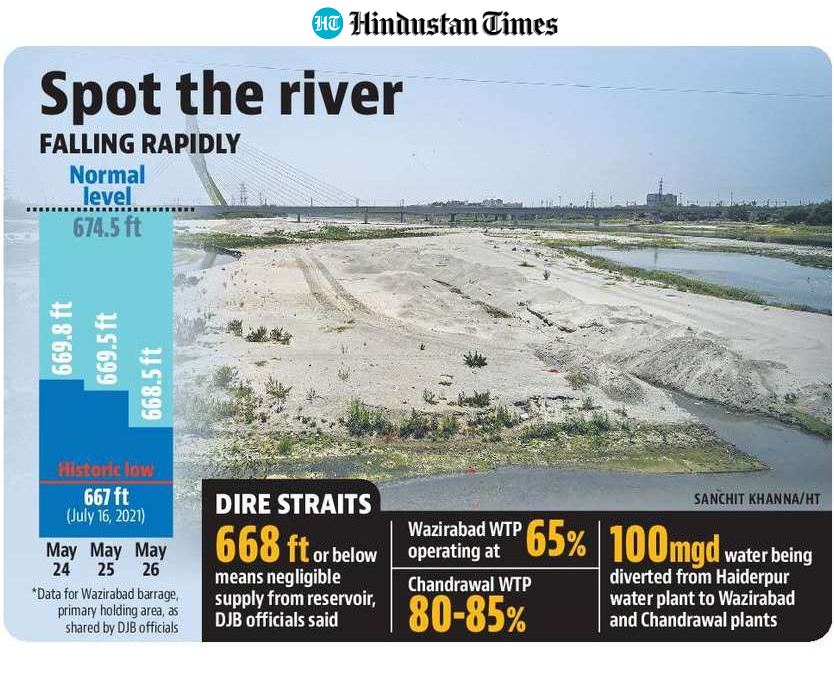
The water level has clocked a steady decline, closing in on the historic low of 667 feet, which was recorded on July 16, 2021.

 Prefer HTon Google


Water level of the Yamuna dipped to around 668.5 feet on Tuesday, six feet below the normal level of 674.5 feet, at the Wazirabad barrage, leaving just around 1-1.5 feet of water in the pondage area, from where the water treatment plants at Wazirabad and Chandrawal draw raw water.
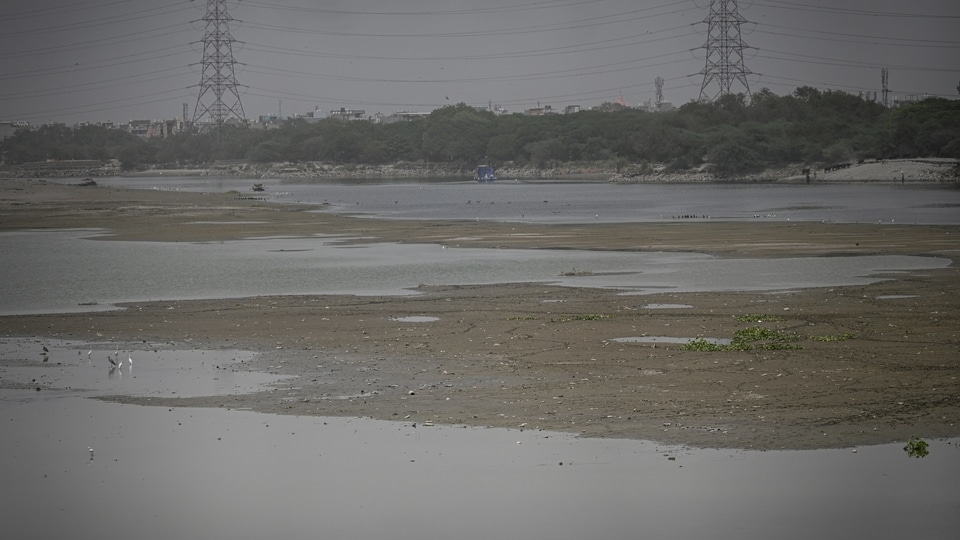
The water level has clocked a steady decline over the past few days, closing in on the historic low of 667 feet, which was recorded on July 16, 2021, officials familiar with the matter said.
Localities in New Delhi also started feeling the pinch on Tuesday, as the Delhi Jal Board (DJB) cut supply by around 14-15%, according to New Delhi Municipal Council (NDMC) officials. They said that the DJB supplied 125 million litres per day (mld) of water on the day, against their demand of 148mld.
A DJB official, requesting anonymity, said, “The historic low level has been recorded at 667ft but for all practical purposes, there is negligible water in the reservoir. Below 268 feet, we are forced to dig channels in the riverbed to push water from deeper areas towards the plant. This raw water too is mixed with silt. More than 100mgd water is being diverted from Haiderpur to keep the Wazirabad and Chandrawal plants running but this will impact water pressure in areas under other plants.”
An NDMC official said, “The supply has been further cut by 14-15% and we are advising residents to store enough water in case the situation worsens.”
Meanwhile, a Delhi government official, who did not wish to be named, said that Delhi is in talks with Haryana to procure more water and that relief is likely in the coming days.
Unlike previous years, the Delhi government and the DJB have not issued any advisory, or even acknowledged dropping water levels. The practice of issuing daily summer bulletins was also discontinued last year.
On Tuesday, DJB officials said that they were digging deeper water channels in the riverbed, but the base level at Wazirabad was uneven due to heavy siltation. However, this translated to acute water shortage in north, northwest and central areas of Delhi.
Also Read | Yamuna cruise launch stalled again as its 5km route dries up
Areas of Model Town, Shadipur, Tilak Nagar, Paryavaran complex, parts of Narela, Pul Prahladpur, Patel Nagar, Dakshinpuri and Rajinder Nagar reported acute shortage, while residents of Deoli and Dakshinpuri staged protest outside the DJB office in Greater Kailash on the day.
Usually, DJB supplies 1,000 million gallons a day (mgd) of water through nine water treatment plants.
A second DJB official said that the Wazirabad water treatment plant, which supplies 110mgd, is operating at 65% capacity; the Chandrawal plant, which supplies 90mgd, is operating at 80-85% capacity, and all other plants will face 10% supply cut due to diversion of water from Haiderpur. “We cant create a situation in which catchment area of Wazirabad and Chandrawal get zero water supply,” the official said.
Fifty-five-year-old Savitri Devi, a resident of Block-14 in Kalyanpuri, said the water supply often lasts only 15 minutes. “The water supply is highly irregular. Sometimes, there is no supply at all in the evening. We switch on the motor, but within 15 minutes, the supply stops. We try to store water in large utensils, but there is only so much water we can store that way. For drinking water, we depend entirely on tanker water from nearby sources, and these days, we even use that water for washing utensils at times,” said Devi, who lives in a family of 10 members.