
 E-Paper



Election commission reviews poll preparedness for Haryana assembly poll
The meeting was aimed at assessing the implementation of the directives issued during the commission’s visit to Haryana in August

 Prefer HTon Google


The Election Commission of India (ECI) conducted a high-level meeting on Monday in Gurugram to review the poll preparedness for the upcoming assembly elections. Senior officers from the ECI held discussions with key officials from 11 districts, such as divisional commissioners, Inspector Generals of Police (IGPs), Deputy Commissioners (cum District Electoral Officers), Police Commissioners, Superintendents of Police (SPs), Municipal Commissioners, General Observers, Expenditure Observers, and Police Observers. The meeting was aimed at assessing the implementation of the directives issued during the commission’s visit to Haryana in August.
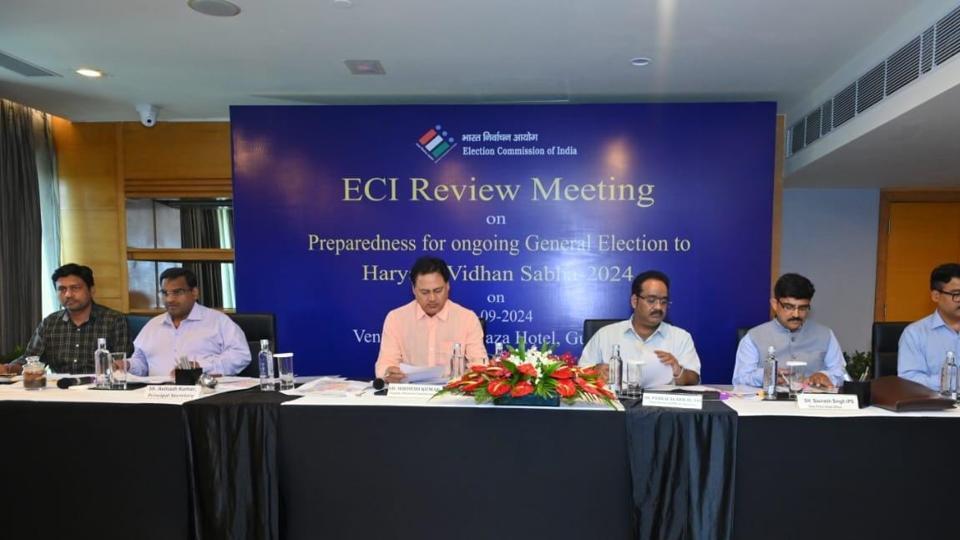
The Election Commission team was led by Deputy Election Commissioner Hridesh Kumar and included Secretary KP Singh, Principal Secretary Avinash Kumar, and SB Joshi. Officials said the commission had previously emphasised the need for free and fair elections, focusing on law and order, electoral roll maintenance, and the removal of ineligible voters. Monday’s meeting reviewed the steps taken by local authorities in response to those directives.
Deputy election commissioner addressed the need for accuracy in electoral rolls and the timely preparation of ASD (Absentee, Shifted, Duplicate or Dead) voter lists. He urged the officials to expedite the distribution of Electoral Photo Identity Cards (EPICs) and voter slips, ensuring that pending EPIC cards are printed and distributed by September 30. Kumar also emphasised the importance of engaging Booth Level Officers (BLOs) to meet these deadlines and to maintain consistency between the marked voter rolls used on polling day and those provided to candidates.
In addition to the voter rolls, Kumar focused on voter facilitation at polling stations, instructing the District Commissioners-cum-DEOs and SPs to personally inspect polling booths. “All polling stations must have essential facilities, such as proper seating arrangements for voters standing in queues. special attention was given to ensuring the setup of voter facilitation booths at each station,” he said.
The team emphasised the importance of webcasting from all polling stations to enhance monitoring and transparency. They instructed the use of high-resolution cameras positioned strategically to ensure comprehensive surveillance without compromising voter secrecy.
The police authorities briefed the commission on security preparations, particularly in areas near the state borders. The commission instructed the establishment of mirror checkpoints in districts bordering neighbouring states, in line with the police manual, to prevent cross-border illegal activities during the elections.
Haryana’s Chief Electoral Officer Pankaj Agarwal highlighted efforts to facilitate voting for persons with disabilities (PwD) and senior citizens over 85 years of age.
The Election Commission reiterated its focus on maximizing voter turnout through targeted efforts at the district and state levels. They reviewed district plans for setting up themed polling stations, such as ‘pink booths’ staffed by women and youth, as well as booths managed by PwD employees. Queue management and logistics for counting centres were also discussed.
Districts included in the meeting were Faridabad, Nuh, Palwal, Gurugram, Mahendragarh, Rewari, Bhiwani, Charkhi Dadri, Jhajjar, Rohtak, and Sonipat.


