
 E-Paper



Narrow roads, mounting garbage and stray cattle trouble Sector 48 residents
Residents said the rapid growth of commercial establishments around the sector had not been matched by improvements in road infrastructure, worsening congestion and making daily commutes increasingly difficult

 Prefer HTon Google


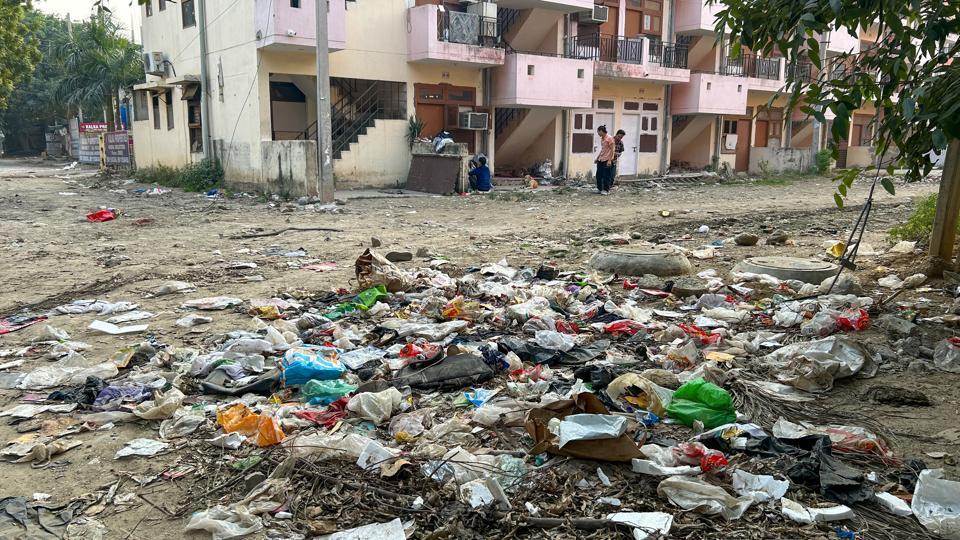
Outside the upscale condominiums in Sector 48, stray cattle wander onto narrow roads already struggling to accommodate heavy traffic, often bringing vehicles to a halt. When the traffic finally moves, cars kick up plumes of dust, prompting everyone in the vicinity to hastily cover their faces. Farther inside the sector, piles of garbage line the roadsides, while commuters negotiate damaged stretches. During the monsoon, waterlogging adds to their woes.
Residents said the rapid growth of commercial establishments around the sector had not been matched by improvements in road infrastructure, worsening congestion and making daily commutes increasingly difficult. The consequences sometimes extend beyond inconvenience, with traffic even obstructing emergency access to residential complexes.
At Vipul Greens, ambulances have struggled to enter the condominium on a couple of occasions, prompting residents to open a first-aid clinic in their clubhouse, according to Amit Jindal, president of the residents’ welfare association (RWA).
Jindal said commercial hubs such as Candor Techspace and Orchid Business Park had added to traffic volumes along Sohna Road, but the available road space had not increased with the traffic.
“The road outside our society is simply not wide enough to handle the volume of traffic. It remains congested, and even during an emergency, residents have to struggle to get through,” he said.
He said traffic congestion had, on occasion, prevented residents from leaving the condominium during emergencies and also delayed ambulances trying to enter.
“This happened a couple of times. An ambulance was unable to enter the society for a long time, while residents were also unable to get out. Given these difficulties, we eventually opened a first-aid clinic in our clubhouse,” he said.
Waterlogging along Sohna Road during the monsoon is another concern. Jindal said that despite being situated at a lower elevation, Vipul Greens had managed to prevent water accumulation within the condominium.
“Vipul Greens is around six feet below Sohna Road, but we manage waterlogging much better inside the society than what happens on the main road,” he said.
The condition of roads near Vega School has also drawn complaints from residents. Manjeev Agrawal, a resident of Tatvam Villas, said water accumulated to nearly two feet near the school during heavy rain, making the stretch difficult to navigate.
According to Manoj Ahlawat, sub-divisional officer, MCG, three key waterlogging points have been identified near the affected area, and sump wells have been dug to drain out the excess water.
An HT spot check found that the road adjacent to Vega School had deteriorated into a dirt track, with garbage piled in the middle, leaving little usable space for vehicles. Residents said damaged roads and unpaved shoulders generated dust whenever vehicles passed, affecting nearby homes, shops and commuters.
Agrawal said inadequate road infrastructure and poor waste management had compounded residents’ difficulties. He also pointed to congestion near the CNG station on Sohna Road, where queues of vehicles frequently slowed traffic.
Another bottleneck is CD Chowk near Shriram Dhaba, a key junction for vehicles entering the sector from the Badshahpur-Sohna road and those travelling towards Fazilpur. Residents said haphazard roadside parking, with auto-rickshaws and e-rickshaws often parked in two rows, reduced the available road space and worsened congestion.
Traffic police officials acknowledged that vehicles moved slowly along Sohna Road during peak hours but said they had received no formal complaints about congestion. They said action would be taken if a complaint was filed.
Garbage accumulation along internal roads and connecting stretches is another persistent problem. Sushmita Shah, a Sector 48 resident, said waste was frequently dumped along the road connecting Tatvam Villas to Fazilpur and was sometimes burnt.
“There is no proper facility for garbage disposal on the stretch from Tatvam Villas towards Fazilpur. Waste keeps accumulating, and once it forms a heap, it is simply burnt,” she said.
An MCG official, requesting anonymity, said 50 additional sanitation workers had been allocated to each ward and would be deployed after Diwali to improve cleanliness. “Their main task will be to remove road dust and collect garbage dumped along roadsides,” he said.
The official added that MCG had issued 54 challans for waste burning since October 24 as part of its efforts to strengthen enforcement against improper waste disposal.
Stray cattle wandering onto roads have added to the difficulties of commuters. Reena Goyal, another resident, said the animals frequently obstructed traffic, forcing motorists to slow down or stop.
“I have sometimes even seen calves feeding in the middle of the road, slowing down traffic and making it difficult for vehicles to pass,” she said.
Ward councillor Kuldeep Yadav said repeated complaints to the Municipal Corporation of Gurugram (MCG) about stray cattle had failed to yield results.
“We have complained about the stray cattle issue numerous times, however MCG has not taken any action. All ward councillors are tired of filing complaints on the same issue,” he told HT.
For residents, the civic conditions stand in stark contrast to the image of Gurugram as a modern, well-planned city.
“This is the dream of the Millennium City that has been sold to us,” Agrawal said.

Stay updated with all the Breaking News and Latest News from Mumbai. Click here for comprehensive coverage of top Cities including Bengaluru, Delhi, Hyderabad, and more across India along with Stay informed on the latest happenings in World News.


