

 E-Paper


Uttar Pradesh chief electoral officer directs DEOs to re-examine all rejected Form 6 applications
Missing voters should be included by matching electoral rolls of panchayat and assembly constituencies, says Rinwa; poll preparations for 18 districts reviewed

 Prefer HTon Google


Uttar Pradesh chief electoral officer Navdeep Rinwa on Monday directed all district election officers (DEOs) to re-examine all rejected Form 6 applications in order to include eligible citizens in the voter list.
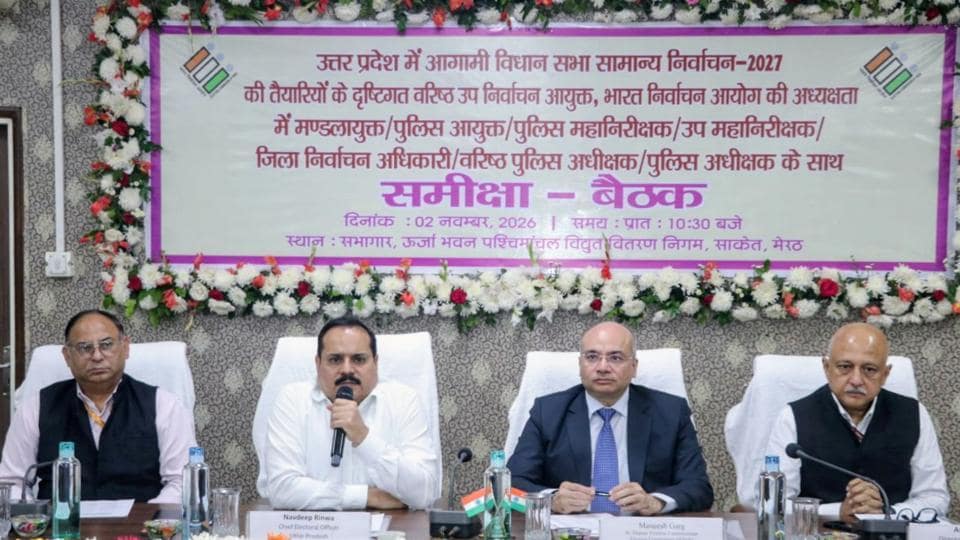
Missing voters should be included in the voter list by matching the electoral rolls of panchayat and assembly constituencies, he said at a meeting in Meerut on Monday.
He issued the directive while he, along with senior deputy election commissioner Manish Garg, and other senior officials of the Election Commission of India reviewed preparations for the 2027 Uttar Pradesh assembly elections for 18 districts under the Meerut, Saharanpur, Moradabad and Aligarh divisions
Addressing officers, Rinwa directed the DEOs/ DMs to re-examine all Forms 6, 7, and 8 submitted by computer assistants since completion of the special intensive revision (SIR) on April 10.
District contact centres should be kept functional during the Special Summary Revision-2027 and the assembly elections, he said.
Regular reviews of complaints received through NGRS, PGRS, and other channels should be conducted to ensure timely and quality disposal, he added.
Appeals received under the Representation of the People Act, 1950, and the Electoral Registration Rules, 1960, should also be resolved in a timely and quality manner, he said.
He instructed the officers to ensure that applicants enter their mobile phone number and complete address correctly while filling Form 6 for enrolment as a voter. Operators of public convenience centres should be trained regarding the online application process for Form 6 and prevent multiple entries, he said.
In the 2027 Uttar Pradesh assembly election, webcasting will be conducted at all polling stations and CCTV cameras will be installed inside and outside polling stations as well, he said.
He also directed that the flying surveillance team (FST) and static surveillance team (SST) should be deployed in all districts during the assembly elections.
Sector magistrates and sector police officers were instructed to jointly visit polling stations, map the vulnerability of highly sensitive areas, and provide necessary information.
“The district magistrate and superintendent of police should jointly inspect polling party departure points and material storage points. The Essential Basic Facilities at polling stations should also be updated on the ECINET app,” Rinwa said.
Senior deputy election commissioner Manish Garg instructed officers to ensure that voter information slips were distributed and marked in the BLO register five days before polling day.
“Complaints received on social media should be promptly addressed and factual responses should be provided, while false/misleading news should also be shared with the cyber cell,” he said.
He emphasised training all concerned officials, verifying absentee, transferred, duplicate, and deceased (ASDD) voters in the electoral rolls, and holding coordination meetings with border districts at the district level.
The ECI official said the accuracy and inclusiveness of the voter list is a top priority, adding that special attention should be paid to enrolling young and women voters to ensure their participation.
The meeting was attended by the respective divisional commissioners, police commissioners, inspectors general of police/deputy inspectors general of police, district election officers and senior superintendents of police/superintendents of police.
The ECI officials also reviewed the work regarding the preparation of an error-free voter list, updating voter lists, and the availability of Essential Facilities (AMF) at polling stations and voting booths.
They also took stock of the availability and management of EVMs and VVPATs, training of election personnel, necessary security arrangements at polling booths, and various other issues related to the smooth conduct of the election process.
The law and order situation, identification of sensitive and hyper-sensitive polling booths, availability and deployment of security forces, coordination between the police and administration during the elections, webcasting, and arrangements related to monitoring the voting process were also reviewed.


