
 E-Paper



In absence of recharge mechanisms, water sources depleting fast in Lucknow
The city has failed to recharge its water sources by not being able to ‘catch the rain’ during the monsoon season, causing a depletion in its groundwater levels.

 Prefer HTon Google


LUCKNOW Environmentalists have flagged the impending water scarcity the state capital is staring at in the wake of fast-depleting water sources in the city. According to data, Lucknowites extract groundwater equal to one-third of the capacity of the Bhakra Nangal dam every year to quench their thirst. In addition, millions of litres of groundwater is extracted by 750 government tubewells and around 550 private tubewells in Lucknow.
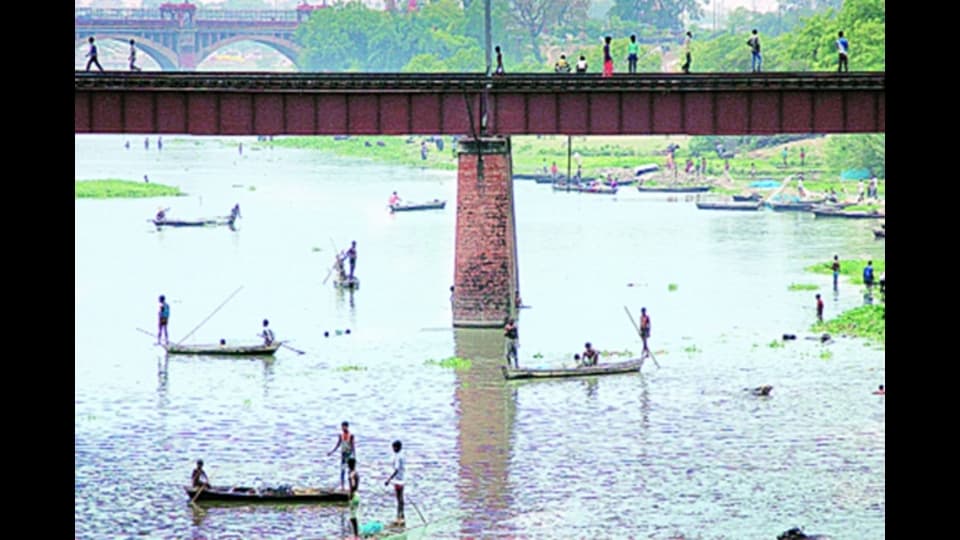
However, the city has failed to recharge its water sources by not being able to ‘catch the rain’ during the monsoon season, causing a depletion in its groundwater levels. “Hardly any water bodies are left in the state capital to recharge the water table, which is fast depleting. Considering urbanised area as 500 sq km in Lucknow, the daily extraction here is about 1,650 million litres per day,” said Venkatesh Dutta, noted environmentalist and professor at the School of Earth & Environmental Sciences (SEES), BBAU.
He added, “Areas like Alambagh, Natkhera, Azad Nagar, Krishna Nagar, Ashiana, and Bijnore had large ponds that have vanished today. There were natural water bodies like lakes which are now encroached upon. Colonies have come up there. Besides, the catchment area of river Gomti has been tamed in the form of a riverfront, hitting the process of water recharge. Such a large volumetric loss is happening every day without any recharge for years. This is why the water table is depleting fast.”
Ram Kailash, general manager, Jal Sansthan, says, “According to official figures, around 60,000 houses in the city extract water through submersibles directly from land. According to the Uttar Pradesh Ground Water (Management and Regulation) Act, 2019, we can only stop commercial extraction of groundwater. However, the domestic use is permitted under The Indian Easement Act of 1882. All the affluent people have their supplies from submersibles and borewells. So, not just the authorities, the residents are also responsible for the depleting natural resource as people can be seen washing their cars with tap water without any regard for the limited natural resource.”
Notably, Lucknow is divided into eight blocks for underground water extraction by the state’s ground water board. These blocks are Bakshi-Ka-Talab, Chinhat, Gosainganj, Kakori, Mal, Malihabad, Mohanlalganj, and Sarojini Nagar.
VK Upadhyaya, director of the U.P. State Ground Water Board, said, “The maximum water level depletion is being reported from the Malihabad block. Here, the decline is around 57 cm per year. After this, the decline in Mal block is around 37.43 cm per year, 36.22 cm per year in Bakshi Ka Talab, 29 cm per year in Mohanlalganj, and 30.78 cm per year in Sarojini Nagar.”
In the urban areas, the maximum fall in water level is reported from Faizullagnaj. Here, the water level is falling by 253.4 cm per year. This is followed by a decline of 153.4 cm per year in Purania; 128.4 cm per year in Mahanagar; 110 cm per year in Naubasta; and 102 cm in Lalkurti. On average, the depletion of water level is 75.61 cm per year, said Aditi Singh additional director of the state’s groundwater board.
Singh added, “Commercial establishments have to take permission for boring to install submersibles. The nod is given after certain conditions are adhered to -- like they would arrange to refill double the groundwater which they extract. Also, the permission is only given after an inspection by the officials. However, when it comes to domestic installation of submersibles, there is no such condition, and people use this shortcoming of law to extract water from the ground.”
In 2021, the groundwater level in Lucknow district was at 15.78 metres below the ground level. While Lucknow’s groundwater level fluctuated substantially in recent years, it tended to increase through 2015-2021 period. It ended at 15.78 metres below the ground level in 2021.
Speaking on the issue, environmentalist VK Joshi said at some places, the water level was going down by more than 1 metre-to-1.4 metre every year but there were no efforts to recharge the water table. In the areas like Charbagh, Alambagh, Lalbagh, Naka Hindola, Krishna Nagar, the water table is going down every year at an alarming rate.
“Instead of thinking about recharging the water table, the municipal authorities are exploiting underground water as if it will never get exhausted. Not only that, with the trend of high rises and apartments in the city, the builders have started installing private tubewells in their apartment blocks. It is now up to the state government to regulate the extraction of underground water as it belongs to our future generation too,” said Joshi.
“In the past, Gomti was the main source of drinking water in Lucknow, but now 80% of municipal water supply is dependent on groundwater. Once, Lucknow was also called the city of ponds. However, water bodies have vanished now. Earlier, ponds were the main source of water recharging. That’s why it becomes important to protect the remaining underground water resources,” he added.
Meanwhile, Venkatesh Dutta said, “Natural sources of recharge other than ponds are, open areas, natural depressions, forests, floodplains, influent rivers, and paleochannels. Artificial recharge is just a small fraction. To maintain underground water levels, we will have to check groundwater over-exploitation. At the same time, we will have to save the water from contamination. We will have to guard them against non-engineered landfills, Nitrate, Iron, Flouride, Arsenic, and other contaminants.”
He added, “The authorities will have to scale up the recharge, making it a masterplan. The highly uneven distribution and its utilisation make it impossible to have a single management strategy for the state or the country.”
When queried on the issue, additional municipal commissioner Abhay Pandey said, “The state government already has rules for stopping overexploitation of underground water. We have stopped commercial installation of tubewells and submersibles by commercial establishments but for residents, we sometimes have to adopt a lenient approach for the areas where piped water supply is still not possible.”


