
 E-Paper



Startup Mantra: From studying the human brain to building humanoids
With Muks Robotics, Mukesh Bangar is looking to take AI beyond the digital world and into the physical one


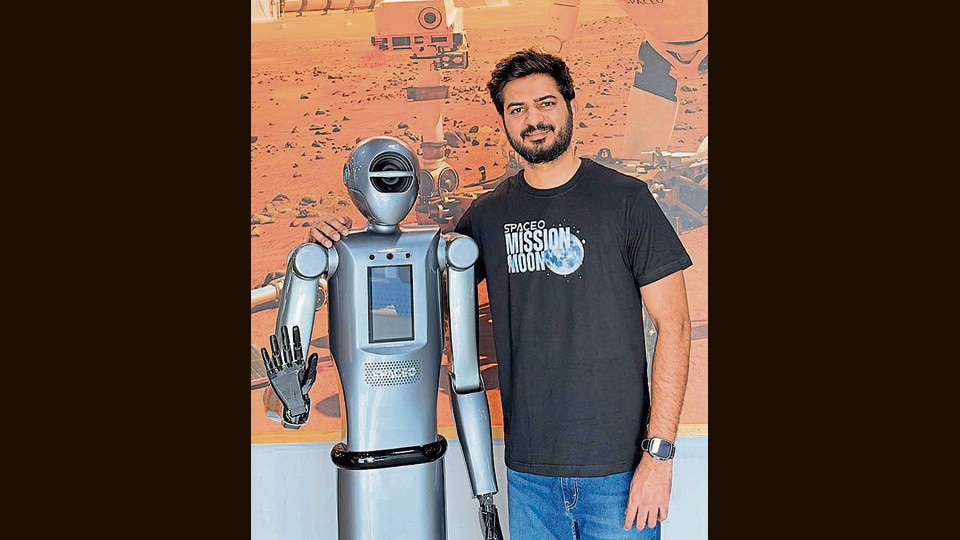
For someone building humanoid robots, Mukesh Bangar has a rather unconventional educational background. A graduate of Government Dental College, Nagpur, Bangar’s fascination with the human brain and its ability to process information and control physical movements led him to explore whether machines could be endowed with similar capabilities. Today, his startup, Muks Robotics, founded in 2021 and registered in Pune, is developing humanoids that can communicate, navigate their surroundings and perform physical tasks.
The idea
“My curiosity about technology started in childhood. I used to open electronic gadgets to understand how they worked and started learning programming at an early age. Later, when I pursued medical science, I became fascinated by the human brain and nervous system,” Bangar says.
As artificial intelligence advanced rapidly, Bangar saw a significant gap between digital intelligence and physical-world intelligence.
“I realised that while AI was advancing rapidly, there was a significant gap between digital intelligence and physical-world intelligence. I saw an opportunity to bridge that gap through humanoid robotics.”
Unlike conventional industrial robotic arms programmed to perform repetitive tasks on assembly lines, humanoids are designed to operate in dynamic environments where the size, shape, colour and position of objects can change.
Muks Robotics uses vision-language-action models that enable robots to perceive their surroundings, interpret instructions and translate them into physical actions. Speech recognition and synthesis enable them to communicate with people.
Building the company
Developing humanoids requires expertise across mechanical engineering, robotics and artificial intelligence. While finding mechanical and AI engineers was relatively easy, finding people with expertise in robotics proved challenging. Bangar had to train engineers in the specialised skills required.
Today, the company has a multidisciplinary team of approximately 45 people.
“Our biggest challenge was integrating mechanical engineering, electronics, software and artificial intelligence into one reliable system. We developed multiple generations of humanoid prototypes through continuous testing and improvements,” he says.
The other challenge was financing the development of humanoids, particularly the expensive process of developing actuators and training AI models.
To generate revenues, he initially focused on software and industrial AI solutions. Bangar said, “In 2023, we developed AI-powered vision systems that used cameras and software to detect manufacturing defects. We built 600 such systems for Tata Motors. We also developed software for Nokia and generated revenues of ₹2.6 crore over two years.”
The earnings from these businesses were channelled into humanoid development.
The market
Muks Robotics has categorised its humanoids into three segments based on their capabilities, applications and price points.
Spaceo M1, priced at ₹6 lakh, is designed primarily for customer-facing roles in offices, retail outlets, museums and exhibitions. It can function as a receptionist, escort visitors to meeting rooms or explain products to prospective customers. Ace Software and L&T Services are among its customers, according to Bangar.
Spaceo Pro, priced upwards of ₹15 lakh, is an industrial humanoid designed to perform physical tasks in automobile, pharmaceutical and other manufacturing facilities, warehouses and logistics operations. The company has demonstrated the technology to Emirates airline, with the engagement currently at the pilot stage.
Spaceo Prime, priced at around ₹30 lakh, is a bipedal humanoid designed to negotiate uneven terrain, slopes and environments where wheeled robots have limitations.
“We are particularly proud to be among India’s pioneering humanoid robotics companies to have secured orders from ISRO,” Bangar says.
The company is developing Spaceo Prime for an application related to ISRO’s proposed space station.
Its revenue model includes robot sales, AI solutions, customised development, software integration and maintenance contracts.
Funding and growth
The startup has largely been bootstrapped through founder investment, business-generated revenues and debt financing. Of the approximately ₹5 crore invested in technology, research and development, infrastructure and team building, ₹1.5 crore has come from Bangar’s own funds.
The company is now looking to raise ₹30 crore in a pre-Series A funding round and has begun approaching venture capital firms. The funds will be used to strengthen research and development, scale manufacturing, recruit talent and expand commercial deployments.
In the first year of its commercialisation plan, Muks Robotics aims to deploy 100 Spaceo M1 humanoids and generate revenues of ₹10 crore. The company is currently conducting around 22 product demonstrations every month.
In the second year, with the commercial launch of Spaceo Pro and Prime, it hopes to deploy over 500 units and generate revenues of ₹50 crore. Its five-year target is to deploy more than 5,000 humanoids globally.
“Our ambition is to build a complete Physical AI ecosystem rather than just a robot manufacturing company. I believe the next technological revolution will be about AI moving beyond computers and interacting with the physical world,” says Bangar.
“Our vision is to develop intelligent machines that can perceive, understand, learn, reason and perform tasks autonomously.”


