


 Live Score
 Cricket Teams
 Cricket Players
Identifying the keys to an Afghanistan resurgence
Having learnt and honed their skill in IPL, Afghanistan are now tweaking it to great effect in ODI cricket

 Prefer HTon Google


Afghanistan beating Pakistan isn’t an upset, at least their English coach Jonathan Trott doesn’t think so. To him, it’s a “disservice to the guys in the changing room” call it one. They are probably not even underdogs after beating England, surely not when they are this meticulous, dedicated to improving every aspect of their cricket.
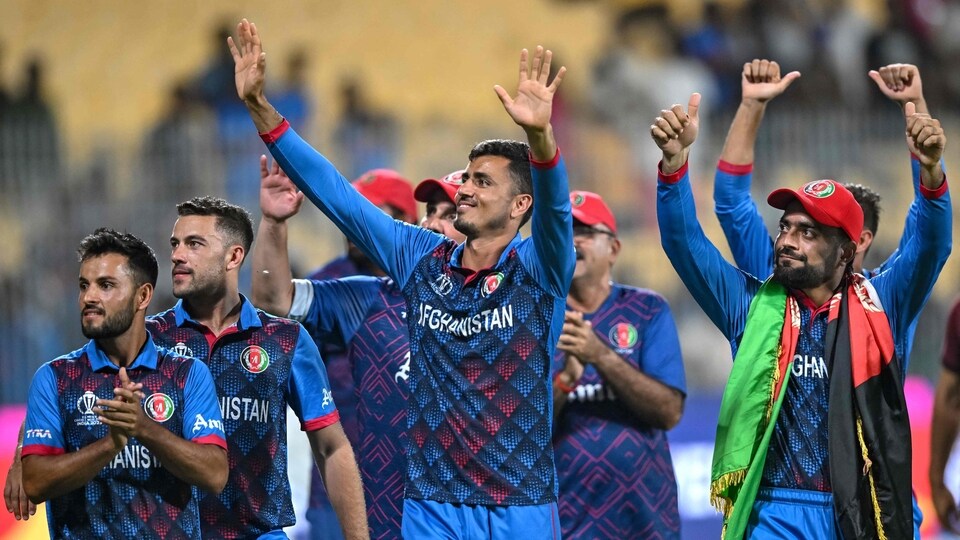
You lose, you learn, you evolve; Afghanistan are no different. The infrastructure may not be up to scratch, the team itself may be seeking home comfort for years now but Afghanistan are also a culture stemmed from resilience. In real life, outside the statistical realm of match-ups, predictions and history, Afghanistan gave themselves as much chance of winning as Pakistan. Perhaps more.
You could feel that in the controlled aggression that underlined Afghanistan’s batting — always level with the asking rate, giving respect to the bowlers wherever due but also coming down heavily on the loose balls, and running like their life depended on it. At the core of this approach was also a brutally honest assessment. “I said, we're not going to be able to win this game in 35-40 overs. We're going to have to bat well for 50 overs. And we broke it down to 10-over splits,” said Trott, the former England batter.
It resulted in calculated mayhem. Never before — and there are 13 instances of that — had Pakistan failed to defend a 275-plus target at the men’s ODI World Cup. Only once now has a target higher than 283 been successfully chased (286/2) for the loss of two or fewer wickets — Sri Lanka scored 310/1 to defeat England in 2015. Never before have the top three batters in any side scored fifty or more in an ODI World Cup chase. “The turning point for me was the start (130-run opening stand) that Ibrahim (Zadran) and (Rahmanullah) Gurbaz gave us,” said Trott. “That’s always good when you're chasing a total like that, you need a good start, there's less pressure on the players coming in. And it makes their job easier.”
Afghanistan’s bowling never needed any selling, not with Rashid Khan helming it. But following their instinct, picking a three-match old Noor Ahmad (left-arm wrist spin) over left-arm seamer Fazalhaq Farooqi on a Chennai pitch tailormade for spinners underpinned Afghanistan’s courage to stick to their strengths. Once Noor held back his length and got Babar Azam to slash hard at a quicker one straight to extra cover, Pakistan knew getting to 300 could be difficult.
In beating Pakistan comprehensively with the ball, Afghanistan showed the maturity of a side so assured of its skill. “I think whenever Afghanistan plays, the way the spinners bowl is going to be important,” Trott said. “It's a case of just having a look at the conditions. I thought we got it right with Noor today coming in and the way that he bowled, certainly for a youngster as well. The way that he bowled and started really well and then got a few wickets (3/49) and a bit of momentum.”
Led by Rashid, most of Afghanistan’s skills have been learnt and honed in IPL. Mention of T20 might invoke skepticism, that most modern batters don’t understand how playing within their limitations actually works in one-dayers, something Virat Kohli has studied, grasped and mastered. But on Monday, we watched a refined side that was patient, tweaking the tempo when needed but not necessarily getting ahead of themselves. No one symbolised that pragmatism better than Zadran who essentially killed Pakistan’s chances by staying put till the 34th over.
“You know he's scored four 100s already for such a young age and unfortunately didn't get another one tonight," Trott said of the 21-year-old who top-scored with 87. "But I think if he did get a little bit more exposure in franchise cricket, he would develop that side of his game as well. He plays in our T20 side and is a fantastic player. So, the more exposure he can get in franchises, I'm not saying he has to play IPL, any league around the world, develops his T20 skills. I think they'll have a good knock-on effect in his 50-over cricket and Test cricket as well.
“But it's not just the format, it's more the playing under pressure, big crowds, different conditions, learning to play. And that's the test of the modern player nowadays, to be able to play in all different conditions you know; you go to Australian bouncy wickets and spinning wickets here in the subcontinent. So, that's what it'd be, that's what's good for young players.”


