
 E-Paper



Pollution levels soar on Diwali as cracker ban falls flat in Delhi
On Saturday, early Sunday, air quality sensors across Delhi showed a rapid rise in harmful emissions.

 Prefer HTon Google


Pollution levels soared in the national Capital on Saturday night and early Sunday morning as tens of thousands of people defied the ban on firecrackers, before providential winds blowing in the right direction flushed the pollutants out on Sunday, with a smattering of rain in the late afternoon and evening washing everything down.
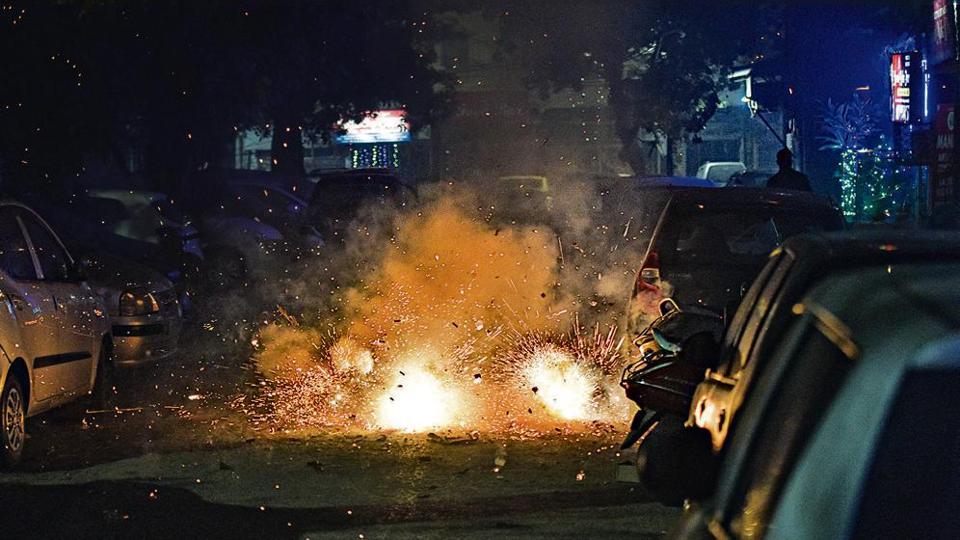
On Saturday and early Sunday, though readings from air quality sensors across the city showed a rapid rise in concentration of harmful emissions, before going on to surpass levels seen during last year’s Diwali.
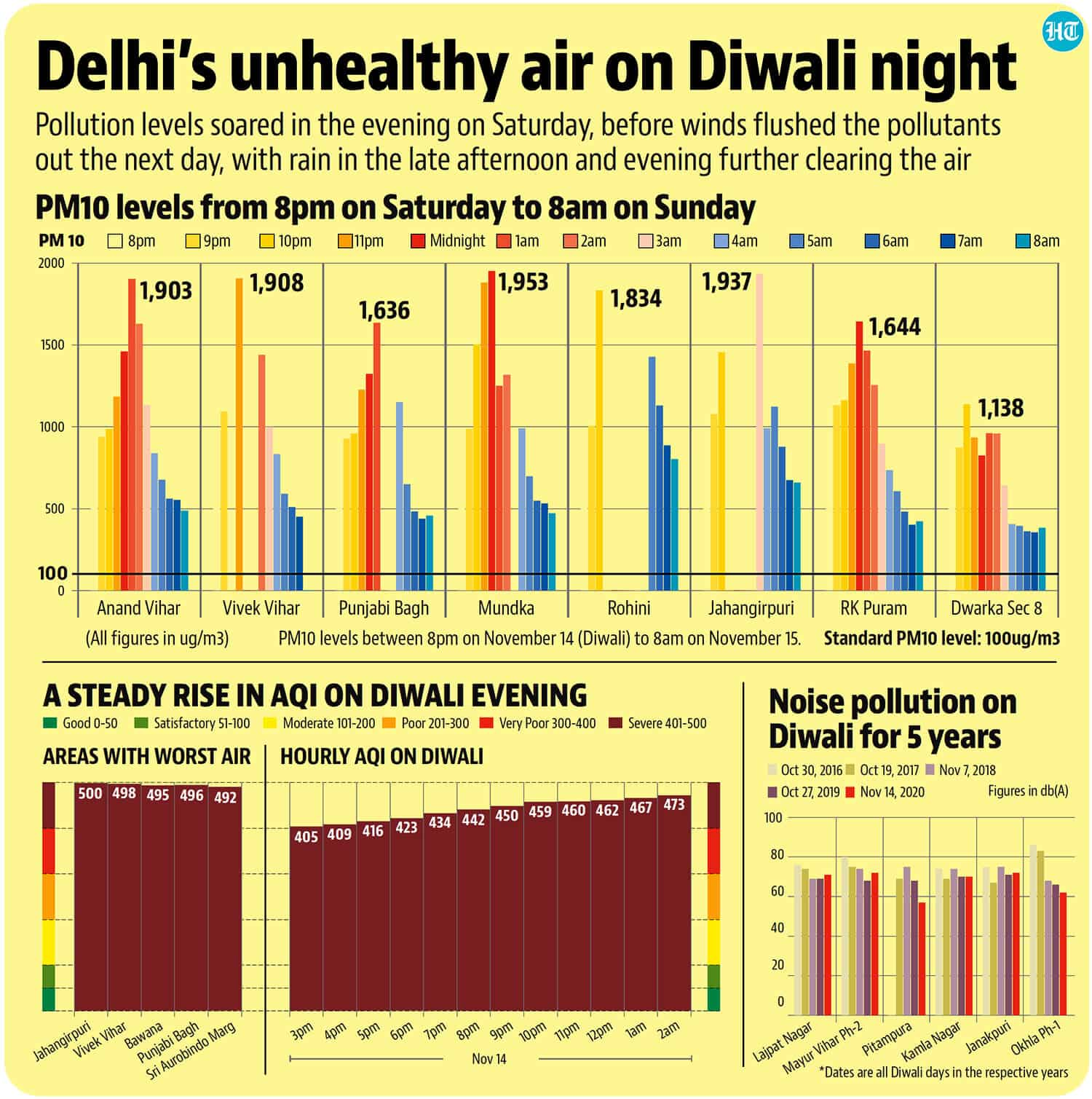
The average air quality index rose from 414 at 4pm on Saturday to reach 435 on Sunday, with PM2.5 and PM10 emission concentration recording a sharp spike that began at 6pm. According to the Central Pollution Control Board’s emergency dashboard, concentration of PM2.5 – ultra-fine particles that can stick deep into a person’s lungs – went from 306ug/m3 at 5pm to a peak of 672 ug/m3 at 2am.
The crackers just made already bad air worse.
“This year air pollution levels both during pre-Diwali and Diwali day has been higher than last year. One of main reasons for this is the contribution of stubble fires to Delhi’s PM 2.5 concentrations on both days. On Diwali day, stubble fires contributed to 32% of Delhi’s PM 2.5 load and on pre-Diwali day it was 38%,” said a senior CPCB scientist on condition of anonymity.
But then, the region had an unexpected stroke of luck this year, one absent during last year’s Diwali, when pollutants from the farm fires and from firecrackers enveloped the city in a noxious shroud.
A senior official from SAFAR, Union ministry of earth sciences’s air quality monitoring centre, said that even though the spike in pollution levels witnessed on Saturday was highest compared to the Diwali days, the dispersion post-Diwali was also the fastest because of high wind speed.
“Looking at the dispersion of pollutants, this was the best Diwali compared to the last four years. The winds were strong and the rain also helped wash off pollutants,” said the Safar official. By late Sunday evening, the AQI was at 395, in the ‘very poor’ category.
On Diwali day, the emissions trajectory was in near tandem with what was seen last year, when it began climbing around 5-6pm before peaking around 1-2am. In 2019, baseline pollution levels were lower than what they were this year, which meant the peak pollution was nine times more than before Diwali celebrations began – compared to twice as more this year. In absolute terms, however, the concentration of the ultra-fine particles was more this year than it was last year.
It was around 6pm on Saturday that PM2.5 levels crossed the emergency threshold – 300ug/m3, a level where it would stay at least for the next 24 hours despite an increase in wind speeds and some rain the following day.
This post-Diwali spike in pollution has been a consistent trend for the last five years and it comes at a time of the year when the air is already a mix of smoke from farm fires in neighbouring states and dust from an increasingly drying, post-monsoon ground.
“Meteorological conditions are also adverse because Diwali was in mid-November this year when mixing height is low (mixing height is the height at which pollutants mix in the air). But our understanding is that the contribution of firecrackers or festivities is lower this year compared to 2019. This is evident from the fact that pollution levels spiked substantially last year on Diwali in comparison to pre-Diwali day,” the CPCB scientist added.
According to CPCB’s analysis of its three manually operated stations at ITO, Pitampura and Janakpuri, and three real time stations at Dilshad Garden, Shadipur and Dwarka, most pollution parameters were found to be higher than last year in a majority of the stations monitored both on Diwali day between 6am on Saturday to 6am on Sunday and on a pre-Diwali day on November 9 during the same period.
“On Diwali day (this year), almost all the pollutants reported higher values as compared to 2019 Diwali day. Pitampura recorded increase in PM and SO2 indicating impact of firecracker bursting on Diwali day,” said the CPCB report referring to data from three manual monitoring stations. Similar trends were seen in data from automatic stations also.
Noise data from six stations reveal that at three locations (Lajpat Nagar, Mayur Vihar Phase-II, Janakpuri) it increased on Diwali night this year compared to 2019, while it remained same at one (Kamla Nagar) and decreased at two (Pitampura and Okhla). Highest noise levels were recorded at Mayur Vihar Phase II and Janakpuri at 72 Leq dB(A) between 6pm and midnight.
According to CPCB data, the air quality index (AQI) at 10am on Saturday was 369, but the value reached 378 at 12pm, 385 at 1pm, 396 at 2pm. By 3pm, the AQI recording had slipped into the “severe” zone, at 405.
As firecracker bursting continued unabated across the national Capital, by Saturday midnight the AQI had spiked to touch 460, with air quality monitoring stations such as Jahagirpuri maxing out at 500, which is the highest possible recording on the AQI scale. Stations including Narela, Bawana, Vivek Vihar and Alipur also clocked AQI levels above 485, by 12am.
With a ban ordered by the National Green Tribunal on November 9, the Delhi Police said it registered 1,206 cases on Saturday for selling and bursting firecrackers, and held 850 people for such offences.
In all, the number of people booked and held for selling and bursting firecrackers on Diwali night and in the days preceding it far outnumbered similar action last year when there was a ban only on non-green firecrackers.
The police said that people were also able to burst firecrackers because it was difficult for the police to act against those who were bursting them from their homes or from multi-storey buildings. “We had an active presence in the streets, but there is only so much you can do about such activities in buildings,” said another police officer.
Anumita Roychowdhury, executive director (research and advocacy), Centre for Science and Environment (CSE), said that the firecracker bursting on Saturday showed that no ban can be implemented without the participation of public and therefore the stress should be on creating awareness among people.
“Collective and cohesive framing of problems and solutions at the community level is still a work in progress.This argument by no means is pushing the onus and burden of action to individual decisions and choices and detracting attention from stronger governmental action for good governance. Governments will have to act. But this is about strengthening societal acceptance of difficult action that otherwise get slow because of lack of public support,” she said.


