
 E-Paper



Covid-19: Record infection spike again as daily tests cross 58k mark in Delhi
However, there was also a sharp dip in the number of reverse-transcription polymerase chain reaction (RT-PCR) tests, considered the most accurate diagnosis for the disease. Only 9,004 samples, or 15.4% of the total tests, were collected using the RT-PCR method on Thursday.

 Prefer HTon Google


The number of tests for coronavirus disease (Covid-19) in Delhi touched another high, with 58,340 samples tested in 24 hours, according to the daily health bulletin released by the Delhi government on Thursday — 4,000 more than were conducted the day before.
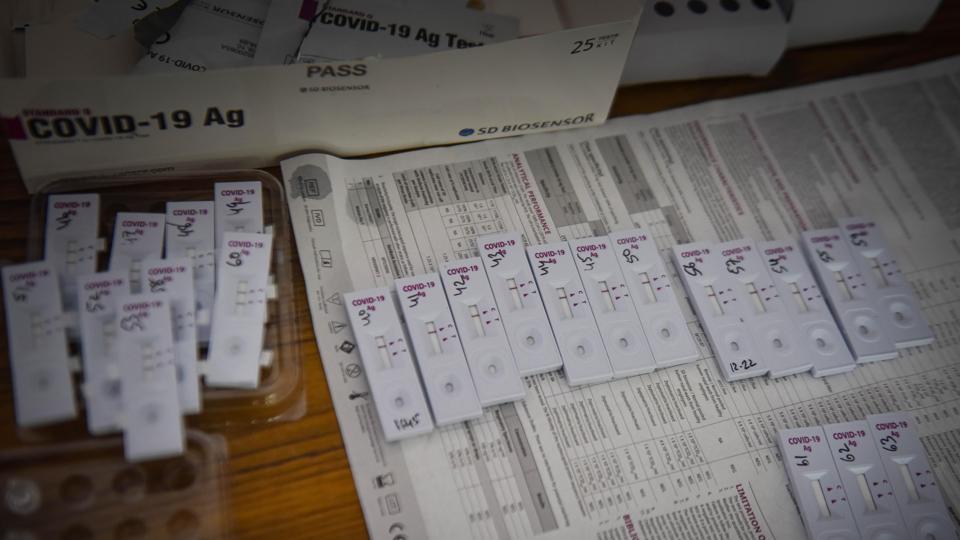
However, there was also a sharp dip in the number of reverse-transcription polymerase chain reaction (RT-PCR) tests, considered the most accurate diagnosis for the disease. Only 9,004 samples, or 15.4% of the total tests, were collected using the RT-PCR method on Thursday.
This is less in both absolute and percentage-wise terms than on Wednesday. On that day, 11,101 RT-PCR tests were conducted, which worked out to 20.3% of the 54,517 samples collected.
The rapid antigen test, although cheaper and quicker, is known to throw false negatives.
As the number of cases and positivity rate — the fraction of people who test positive among those tested —started going up towards the end of August, chief minister Arvind Kejriwal had said testing would be scaled up to 40,000 tests a day. To facilitate this, the government has started outreach activities, setting up testing counters in public places like weekly markets, and began testing all those coming to Delhi government hospitals.
Also read: Private labs welcome Delhi’s on-demand testing approach
As tests have increased though, so have the number of new cases detected every day. On Thursday, Delhi reported 4,308 new cases of Covid-19, the highest one-day spike so far in the city. During the initial surge, the most cases recorded in a single day was 3,947 on June 23. That number has been breached twice now, the first of which came on Wednesday when the city added more than 4,000 new cases for the first time.
However, the positivity rate is much lower than it was during the late-June, early-July peak. On June 23, for instance, the test positivity rate was 23%.
The number of hospitalisations and deaths, however, are fewer as compared to June. There were 5,775 patients with Covid-19 admitted to hospitals across the city, according to Thursday’s report. In contrast, 6,264 were hospitalised as on June 23, as per government data.
The city reported 28 deaths due to the infection on Thursday, as compared to 68 reported on June 23.
“The Delhi government is doing everything to ensure that people do not die of the infection. We have standardised treatment protocols across hospitals. Plasma therapy is also being given,” said Delhi health minister Satyendar Jain, adding that the Indian Council of Medical Research’s (ICMR) study on plasma therapy says it does not have benefits in the late stages of the disease, when patients are on ventilators.
“The ICMR study says that very serious patients do not benefit from plasma therapy, which is what doctors have said. People do benefit from the therapy in the initial stages. This is not a new therapy, and has been used for other diseases, and is now being used to treat Covid-19 in the absence of a definitive treatment,” Jain said during a media interaction on Thursday.
He said that during a review meeting on Wednesday, chief minister Kejriwal had directed the medical superintendents to increase the number of ICU beds in the city.
“There are already enough beds in several Delhi government hospitals for the treatment of Covid-19 patients. Now, we have been asked to prepare to work at full capacity and utilise the existing infrastructure. This means, we need to maintain proper stocks of antiviral medicines, convalescent plasma, PPE kits, and also rope in more health care workers. We are already in the process of hiring some doctors,” one of the medical superintendents present in Wednesday’s meeting said.
Another official not present in the review meeting by the CM held on Wednesday, said, “I do not know what was said in the meeting, but internally, there have been discussions about the ICUs now filling up and whether the normal ward beds could be converted to ICU beds. This would of course require not just ventilators — which there are enough of — but high-flow oxygen supply, monitors for the vitals, and nurses, doctors and technicians.”


