
 E-Paper



How India commutes | Number Theory
A first-of-its-kind survey by NSO, the summary findings shows that the average Indian does not have it so bad when it comes to commute
Updated on: Oct 6, 2026, 06:28:12 IST

 Prefer HTon Google
Share via


Copy link

Traffic, or rather bad traffic, is one of the biggest subjects of discussion in Indian public sphere. A first-of-its-kind survey by the National Statistics Office (NSO), the summary findings of which were published on Monday, shows that the average Indian does not have it so bad when it comes to commute. Only 57.6% of workers actually travel more than a kilometre for their daily commute. Among those who do, 83% spend half an hour or less. Even schools and educational institutions, do not require more than 12.5% of students to travel for more than 30 minutes. These headline numbers notwithstanding, here are some interesting nuggets from the data.
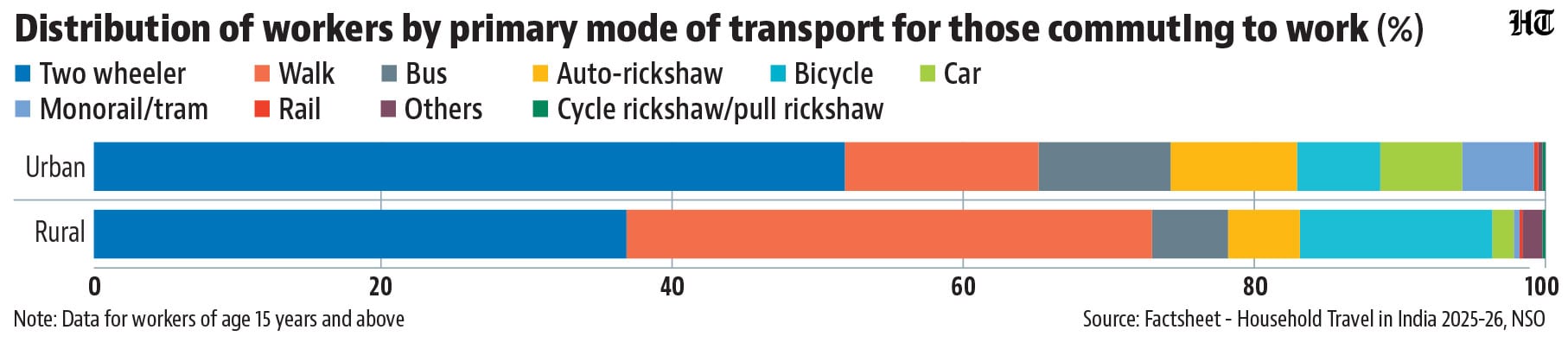
 Urban India does not see a real boost to use of public transport for workThis is perhaps the most damning indictment of Indian cities in the data. While there is a big increase in the share of people using two-wheelers and cars from rural to urban areas (39% to 58%), the share of those using mass public transport (bus/train/Metro/tram) remains just 14.5% even in urban areas. The increase in use of buses shows a much smaller increase than use of trains/trams/metros. As is expected, fewer people walk and cycle to work in cities than villages.
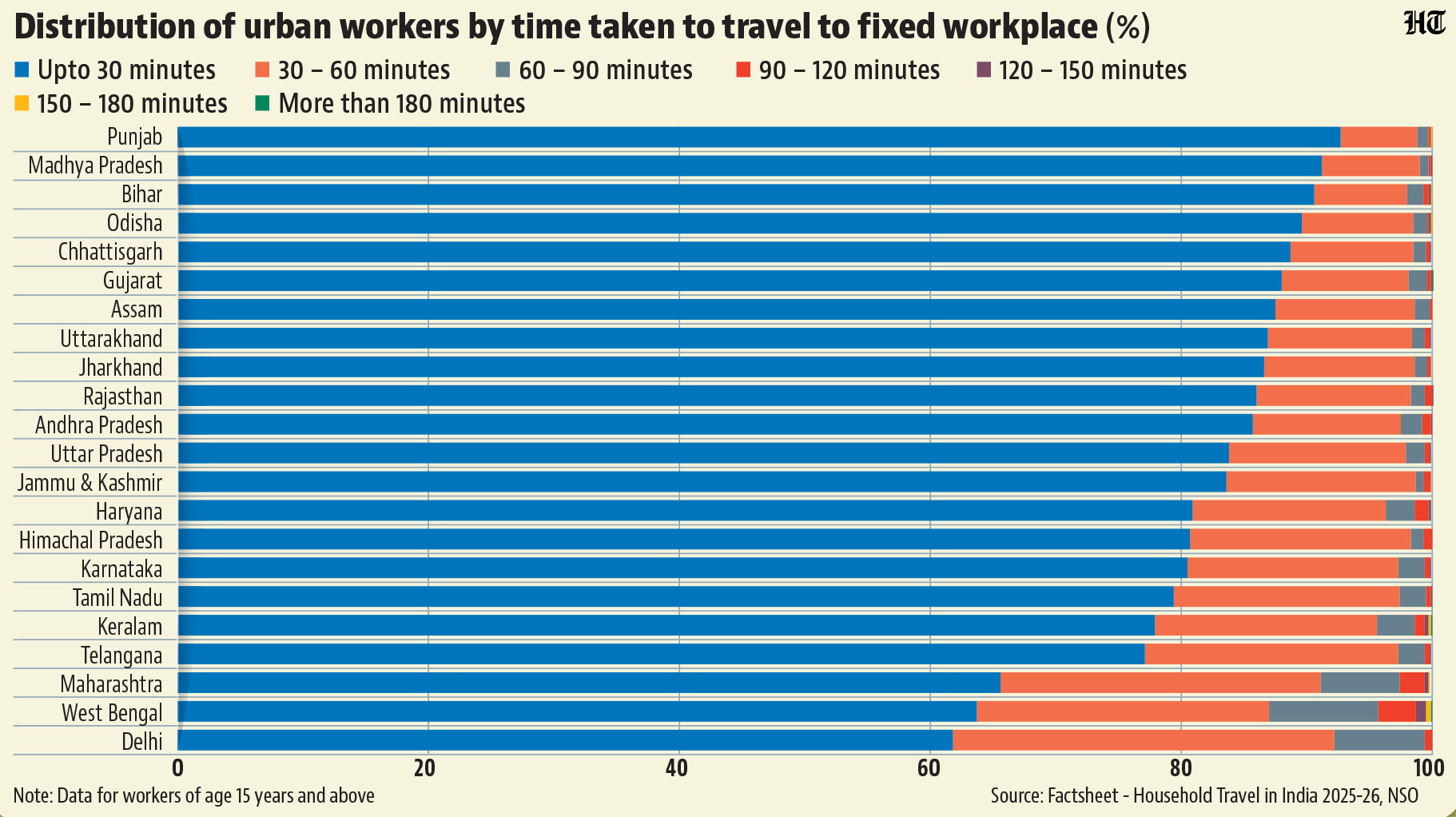
- Even in cities, 80% of workers take under 30 minutes to travel to workThis is perhaps the most counter-intuitive fact for those who always, and often rightfully, crib about traffic. Only 2.8% of workers in India – 2.1% in rural and 4.1% in urban – took more than an hour for a work commute. An overwhelming 83.4% – 86.1% in rural and 79.3% in urban – spent up to 30 minutes on a work commute. To be sure, the share of people using a car for a work commute is even smaller (3%) although using a personal car, a taxi, a shared car, or an employer-provided car was all counted as travelling in a car. Since NSO has only released summary tables, it is not possible to disaggregate commute time but medium of transport to work. Among major states, the average commute-to-work time in urban areas is the longest in West Bengal and the shortest in Punjab. In Delhi, the only representative of a metropolitan city in the data – since data is only disaggregated at state/UT level – the average commute time is 35 minutes and the share of people who took longer than an hour is 7.8%.
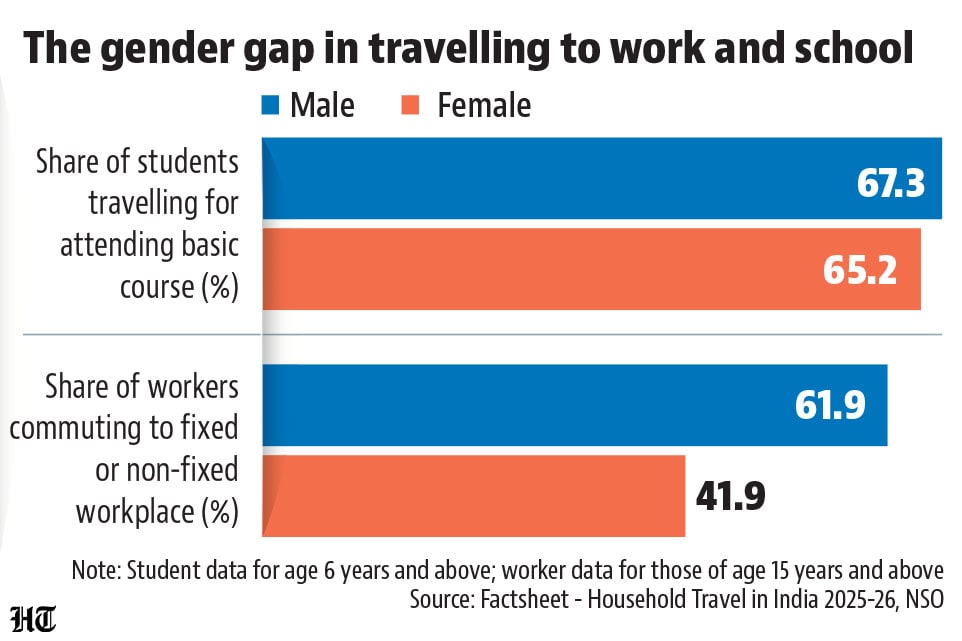
- Gender gap in travelling more than a kilometre increases for workers compared to studentsGender, as is to be expected, plays a role in a commute, either for studying or work. But the gap is significantly larger when it comes to working rather than attending a school or any other educational institution. This is in keeping with intuitive wisdom given the shrinking gender gap in educational enrolment but its persistence in the labour market.
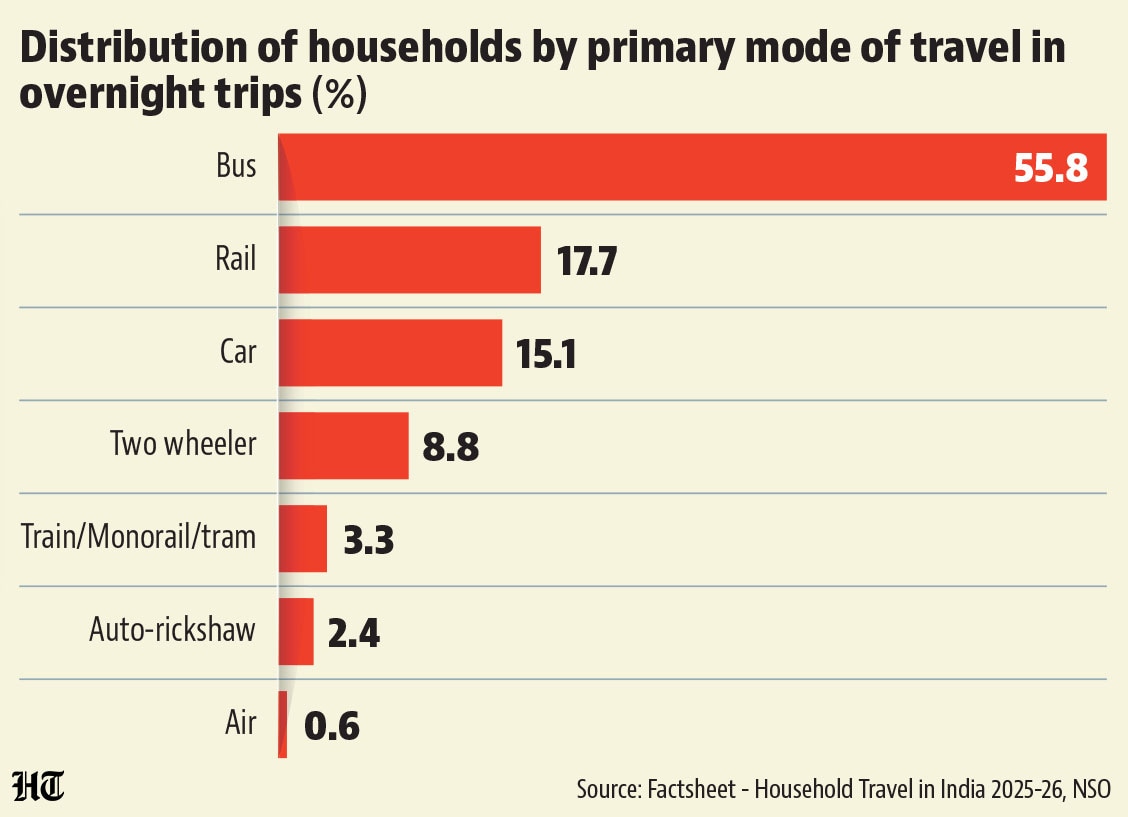
- Cars are only marginally behind trains as a medium of overnight trips, buses are the leaderThe survey also sought responses on overnight trips taken. While socialising, communication and religious practice were the leading purpose of such trips, what is interesting in the data is the fact that cars (15.1%) and rail (17.7%) are almost at par in the medium of transport for such trips. Buses were used by more than half of the people undertaking such trips.



Unlock a world of Benefits with HT! From insightful newsletters to real-time news alerts and a personalized news feed – it's all here, just a click away! -Login Now!


